By Eric Andrew Kristof, RN, CAHIMS | Healthcare IT Professional | HIMSS Arkansas Chapter Member
About This Series: The HIMSS Word of The Day is a running blog series drawing from the HIMSS Dictionary of Health Information and Technology Terms, Acronyms, and Organizations, 6th Edition (2025) — the authoritative reference for healthcare IT professionals and the primary study resource for CAHIMS and CPHIMS certification. Each post paraphrases the term in plain language, grounds it in real-world healthcare IT context, and adds a bedside nursing perspective you won’t find in a textbook.
📖 The Term: SMTP (Simple Mail Transfer Protocol)
Source: HIMSS Dictionary of Health Information and Technology Terms, Acronyms, and Organizations, 6th Edition (2025)
🔍 Plain-Language Definition
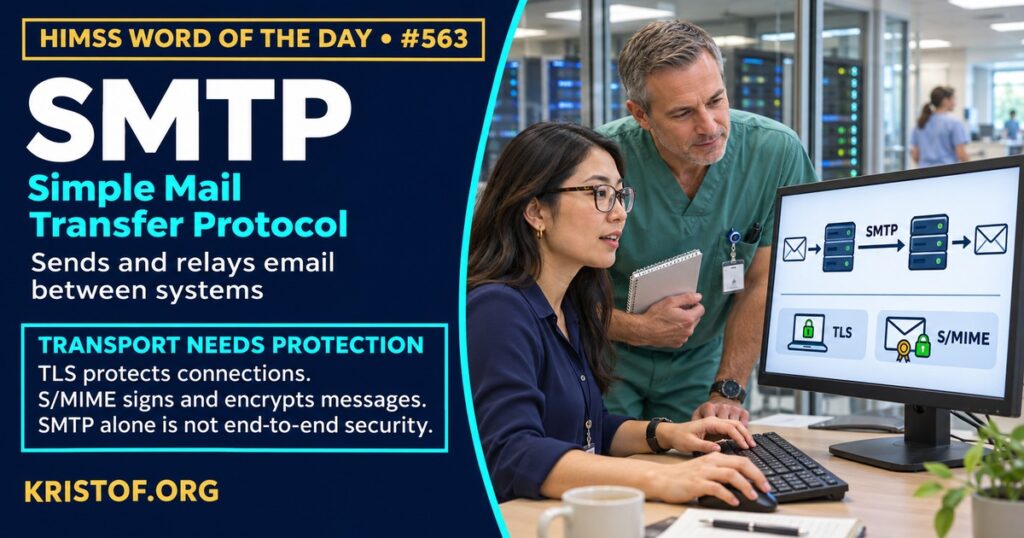
The HIMSS Dictionary describes SMTP (Simple Mail Transfer Protocol) as the communication protocol used to move e-mail between systems. The entry notes that e-mail programs most often use SMTP to send messages, and use POP3 or IMAP to receive them.
The Internet Engineering Task Force’s RFC 5321, written by J. Klensin and dated October 2008, describes SMTP as the basic protocol for Internet e-mail transport. The RFC says it consolidates and updates earlier documents, including RFC 2821, and it includes a section on relaying, noting that servers may decline to act as relays. A separate extension, RFC 3207, describes how SMTP servers and clients can use Transport Layer Security (TLS) for private, authenticated communication. That RFC also states that SMTP is not an end-to-end mechanism, meaning that securing the link between one pair of servers does not make the whole delivery path private.
In health care, the Direct Project‘s Applicability Statement for Secure Health Transport describes how to use SMTP, S/MIME, and X.509 certificates together to transport health information securely over the Internet.
| Related term | How it relates to SMTP |
|---|---|
| POP3 and IMAP | Protocols that e-mail programs commonly use to receive mail, as the dictionary entry describes |
| TLS | Can protect an SMTP connection between servers through the STARTTLS extension |
| S/MIME | Adds message-level signing and encryption, which SMTP alone does not provide |
| Direct messaging | Health information exchange method that uses SMTP, S/MIME, and X.509 certificates |
| HISP | Service provider that handles Direct messages for participants |
The table is a teaching sketch and not an official taxonomy.
⚠️ Exam Alert: SMTP moves, or sends, e-mail, while POP3 and IMAP are used to receive it. SMTP is a transport protocol and does not by itself make a message secure end to end. TLS can protect a connection between servers, and S/MIME protects the message itself, which is the combination that Direct messaging relies on. Do not confuse SMTP with the HL7 standards used for clinical messages.
🌐 Why It Matters: Real-World Healthcare IT Context
Peer-reviewed research about SMTP itself in health care is thin. A PubMed search on the abbreviation returned mostly unrelated uses, since SMTP is also the name of a group of compounds in pharmacology. For that reason, this post relies on the standards documents for the protocol and on health e-mail studies for context.
What the standards say. RFC 5321 is the core SMTP specification, and RFC 3207 defines the TLS extension. The RFC 3207 statement that SMTP is not an end-to-end mechanism is the main reason health IT teams look beyond transport encryption alone. The Direct Project’s Applicability Statement for Secure Health Transport describes how SMTP, S/MIME, and X.509 certificates work together to protect health information in transit, and the DirectTrust organization notes that this guide is commonly called the Direct Standard.
Why e-mail raises concerns in care. Ye and colleagues, in Patient Education and Counseling (2010), systematically reviewed 24 studies published from 2000 to 2008 on e-mail between patients and providers. Both patients and providers recognized benefits for communication, and concerns about confidentiality and security were also expressed. The review is more than a decade old and describes provider and patient views, not the technical protection of any particular system.
E-mail as an attack path. Lee and colleagues, in Studies in Health Technology and Informatics (2019), reported a phishing simulation in a hospital meant to gauge staff response to e-mail attacks and to raise awareness of information security protocols. The abstract available for this review does not report results, so only the purpose of the study is described here. Malicious e-mail is a reminder that securing the transport does not address deceptive content.
Common SMTP problems:
- Assuming SMTP, or an encrypted connection to one server, protects a message end to end
- Mixing up sending (SMTP) with receiving (POP3 or IMAP)
- Sending protected health information in ordinary e-mail without confirming the organization’s policy and safeguards
- Misconfigured relay or authentication settings that allow unwanted use of a mail server
- Phishing and other deceptive messages, which transport security does not stop
- Confusing general e-mail with Direct messaging, which adds specific requirements
What supports secure use of SMTP:
- TLS for server connections, as RFC 3207 describes
- Message-level protection such as S/MIME, as the Direct specification uses
- Certificates and trust arrangements, which the Direct specification builds on X.509
- Staff training on suspicious e-mail, as in the hospital phishing exercise
- Clear organizational policy on what may and may not be sent by e-mail
🏥 The Nurse’s Perspective: Clinical, Bedside, & Workflow
For nurses, SMTP is invisible plumbing, but the rules around e-mail and messaging are part of daily practice.
At the Bedside
Nurses rarely see SMTP directly, but they meet its consequences: automated e-mail notifications, shared mailboxes, and messages from patients who expect fast replies. Reviews of patient and provider e-mail note benefits for communication alongside confidentiality concerns, so organizational policy on what may be sent by e-mail matters. Phishing messages also reach clinical staff, and reporting suspicious e-mail is a patient-safety habit as much as an IT one.
In Clinical Workflow
Referral documents and summary records may travel by Direct messaging, which uses SMTP together with S/MIME. Staff who handle these transfers benefit from knowing that a Direct message is different from a regular e-mail, since it follows specific rules for identity and encryption. Nurse informaticists can help clarify which channel a task should use and who monitors delivery problems.
In EHR Implementation (Go-Live Perspective)
During an Epic Go-Live, analysts at the elbow field questions about messages that do not arrive. Applications such as notification or reporting tools may be configured to send e-mail through an organization’s mail server, so project teams confirm the settings, who owns them, and what content is allowed to leave the system. Any change to those settings should follow the organization’s security review.
🎓 CAHIMS / CPHIMS & HIMSS Perspective
CAHIMS Exam Domain Mapping
SMTP connects networking basics, security, and health information exchange:
| CAHIMS Domain | How SMTP Appears |
|---|---|
| Healthcare & Technology Environments | Internet protocols, e-mail systems, and information exchange pathways |
| Clinical Informatics | Direct messaging for referrals and care summaries |
| Healthcare Information & Systems Management | Mail server configuration, relay settings, and monitoring |
| Management & Leadership | E-mail policy, security training, and risk management |
Key Terms to Know Alongside SMTP
- Direct messaging — secure method for exchanging health information using SMTP and S/MIME
- S/MIME (Secure Multipurpose Internet Mail Extensions) — standard for signing and encrypting e-mail messages
- TLS (Transport Layer Security) — protocol that protects communication between systems
- Encryption — transforming data so that only authorized parties can read it
- HISP (Health Information Service Provider) — organization that manages Direct addresses and message exchange
- Phishing — deceptive messages designed to steal information or credentials
HIMSS Organizational Position
HIMSS offers education and research on health information and technology topics through its Resource Center. Members can find related information on the HIMSS Resource Center page.
🧭 More HIMSS Word of The Day Terms
Related terms in the Interoperability and Standards series:
Browse all Interoperability and Standards terms or the A–Z glossary.
🔗 Explore Further: External References
- IETF — RFC 5321: Simple Mail Transfer Protocol (J. Klensin, October 2008) https://www.rfc-editor.org/info/rfc5321/
- IETF — RFC 3207: SMTP Service Extension for Secure SMTP over Transport Layer Security (February 2002) https://www.rfc-editor.org/info/rfc3207/
- Direct Project — Applicability Statement for Secure Health Transport https://directproject.mywikis.wiki/wiki/Applicability_Statement_for_Secure_Health_Transport
- DirectTrust — The Direct Standard: Versions https://directtrust.org/standards/the-direct-standard/versions
- Ye et al. (2010), Patient education and counseling — E-mail in patient-provider communication: a systematic review https://pubmed.ncbi.nlm.nih.gov/19914022/
- Lee et al. (2019), Studies in health technology and informatics — Result and Effectiveness of Malicious E-mail Response Training in a Hospital https://pubmed.ncbi.nlm.nih.gov/31438426/
- HIMSS — Resource Center https://www.himss.org/resource-center
Term source: HIMSS Dictionary of Health Information and Technology Terms, Acronyms, and Organizations, 6th Edition (2025). All definitions in this series are paraphrased for editorial purposes. Readers are encouraged to consult the primary source for exact language.
Eric Andrew Kristof, RN, CAHIMS is a Healthcare IT professional and HIMSS Arkansas Chapter member based in Hot Springs Village, AR, with hands-on Epic Go-Live experience and a diverse healthcare and IT background. He writes at kristof.org at the intersection of clinical care and healthcare technology.
Leave a Reply