By Eric Andrew Kristof, RN, CAHIMS | Healthcare IT Professional | HIMSS Arkansas Chapter Member
About This Series: The HIMSS Word of The Day is a running blog series drawing from the HIMSS Dictionary of Health Information and Technology Terms, Acronyms, and Organizations, 6th Edition (2025) — the authoritative reference for healthcare IT professionals and the primary study resource for CAHIMS and CPHIMS certification. Each post paraphrases the term in plain language, grounds it in real-world healthcare IT context, and adds a bedside nursing perspective you won’t find in a textbook.
📖 The Term: WORM (Write Once, Read Many Times)
Source: HIMSS Dictionary of Health Information and Technology Terms, Acronyms, and Organizations, 6th Edition (2025)
🔍 Plain-Language Definition
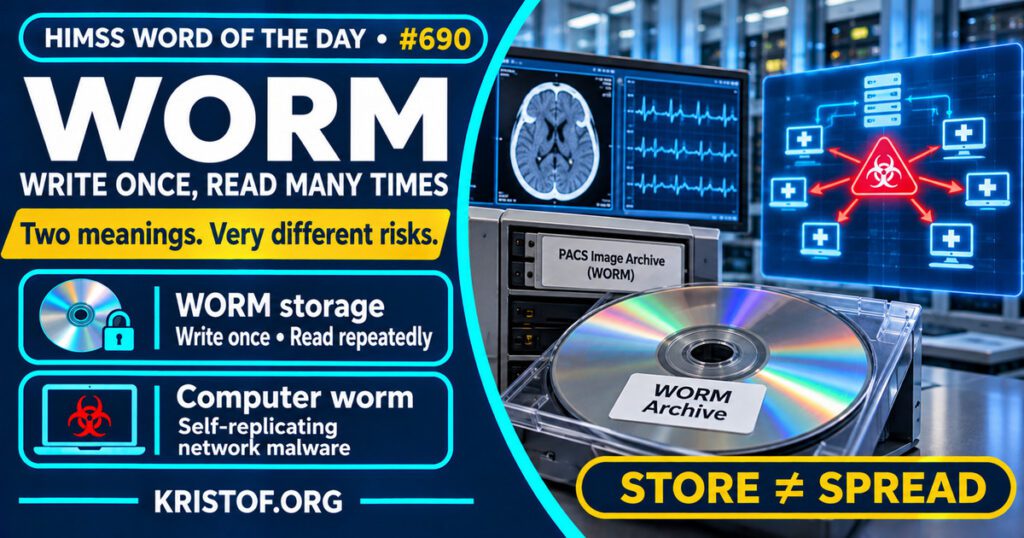
The HIMSS Dictionary gives WORM, short for Write Once, Read Many times, two unrelated meanings. The first is an optical disk technology. Data are recorded on the disk once, and from then on the record is fixed and can be read as often as needed. The second is a program or algorithm that makes copies of itself across a computer network and usually does damage, for example by consuming a computer’s resources, which can eventually bring the system down. For that second meaning the dictionary sends the reader to Virus. The dictionary also lists “Write Once, Read Many Times” as an alternate entry that points to this one.
In the studies below, the first meaning shows up in image and waveform archives, and the second in work on how network malware spreads and reaches imaging networks.
| Meaning | What it describes | Study in this post |
|---|---|---|
| WORM storage | Optical disks that accept data once and are then read only | Mankovich et al.; Wong et al.; Froning et al.; Bookman and Baune |
| Computer worm | A self-copying program that spreads over a network | Zhang et al. |
| Malware in imaging networks | Malicious software reaching PACS and related systems | Eichelberg et al. |
⚠️ Exam Alert: The same acronym names a storage medium and a kind of malicious program, so read the question for context. A WORM disk is a type of medium, not a backup policy, and it differs from the erasable magneto-optical disks that one archive in these studies used alongside it. For the program meaning, the dictionary’s Virus entry says a virus cannot run by itself and needs its host program to be run, while the WORM entry describes copying over a network and does not mention a host program. Review how Virus, Malware, and Trojan horse are defined before the exam.
🌐 Why It Matters: Real-World Healthcare IT Context
Where it shows up. In my searches, the PubMed papers that name WORM disks in health care date from 1988 to 1998, and the studies of worms are general network research or an imaging security article. The six studies below were read as abstracts only, and I did not find a study of current write-once storage or of a computer worm outbreak in a hospital.
An early optical disk image archive. Mankovich et al. (1988) reported a digital optical disk archive for computed radiographic, computed tomographic, magnetic resonance, ultrasonographic, and digitized film images. Images entered a minicomputer, were held briefly on magnetic disks, and were then archived at full resolution onto write-once read-many optical disks, with a pictorial index of minified images for each patient. After 8 months, 49,400 megabytes of images had been kept on 19 optical disks, stored in a mechanical jukebox-style library. The success rate for archival capture was 96.6%, the failures were due to overfilling of the magnetic disk and were addressed by adding a second magnetic disk unit, and there were no medium-related image errors in the early period. The slow speed of optical disks was handled by starting recall of a patient’s archived images to the faster magnetic disk as soon as the system received a request to acquire a new image. It is a 1988 report of one installation.
A PACS archive that mixed media. Wong et al. (1994) described a second-generation archive for a departmental PACS that used a staging mechanism across magnetic disks, erasable magneto-optical disks, and WORM disks. The system archived 1.5 Gbytes of images daily from three magnetic resonance imagers, two computed tomography scanners, one computed radiographic system, and one laser film digitizer. Its features included multiple optical drives with robotic arms, a pre-fetch mechanism to reduce on-line retrieval from the optical library, and job prioritizing to cut waiting time for radiologists and referring physicians. The abstract describes the design, not measured outcomes.
WORM disks for ECG recording. Froning et al. (1988) described an exercise ECG data-logger that used a removable 200 Mbyte optical disk (WORM) to record all 12 leads continuously for an entire exercise test of up to 38 minutes. The archived data and patient information could be recalled later for off-line analysis on a PC or replayed through a D/A converter. The resulting database held more than 600 complete exercise tests, and the authors projected nearly 3,000 within 2 years. It is a 1988 system description and reports no clinical outcomes.
The case for tape. Bookman and Baune (1998) argued that long-term PACS storage on optical jukeboxes or on-line disk alone becomes unworkable as image volumes grow, because floor space, the number of jukeboxes, and off-line shelf storage become unmanageable. They described automated tape, behind a RAID disk cache, as the preferred alternative and used the University of Utah Department of Radiology PACS as the example. The abstract says the performance and cost of the tape design are compared with a solution that includes optical, but it gives no numbers. It reflects the authors’ position in 1998.
How a worm spreads. Zhang et al. (2015) modeled Conficker, a computer worm that erupted on the Internet in 2008 and combined three spreading strategies: local probing, neighbourhood probing, and global probing. The model’s parameters were inferred from network data from the first day of the epidemic. The authors report that Conficker was a critically hybrid epidemic, in which the different modes of spreading in isolation do not lead to successful epidemics. They add that when hybrid spreading is used maliciously it can present a dangerous challenge to current internet security protocols. The study is not about health care, and it models one worm.
Malware and imaging networks. Eichelberg et al. (2020) described five attack scenarios on PACS and medical imaging networks: patient data imported from storage media containing malware, a compromise of the hospital network, malware embedded in DICOM images or reports, a malicious manipulation of medical images, and a network infiltration of malicious HL7 messages. The authors say prevention and mitigation measures exist for each attack, some for the hospital to apply and some for vendors to build in, but that many are not in common use and that PACS network security guidelines for practitioners are missing. The abstract says malware, and it does not say that any of the attacks involve a worm.
What I could not confirm. I did not find a recent study of write-once storage in hospitals, and the storage papers use media from the late 1980s and 1990s. I did not confirm any claim about the physical lifespan of write-once disks. I did not review retention rules or any rule about whether records must be kept on write-once media. I did not find a PubMed study of a computer worm outbreak in a hospital. My search for the phrase also returned materials-science papers on memory devices, which I did not use.
Common WORM problems:
- Slow retrieval from optical media, which the 1988 archive addressed by recalling images to magnetic disk ahead of a request
- Capture failures when the temporary magnetic disk overfilled
- Growth in floor space, jukeboxes, and shelf storage as image volumes rise, in the 1998 authors’ view
- A worm using several spreading modes that together succeed where each alone does not
- Malware reaching imaging networks through media, networks, images, or messages, with many countermeasures not in common use
What supports WORM:
- Data that are fixed once written and can be read repeatedly, as the dictionary describes
- No medium-related image errors in the early 8-month period of the 1988 archive
- A place in a tiered archive alongside magnetic and magneto-optical disks
- Continuous recording of a full exercise ECG test on one removable disk
- Prevention and mitigation measures for each imaging attack scenario, according to the 2020 authors
🏥 The Nurse’s Perspective: Clinical, Bedside, & Workflow
None of the six studies involve nurses as participants, so this section is workflow context and not evidence.
At the Bedside
Bedside staff are unlikely to handle write-once media directly, though that could not be confirmed for any particular hospital. They do depend on the archive when a prior image or recorded waveform is needed at the point of care. Both the 1988 and the 1994 archive reports addressed how quickly stored images could be retrieved, which is the part of such a system a clinician would notice.
In Clinical Workflow
For the malicious-program meaning, the practical question for nursing staff is how a unit keeps working if systems go down. The imaging security article above recommends prevention and mitigation measures but its abstract does not describe nursing downtime procedures, and no study reviewed here measures them.
In EHR Implementation (Go-Live Perspective)
During an Epic Go-Live, analysts and at-the-elbow support staff see where records and images live and how interfaces carry them. Storage design and security controls sit behind that work. That is general workflow context, and none of the studies reviewed examines go-lives.
🎓 CAHIMS / CPHIMS & HIMSS Perspective
CAHIMS Exam Domain Mapping
WORM appears in questions about storage, archives, and information security:
| CAHIMS Domain | How WORM Appears |
|---|---|
| Healthcare & Technology Environments | Storage media, archives, and network threats |
| Clinical Informatics | Image and waveform archives and retrieval |
| Healthcare Information & Systems Management | Data retention, backup, and malware controls |
| Management & Leadership | Security risk and recovery planning |
Key Terms to Know Alongside WORM
- Optical disk — a disk that is read or written with laser light, the medium used for WORM storage
- PACS — a picture archiving and communication system that stores and delivers medical images
- Virus — the entry the dictionary points to for the program meaning of WORM, described there as needing a host program to be run
- Malware — the dictionary’s broad category for intentionally harmful software, which it says includes viruses, worms, Trojan horses, ransomware, and spyware
- Trojan horse — a program that looks useful but carries a hidden, potentially harmful function
- Anti-virus software — a program designed to detect many forms of malware, prevent infection, and clean infected computers
HIMSS Organizational Position
HIMSS offers education and research on health information and technology topics through its Resource Center. Members can find related information on the HIMSS Resource Center page.
🧭 More HIMSS Word of The Day Terms
Related terms in the IT Infrastructure series:
- WLAN (Wireless Local Area Network)
- ERP (Enterprise Resource Planning)
- RTLS (Real-Time Location System)
Browse all IT Infrastructure terms or the A–Z glossary.
🔗 Explore Further: External References
- Mankovich et al. (1988), Radiology — Operational radiologic image archive on digital optical disks. https://pubmed.ncbi.nlm.nih.gov/3347715/
- Wong et al. (1994), Radiographics — Digital archive system for radiologic images. https://pubmed.ncbi.nlm.nih.gov/7991818/
- Froning et al. (1988), Journal of Electrocardiology — A real-time data-logger system using an optical disk WORM for archiving continuous 12-lead ECG data during exercise testing. https://pubmed.ncbi.nlm.nih.gov/3216169/
- Bookman and Baune (1998), Journal of Digital Imaging — A case for automated tape in clinical imaging. https://pubmed.ncbi.nlm.nih.gov/9735431/
- Zhang et al. (2015), PLoS One — Hybrid epidemics–a case study on computer worm conficker. https://pubmed.ncbi.nlm.nih.gov/25978309/
- Eichelberg et al. (2020), Academic Radiology — Cybersecurity Challenges for PACS and Medical Imaging. https://pubmed.ncbi.nlm.nih.gov/32418786/
- HIMSS — Resource Center https://www.himss.org/resource-center
Term source: HIMSS Dictionary of Health Information and Technology Terms, Acronyms, and Organizations, 6th Edition (2025). All definitions in this series are paraphrased for editorial purposes. Readers are encouraged to consult the primary source for exact language.
Eric Andrew Kristof, RN, CAHIMS is a Healthcare IT professional and HIMSS Arkansas Chapter member based in Hot Springs Village, AR, with hands-on Epic Go-Live experience and a diverse healthcare and IT background. He writes at kristof.org at the intersection of clinical care and healthcare technology.
Leave a Reply