By Eric Andrew Kristof, RN, CAHIMS | Healthcare IT Professional | HIMSS Arkansas Chapter Member
About This Series: The HIMSS Word of The Day is a running blog series drawing from the HIMSS Dictionary of Health Information and Technology Terms, Acronyms, and Organizations, 6th Edition (2025) — the authoritative reference for healthcare IT professionals and the primary study resource for CAHIMS and CPHIMS certification. Each post paraphrases the term in plain language, grounds it in real-world healthcare IT context, and adds a bedside nursing perspective you won’t find in a textbook.
📖 The Term: Viral
Source: HIMSS Dictionary of Health Information and Technology Terms, Acronyms, and Organizations, 6th Edition (2025)
🔍 Plain-Language Definition
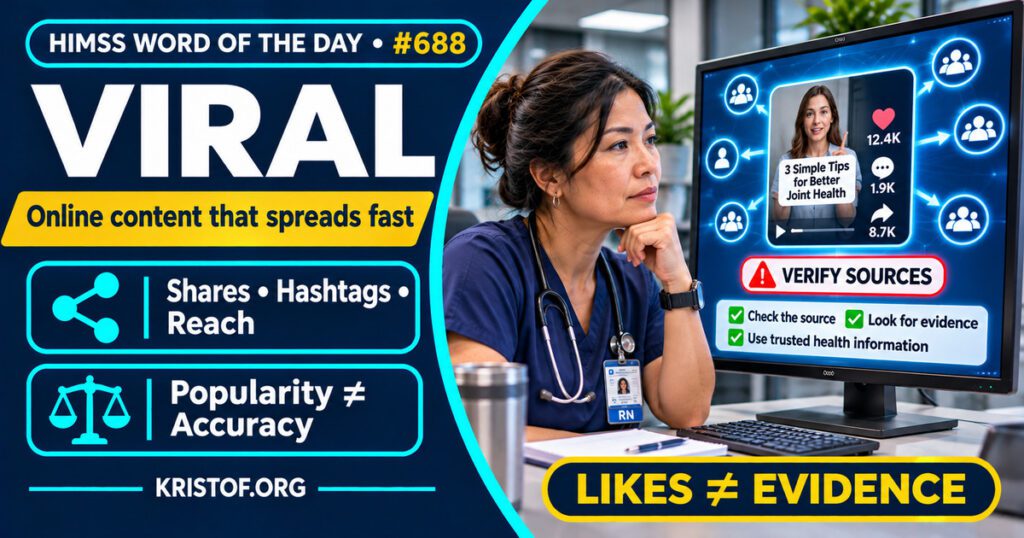
The HIMSS Dictionary describes viral as an informal label for online content, such as a video, photo, game, article, or advertisement, that spreads quickly because many people pass it along through social networks. The dictionary calls it a buzzword.
In health settings the word has a second, clinical meaning tied to viruses. This post follows the dictionary sense, which is about how content travels, and notes where studies borrow the language of infectious disease to describe it.
| Piece | What it means here | Where it appears in the studies |
|---|---|---|
| Content | A video, post, or article people can share | TikTok videos, tweets, and a nurse’s video |
| Sharing | People passing content to others | Likes, comments, and shares counted in one study |
| Amplification | Platform features that push content further | Recommendation feeds and hashtags |
| Spread model | An equation that describes how content moves | Epidemic-style models in two studies |
⚠️ Exam Alert: Viral, in this dictionary entry, means widely shared content. It does not mean a virus or a viral infection, and it is not the same as a computer virus, which the dictionary defines separately as software that infects a computer. Content can spread widely without being accurate, and in one study below, the number of likes did not track how well supported the advice was.
🌐 Why It Matters: Real-World Healthcare IT Context
Where it shows up. In my searches, the research on viral content in health was concentrated on short-video platforms and on misinformation during the COVID-19 pandemic. The six studies below are descriptive, modelled, or single-case, and I read abstracts only. None evaluates a health system or an electronic health record.
Top viral videos on a health topic. Hong et al. (2023) examined the top 100 TikTok videos by likes under the hashtag osteoarthritis, collected on March 29, 2023. They classified each by uploader and content and rated the treatments it recommended against the American Academy of Orthopaedic Surgeons guideline, using a one to four star evidence scale. Of the top videos, 67.7% were uploaded by medical professionals. Private companies had the highest average likes and shares but an average evidence strength of 2.13, physician videos had slightly lower averages with an evidence strength of 3.03, and non-medical professional videos had the lowest, at 0.89. Medical treatments were the most liked and shared content and had the lowest evidence strength. There was no statistically significant correlation between likes, comments, or shares and strength of evidence. It is a single topic on a single platform on one day.
Hazardous content and how it spreads. Shah et al. (2026) did a descriptive qualitative content analysis of public TikTok videos showing potentially hazardous behaviors among adolescents and young adults. Of 69 videos included, 55 (79.7%) addressed highly prevalent youth challenges and had more than 30,000 views, and 28 (40.6%) were associated with challenge types with documented fatalities. All identified behaviors were judged medically dangerous, and medical misinformation or disinformation was present in 62 of 69 videos (90.0%). The authors say spread was helped by recommendation-feed amplification, shared audiovisual templates, hashtag aggregation, social proof, and moderation evasion through re-uploads, altered hashtags, or coded language. The sample is small, it came from searches supplemented with other sources, and the abstract does not say how the videos were selected beyond that.
A nurse’s video that went viral. Gonzalez-Luis et al. (2024) used a mixed-methods design to study one case in which a Spanish nurse posted a TikTok video criticizing a language requirement for working in Catalonia’s public health system, and the video went viral. The authors conclude that the nurse exercised her right to freedom of expression, but that appearing in a uniform that identified her hospital and the content of her criticism led to reputational damage after the video spread through the press and social media. The hospital’s reputation was affected because she was identified as its employee, while the reputation of the nursing profession was not significantly harmed, according to the authors, because multiple sources suggested the incident was isolated. They propose a safe self-regulatory framework and training in social media and communication management. It is a single case in Spain, and the bracketed PubMed title indicates the article itself is not in English.
Modelling spread like an infection. Bak-Coleman et al. (2022) built a generative model of viral misinformation spread inspired by infectious disease research, and applied it to a corpus of 10.5 million tweets of misinformation events during the 2020 US election. They report that commonly proposed interventions are unlikely to be effective in isolation, but that a combined approach can substantially reduce the prevalence of misinformation. The data are about an election, not health, and the result is from a model.
The COVID-19 infodemic. Cinelli et al. (2020) analysed information about COVID-19 across Twitter, Instagram, YouTube, Reddit, and Gab. They fit epidemic models to estimate a basic reproduction number for each platform, found different volumes of misinformation across platforms, and report that information from reliable and questionable sources did not show different spreading patterns. The abstract gives no numeric estimates or study period.
Responding to viral rumors. Lalani et al. (2023) describe the efforts of ThisIsOurShot and VacunateYa to spread accurate health information about COVID-19 and its vaccines, and discuss lessons learned. These include a need for substantial financial investment at the local and national levels, and they point to Information Sharing and Analysis Centers and Public Health Emergency Operations Centers as models. This is a description of programs and a call for policy, and the abstract reports no outcome data.
What I could not confirm. I did not find evidence that removing or correcting viral health content changes health outcomes, and I did not review platform policies. None of the studies examines a hospital’s own social media or its staff’s use of it, beyond the one nurse case. The studies concentrate on TikTok and Twitter, and I did not review other platforms. The dictionary’s description does not say what makes content spread, and the mechanisms above are the study authors’ own descriptions.
Common viral content problems:
- Misinformation or disinformation spreading with the content
- Popularity that does not track evidence, as in the knee osteoarthritis study
- Platform features that amplify content, such as recommendation feeds and hashtags
- Re-uploads and altered hashtags that evade moderation
- Reputational damage to an individual and an employer when a video spreads
What supports responding to viral content:
- Content from medical professionals, who uploaded most of the top osteoarthritis videos and whose videos averaged higher evidence strength than non-medical videos
- Combined interventions, which the modelling study found more effective than any single one
- Sustained funding and coordination for monitoring and counter-messaging, as the rumor response authors argue
- Social media training and a self-regulatory framework, as the nurse case authors propose
- Public health infrastructure modeled on existing sharing and operations centers
🏥 The Nurse’s Perspective: Clinical, Bedside, & Workflow
Nurses use social media as individuals and as members of professional groups, which is general context. The nurse case is the only study here that centers a nurse.
At the Bedside
Patients may arrive with health advice they saw online. In the knee osteoarthritis study, the authors suggest that orthopaedic surgeons advise patients that TikTok treatment recommendations may not match established guidelines, and the same caution is reasonable for nurses, though the study does not address nurses.
In Clinical Workflow
The Spanish case shows that a nurse who posts in a uniform identifiable to a hospital can create reputational effects for the hospital as well as the nurse, according to the authors. The authors propose training and a self-regulatory framework for health care centres, nursing organizations, and academic institutions.
In EHR Implementation (Go-Live Perspective)
During an Epic Go-Live, support staff and analysts work inside a facility’s own social media and privacy policies. That is general workflow context, and none of the studies reviewed examines go-lives or screenshots shared online.
🎓 CAHIMS / CPHIMS & HIMSS Perspective
CAHIMS Exam Domain Mapping
Viral appears in questions about social media, health communication, and information risk:
| CAHIMS Domain | How Viral Appears |
|---|---|
| Healthcare & Technology Environments | Social platforms as part of the health information environment |
| Clinical Informatics | Patient-facing information and misinformation |
| Healthcare Information & Systems Management | Monitoring, policy, and reputation risk |
| Management & Leadership | Communication strategy and social media governance |
Key Terms to Know Alongside Viral
- Social network — a platform or set of connections through which people share information
- Social media monitoring — tracking what is said about a topic or organization on social platforms
- Social media fatigue — weariness from heavy social media use, listed as its own term in the dictionary
- Hashtag — a label that groups posts on a topic, which Shah et al. list among the features that helped spread
- Algorithm — a defined set of steps, here the kind a platform uses to recommend content
- Virus — in the dictionary, software that infects a computer, which is a different meaning from viral content
HIMSS Organizational Position
HIMSS offers education and research on health information and technology topics through its Resource Center. Members can find related information on the HIMSS Resource Center page.
🧭 More HIMSS Word of The Day Terms
Related terms in the Connected Health series:
Browse all Connected Health terms or the A–Z glossary.
🔗 Explore Further: External References
- Hong et al. (2023), Cureus — Analysis of the Perception and Treatment of Osteoarthritis of the Knee Through Social Media: An Observational Study of the Top 100 Viral TikTok Videos. https://pubmed.ncbi.nlm.nih.gov/38024061/
- Shah et al. (2026), The American Journal of Emergency Medicine — Risky business on TikTok: Content analysis of hazardous challenges among youth. https://pubmed.ncbi.nlm.nih.gov/42618391/
- Gonzalez-Luis et al. (2024), Anales del Sistema Sanitario de Navarra — [Reputational risks associated with nurses’ presence on social media: proposed actions following the Vall d’Hebron case]. https://pubmed.ncbi.nlm.nih.gov/39698995/
- Bak-Coleman et al. (2022), Nature Human Behaviour — Combining interventions to reduce the spread of viral misinformation. https://pubmed.ncbi.nlm.nih.gov/35739250/
- Cinelli et al. (2020), Scientific Reports — The COVID-19 social media infodemic. https://pubmed.ncbi.nlm.nih.gov/33024152/
- Lalani et al. (2023), Annals of Internal Medicine — Addressing Viral Medical Rumors and False or Misleading Information. https://pubmed.ncbi.nlm.nih.gov/37459614/
- HIMSS — Resource Center https://www.himss.org/resource-center
Term source: HIMSS Dictionary of Health Information and Technology Terms, Acronyms, and Organizations, 6th Edition (2025). All definitions in this series are paraphrased for editorial purposes. Readers are encouraged to consult the primary source for exact language.
Eric Andrew Kristof, RN, CAHIMS is a Healthcare IT professional and HIMSS Arkansas Chapter member based in Hot Springs Village, AR, with hands-on Epic Go-Live experience and a diverse healthcare and IT background. He writes at kristof.org at the intersection of clinical care and healthcare technology.
Leave a Reply