By Eric Andrew Kristof, RN, CAHIMS | Healthcare IT Professional | HIMSS Arkansas Chapter Member
About This Series: The HIMSS Word of The Day is a running blog series drawing from the HIMSS Dictionary of Health Information and Technology Terms, Acronyms, and Organizations, 6th Edition (2025) — the authoritative reference for healthcare IT professionals and the primary study resource for CAHIMS and CPHIMS certification. Each post paraphrases the term in plain language, grounds it in real-world healthcare IT context, and adds a bedside nursing perspective you won’t find in a textbook.
📖 The Term: Social Network
Source: HIMSS Dictionary of Health Information and Technology Terms, Acronyms, and Organizations, 6th Edition (2025)
🔍 Plain-Language Definition
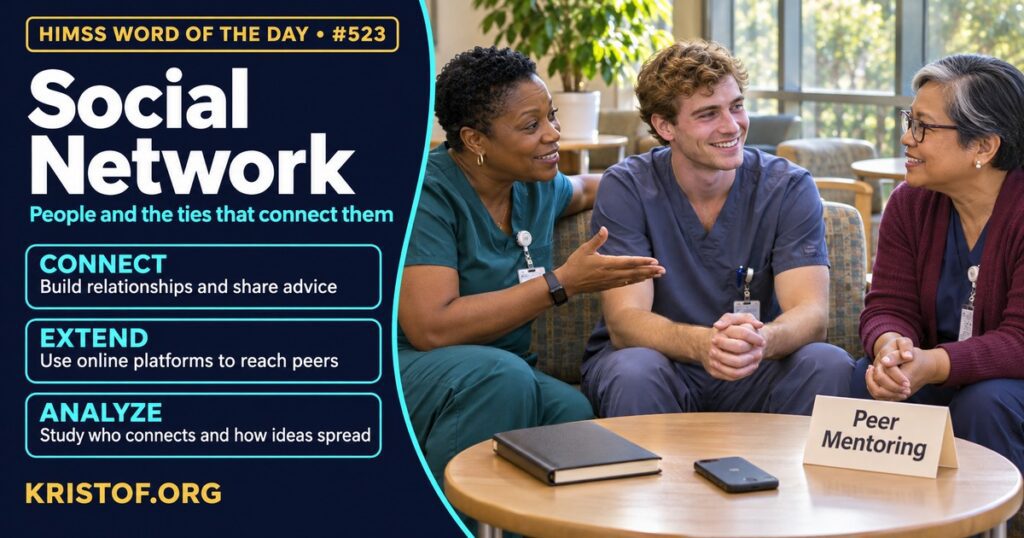
The HIMSS Dictionary gives two meanings for social network. The first is a chain of individuals and the personal connections between them, including applications used to link people so that further connections can form. The second is a website or platform where people with similar interests gather to share information, photos, and videos.
The first meaning is the older and more general one. Any group of people has a network: who talks to whom, who asks whom for advice, who introduces whom to someone new. Researchers study these patterns with social network analysis (SNA), which treats people as points (often called nodes) and their relationships as links (often called ties). The method can describe an individual’s position, the structure of a whole network, or subgroups within it. In health care, that can mean care teams, referral patterns, mentoring relationships, or the spread of a new practice.
The second meaning is the one most people think of first: Facebook, LinkedIn, X, and similar services, as well as private or professional communities. These platforms matter to health IT for several reasons. Patients use them to find peers and information. Clinicians use them for professional connection and learning. Public health teams and researchers use them as data sources. And they introduce privacy and security risks, since information shared there can spread quickly and be difficult to retract.
Put together, the term describes both the structure of human connection and the tools built to extend it. In health IT, both are worth understanding, because information systems work best when they fit the real pathways by which people trust, ask, and share.
| Term | Meaning |
|---|---|
| Social network | People and the ties between them, or a platform for connecting |
| Node | One person or entity in a network |
| Tie | A relationship between two nodes, such as advice-seeking or collaboration |
| Social network analysis | Methods for measuring and visualizing network structure |
| Social media | Platforms and content that enable online sharing |
| Influencer | A well-connected node whose content or advice reaches many others |
⚠️ Exam Alert: A social network is a web of people and relationships or a platform for connecting people. It is not a computer network (LAN, WAN, or Wi-Fi), which connects devices. Social media refers to the channels and content, while social network analysis is the method for measuring the ties between people.
🌐 Why It Matters: Real-World Healthcare IT Context
Studies of social networks in health care draw on nursing research, information security education, and online health communication. Each source below was checked against its published abstract.
Parnell and Robinson, in the Journal of Advanced Nursing (2018), wrote a discussion paper introducing social network analysis as a method for nursing research. They searched Ovid HealthStar, CINAHL, PubMed Central, Scopus, and hard-copy texts from 1965 to 2017 and found that SNA first appeared in the nursing literature in 1995 and appears only minimally since. Using hypothetical scenarios, they illustrate three approaches, and they note that networks can be analyzed at the level of individual attributes, whole networks, and subgroups. The authors conclude the method is underused largely because it is unknown to most nurse scholars. The scenarios are illustrative rather than real data.
Pierce and colleagues, in Nursing Outlook (2021), used an electronic SNA assessment to explore collaboration among PhD-prepared military nurse scientists in the TriService Nursing Research Program. With total enumerative sampling of 136 scientists, they found a complex, service-driven network structure with high-status actors whose advice, knowledge, or skills others sought, and some who served as bridges across service branches. The authors suggest SNA can help identify influential people, plan mentoring, shape policy, and direct career opportunities for novice scientists. The setting is a specific population, so the findings are descriptive of that group.
Johnson and Stellwag, in the Journal of Advanced Nursing (2022), reviewed the use of social network analysis in health care and in nursing doctoral program formats. They report that SNA use in health care dates to 1957 but is rare in the nursing literature, and they argue that nurses, given their high level of interaction with patients, families, staff, and providers, are well placed to act as bridge builders for knowledge diffusion. They recommend building nursing capacity in SNA and changing traditional dissertation formats to publication formats. It is a literature review and position paper, so it presents an argument rather than a tested intervention.
Magdalinou and colleagues, in Studies in Health Technology and Informatics (2023), used social network analysis to ask 164 nurses to select the actors they most trust for information security updates. Nurses tended to trust managers, colleagues, and IT professionals. The short report suggests that network mapping can help target security awareness efforts through trusted people, though it is a small abstract-length study.
Jain and colleagues, in Studies in Health Technology and Informatics (2022), applied SNA to Twitter (now X) networks around the five cancers ranked highest by the CDC, to identify key influencers. They found that organizations and groups geared toward patient support, awareness, prevention, and management made up as much as 40 percent of influencers, while researchers accounted for 24 percent and physicians 14 percent, with variation by cancer. For colorectal cancer, research influence was as high as 40 percent. The authors suggest Twitter data can serve as a source of cancer surveillance data. The analysis reflects one platform at one time and the people who choose to post there.
Taken together, the sources show that network thinking can reveal who people trust and how ideas move, and that social platforms are both a communication channel and a data source with limits.
Common social network problems:
- Information that moves through informal networks but never reaches formal channels
- Key connectors who become overloaded or leave without notice
- Weak links between units, professions, or service lines
- Patient information shared on social platforms in ways that create privacy risk
- Misinformation that spreads along the same ties as good advice
- Network data that is incomplete or hard to interpret
What supports effective use of social networks:
- Mapping real communication and advice paths before designing training
- Using trusted people, such as managers and colleagues, to carry key messages
- Supporting bridge roles that connect units and professions
- Clear social media policies with privacy and professionalism guidance
- Respecting consent and ethics when using network data
- Pairing network analysis with local knowledge
🏥 The Nurse’s Perspective: Clinical, Bedside, & Workflow
Nurses live inside social networks all day, from the unit team to professional organizations and patient communities.
At the Bedside
Nurses rely on colleagues for quick answers: who knows how to troubleshoot a pump, who has seen this order set before, who to call for a transfer. Those informal ties shape how fast and how well care happens. Nurses also meet patients who have searched online communities, and conversations about what was found can be a useful opening.
In Clinical Workflow
Nurse informaticists often work through trusted connectors, including charge nurses, educators, and unit champions. Choosing the right messengers can matter as much as writing the right message. Professional social platforms offer learning and community, and organizational policy guides what can be posted. Patient information, images, and details that could identify a patient do not belong on public platforms.
In EHR Implementation (Go-Live Perspective)
During an Epic Go-Live, informal networks become visible. Nurses ask the person next to them, the super user down the hall, or the analyst at the elbow, and answers spread quickly. Teams that identify these trusted connectors early can use them to share tips and corrections, and can notice when an incorrect workaround is moving through the network.
🎓 CAHIMS / CPHIMS & HIMSS Perspective
CAHIMS Exam Domain Mapping
Social networks touch communication, privacy, and analysis:
| CAHIMS Domain | How Social Networks Appear |
|---|---|
| Healthcare & Technology Environments | Online platforms, communication channels, and professional communities |
| Clinical Informatics | Care-team networks, knowledge diffusion, and patient-generated content |
| Healthcare Information & Systems Management | Privacy, security awareness, and acceptable use policy |
| Management & Leadership | Change champions, communication planning, and policy |
Key Terms to Know Alongside Social Network
- Social Network Analysis — method for measuring and visualizing the ties between people or groups
- Social Media Monitoring — tracking and analyzing public online posts for insight
- Social Engineering — manipulating people into revealing information or taking unsafe actions
- Acceptable Use Policy — rules for how staff may use organizational systems and accounts
- Node and Tie — a person or entity in a network, and the relationship linking two of them
- Knowledge Diffusion — the spread of new information or practices through a group
HIMSS Organizational Position
HIMSS offers education and research on health information and technology topics through its Resource Center. Members can find related information on the HIMSS Resource Center page.
🧭 More HIMSS Word of The Day Terms
Related terms in the Data and Analytics series:
Browse all Data and Analytics terms or the A–Z glossary.
🔗 Explore Further: External References
- Parnell and Robinson (2018), Journal of advanced nursing — Social network analysis: Presenting an underused method for nursing research https://pubmed.ncbi.nlm.nih.gov/29444337/
- Pierce et al. (2021), Nursing outlook — Social network analysis: Exploring connections to advance military nursing science https://pubmed.ncbi.nlm.nih.gov/33579514/
- Johnson and Stellwag (2022), Journal of advanced nursing — Nurses as bridge builders: Advancing nursing through the diffusion of knowledge https://pubmed.ncbi.nlm.nih.gov/36253924/
- Magdalinou et al. (2023), Studies in health technology and informatics — SNA: The Optimal Nodes to Raise Nurses’ Infosec Awareness https://pubmed.ncbi.nlm.nih.gov/37387028/
- Jain et al. (2022), Studies in health technology and informatics — Who Influences Cancer Conversations on Twitter?: A Comparative Surveillance of Cancer Communications https://pubmed.ncbi.nlm.nih.gov/35673111/
- HIMSS — Resource Center https://www.himss.org/resource-center
Term source: HIMSS Dictionary of Health Information and Technology Terms, Acronyms, and Organizations, 6th Edition (2025). All definitions in this series are paraphrased for editorial purposes. Readers are encouraged to consult the primary source for exact language.
Eric Andrew Kristof, RN, CAHIMS is a Healthcare IT professional and HIMSS Arkansas Chapter member based in Hot Springs Village, AR, with hands-on Epic Go-Live experience and a diverse healthcare and IT background. He writes at kristof.org at the intersection of clinical care and healthcare technology.
Leave a Reply