By Eric Andrew Kristof, RN, CAHIMS | Healthcare IT Professional | HIMSS Arkansas Chapter Member
About This Series: The HIMSS Word of the Day is a running blog series drawing from the HIMSS Dictionary of Health Information and Technology Terms, Acronyms, and Organizations, 6th Edition (2025) — the authoritative reference for healthcare IT professionals and the primary study resource for CAHIMS and CPHIMS certification. Each post paraphrases the term in plain language, grounds it in real-world healthcare IT context, and adds a bedside nursing perspective you won’t find in a textbook.
📖 The Term: Social Media Fatigue
Source: HIMSS Dictionary of Health Information and Technology Terms, Acronyms, and Organizations, 6th Edition (2025)
🔍 Plain-Language Definition
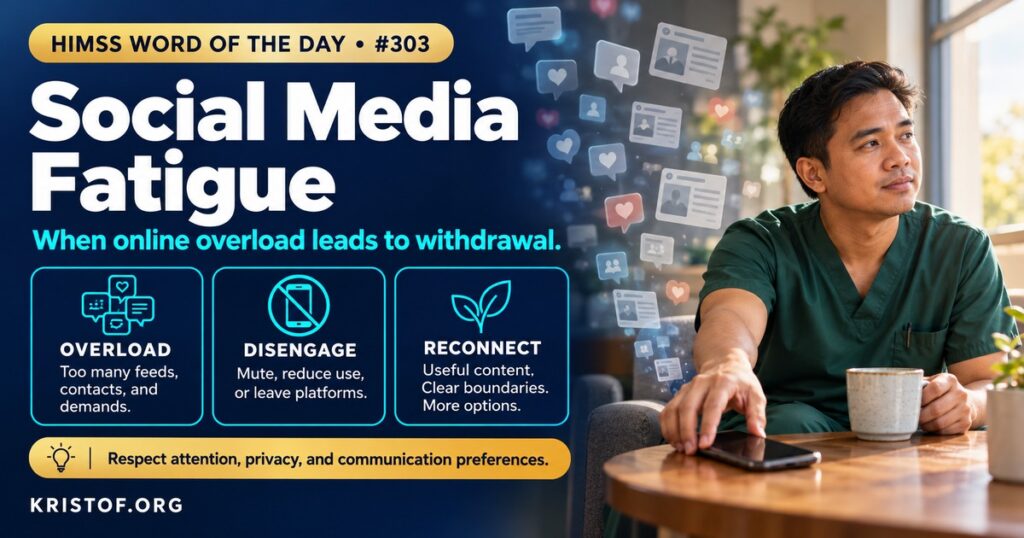
Social media fatigue is the tendency of users to pull away from social media after feeling overwhelmed. The HIMSS Dictionary names three common sources: a surplus of platforms, an oversized circle of contacts, and heavy time spent maintaining those connections. Boredom and concern about online privacy are also linked to it. Related names include social networking fatigue and social media fatigue syndrome.
Researchers treat it as a form of technology-related strain. Users may feel overloaded by information, pressure to respond, or worry about how their data are used, and they may reduce use, switch platforms, or stop altogether. In health care, the idea matters in two places. Organizations that rely on social media for patient education, outreach, and recruitment need to know when audiences tune out. And clinicians, including nurses, who use social media for professional learning and networking may find the volume of content a burden.
| Source of Fatigue | Example | Common Response |
|---|---|---|
| Information overload | Endless feeds and updates | Skimming or muting |
| Social overload | Many contacts and obligations | Unfollowing or leaving groups |
| Privacy concern | Worry about data use | Locking accounts, quitting platforms |
| Boredom | Repetitive content | Reduced use or switching platforms |
| Time pressure | Hours lost to scrolling | Deleting apps, limiting time |
⚠️ Exam Alert: Social media fatigue describes user withdrawal from overload; information overload is the broader condition of more information than a person can process; alert fatigue is the parallel problem with clinical alerts. The concept is about user experience, not a diagnosis.
🌐 Why It Matters: Real-World Healthcare IT Context
The evidence base on social media fatigue sits mostly in psychology and communication research, and it is useful to health IT readers for what it says about measurement and about audiences, with the caveat that few studies involve patients or clinicians directly.
Measurement comes first. A 2026 study in Psychology Research and Behavior Management tested the Social Media Fatigue Scale and a Social Anxiety Scale for Social Media Users among 1,012 Indonesian university students. After removing one item with a very low corrected item-total correlation, both instruments showed satisfactory model fit, internal consistency, and validity, and measurement invariance across gender and academic discipline was confirmed. The authors reported that the two constructs were related but distinct. The study matters because many findings about fatigue depend on a validated scale, and validation in one language and setting does not carry over automatically to others.
Associations with well-being appear in survey research. A 2026 cross-sectional study in Behavioral Sciences surveyed 1,108 Chinese university students. Higher social media fatigue was associated with higher anxiety about artificial intelligence, which was in turn associated with more depressive symptoms; the association of AI anxiety with depressive symptoms became stronger as subjective socioeconomic status increased. The authors described the pattern as a statistical indirect association. Because it is cross-sectional and based on self-report in one student population, it cannot show that fatigue causes depression or that results apply to nurses or patients, but it fits the idea that digital stress accumulates across technologies.
Nurses’ own experience shows another side. A 2026 cross-sectional study in Computers, Informatics, Nursing collected data from 158 nurses across 19 European countries, recruited largely through social media channels for Sigma nursing members, so the sample is highly educated and self-selected. WhatsApp, Facebook, and Instagram were the most used platforms, and nurses mostly used social media to stay updated on research, news, and webinars. Barriers to using it for learning included lack of time, privacy concerns, limited user skills, information overload, doubts about content reliability, and platform complexity. The list overlaps with the sources of fatigue described above, which suggests that organizations promoting social media for professional learning should expect some users to disengage.
Social media can still help when it is designed with purpose. A 2026 systematic review in Health Communication of 17 randomized trials of social media in cancer interventions found frequent improvements in psychosocial measures such as anxiety, depression, and social support, and some physical benefits, with WeChat and Facebook the most common platforms. Few studies measured actual platform use, and the authors stressed theory-informed, context-specific design over the assumption that social media use is beneficial in itself.
For health organizations, the practical implications are modest but real. Messages should be selective and useful, not constant. Teams should offer several channels, including non-social options such as text messaging or email, because some people leave platforms altogether. Privacy practices should be clear. Communicators should track engagement over time and notice when audiences shrink or content is ignored. For staff, policies can support professional use while recognizing limits: clear guidance on patient privacy and professionalism, and no expectation that employees monitor social channels outside work hours.
Common social media fatigue challenges:
- Posting frequently with little new value
- Relying on one platform for patient communication
- Assuming silence means agreement
- Privacy concerns that go unaddressed
- Pressure on staff to follow work-related channels after hours
- Measuring reach without measuring engagement or benefit
What supports sustainable use:
- Selective, useful content on a predictable schedule
- Multiple channels, including non-social options
- Transparent privacy practices
- Tracking of engagement over time
- Staff guidance that respects boundaries
- Evaluation of whether campaigns change knowledge or behavior
🏥 The Nurse’s Perspective: Clinical, Bedside, & Workflow
Nurses use social media for learning, networking, and advocacy, and they see how patients use it for health information.
At the Bedside
Patients arrive with information from social platforms, some of it helpful and some not. Nurses ask what the patient has seen and offer reliable sources without dismissing the patient’s interest. A patient who has stopped using social media may prefer calls or printed materials, and nurses respect that.
In Clinical Workflow
Nurse leaders set expectations about professional use of social media, including privacy of patients and respect for after-hours boundaries. Nurse educators use social channels selectively for learning, and offer alternatives such as email digests or short sessions for colleagues who feel overwhelmed.
Nurse informaticists advise communication teams on what patients prefer, test whether portal messages and text reminders reach people more reliably than social posts, and help evaluate engagement.
In EHR Implementation (Go-Live Perspective)
During an Epic Go-Live, informal social messaging groups can multiply as staff look for tips. At-the-elbow support analysts and the command center direct staff to approved channels so that guidance is accurate and no patient information is shared in unapproved places, and they avoid adding to the flood of messages.
🎓 CAHIMS / CPHIMS & HIMSS Perspective
CAHIMS Exam Domain Mapping
Social media fatigue appears in communication, usability, and privacy questions:
| CAHIMS Domain | How Social Media Fatigue Appears |
|---|---|
| Healthcare & Technology Environments | Consumer technology, privacy, public health communication |
| Clinical Informatics | Patient engagement, communication preferences, digital wellbeing |
| Healthcare Information & Systems Management | Channel strategy, policy, analytics |
| Management & Leadership | Communication governance, staff policy, evaluation |
Key Terms to Know Alongside Social Media Fatigue
- Information Overload — more information than a person can process effectively
- Alert Fatigue — reduced response to alerts caused by too many or low-value alerts
- Patient Engagement — activities that involve patients in their own health and care
- Digital Wellbeing — healthy balance between technology use and personal life
- Health Communication — use of communication to inform and influence health decisions
- Professional Social Media Policy — organization rules for staff use of social media
HIMSS Organizational Position
HIMSS supports patient engagement and the responsible use of digital technology through its research, education, and community work. Members can find related resources through the HIMSS Nursing Informatics Community page.
🔗 Explore Further: External References
- Muthmainnah et al. (2026), Psychology Research and Behavior Management — Psychometric Validation of the Social Media Fatigue Scale and Social Anxiety Scale for Social Media Users Among Indonesian University Students https://pubmed.ncbi.nlm.nih.gov/42788069/
- Wu et al. (2026), Behavioral Sciences — Social Media Fatigue and Depressive Symptoms Among Chinese University Students: Artificial Intelligence Anxiety as a Statistical Mediator and Subjective Socioeconomic Status as a Moderator https://pubmed.ncbi.nlm.nih.gov/42938620/
- Syyrilä et al. (2026), Computers, Informatics, Nursing — Exploration of Social Media Usage Among Nurses in the European Region: A Cross-Sectional Study https://pubmed.ncbi.nlm.nih.gov/42636418/
- Yang et al. (2026), Health Communication — The Use of Social Media in Health Interventions for People Living With Cancer: A Systematic Review https://pubmed.ncbi.nlm.nih.gov/42703921/
- HIMSS — Nursing Informatics Community https://www.himss.org/networking/communities/nursing-informatics/
Term source: HIMSS Dictionary of Health Information and Technology Terms, Acronyms, and Organizations, 6th Edition (2025). All definitions in this series are paraphrased for editorial purposes. Readers are encouraged to consult the primary source for exact language.
Eric Andrew Kristof, RN, CAHIMS is a Healthcare IT professional and HIMSS Arkansas Chapter member based in Hot Springs Village, AR, with hands-on Epic Go-Live experience and a diverse healthcare and IT background. He writes at kristof.org at the intersection of clinical care and healthcare technology.
Leave a Reply