By Eric Andrew Kristof, RN, CAHIMS | Healthcare IT Professional | HIMSS Arkansas Chapter Member
About This Series: The HIMSS Word of The Day is a running blog series drawing from the HIMSS Dictionary of Health Information and Technology Terms, Acronyms, and Organizations, 6th Edition (2025) — the authoritative reference for healthcare IT professionals and the primary study resource for CAHIMS and CPHIMS certification. Each post paraphrases the term in plain language, grounds it in real-world healthcare IT context, and adds a bedside nursing perspective you won’t find in a textbook.
📖 The Term: QHP (Qualified Health Plan)
Source: HIMSS Dictionary of Health Information and Technology Terms, Acronyms, and Organizations, 6th Edition (2025)
🔍 Plain-Language Definition
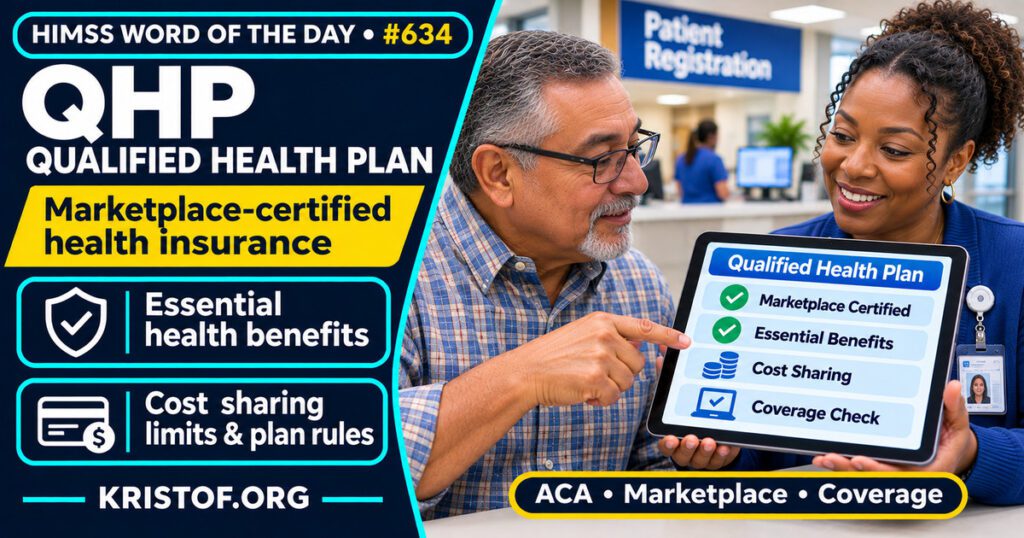
A qualified health plan (QHP) is a health insurance plan that a Health Insurance Marketplace has approved for sale. To earn that approval, the plan has to cover the essential health benefits, keep what members pay within set cost-sharing caps such as deductibles, copayments, and out-of-pocket maximums, and satisfy other Affordable Care Act conditions. HealthCare.gov adds that every QHP counts as “minimum essential coverage,” the level of coverage the ACA looks for.
The term describes the plan’s status, not the insurer. A health insurance company, called an issuer, applies to have particular plans certified, and CMS’s certification page says issuers seeking to join the Federally-facilitated Marketplaces use the QHP Application. Each Marketplace certifies the plans sold through it.
| Element | What it means |
|---|---|
| Issuer | The insurance company that applies for certification |
| Certification | Approval by a Marketplace to sell a plan through it |
| Essential health benefits | The categories of services a QHP must cover |
| Cost-sharing limits | Caps on deductibles, copayments, and out-of-pocket spending |
| Minimum essential coverage | The ACA coverage standard that QHPs meet |
The table is a simplified summary of the CMS and HealthCare.gov descriptions.
⚠️ Exam Alert: A QHP is a Marketplace-certified plan under the Affordable Care Act. It differs from a Medicare Advantage plan, a Medicaid managed care plan, and an employer plan, which follow different rules. It also differs from a federally qualified health center, which is a care provider, not an insurance plan.
🌐 Why It Matters: Real-World Healthcare IT Context
QHPs matter to health IT because they connect insurance rules, plan data, and the front-door workflows of care. Patients who buy coverage through a Marketplace carry a QHP card, and registration, authorization, and billing teams have to recognize the plan and its rules.
How plan data move. CMS’s Plan Year 2025 QHP Issuer Application Instructions, dated August 2024, give a view of the data side. According to the portion of the document I could read, issuers in states served by the federal platform use the Marketplace Plan Management System to submit plan benefit, rating, and business data to CMS. The instructions say issuers complete the Network, Service Area, and Prescription Drug templates before the Plans and Benefits template, and assign each plan a network ID, a service area ID, and a formulary ID. The excerpt I read does not say how these data are later shown to consumers. I could read only the first part of a very long document, and it describes one plan year, so check the current instructions on the QHP certification website before relying on details. CMS’s certification page says the QHP Application, templates, instructions, tools, and FAQs are available there.
What studies show. Researchers have used QHP plan data to describe how plans differ. The findings below are descriptive snapshots from earlier years.
- Hung and Sauvageau (2021) searched all bronze and silver QHPs in California, Florida, and Illinois in 2014 and again in 2018, using marketplace and issuer websites. The number of plans stayed about the same, but coinsurance became more common across drug tiers, and median coinsurance rates rose in several tiers. The share of plans that posted a formulary on the marketplace website increased from 82% to 97%. The authors say cost-sharing transparency for medications under the medical benefit could greatly improve. The study covers three states and two years.
- Wong and colleagues (2017) analyzed physician network data from all 2014 individual marketplace silver plans, covering 1,836 unique networks. They defined a narrow network as one with no providers available in the area or under 10% of available providers. Narrow networks were more common for pediatric specialists (65.9%) than adult specialists (34.9%). The data are from the first marketplace year and cover silver plans only.
- McManus and colleagues (2023) analyzed 58,087 QHPs from 2018 to 2020 for coverage of two HIV preexposure prophylaxis formulations. In the South, the share of QHPs requiring prior authorization for one of the two formulations (emtricitabine/tenofovir disoproxil fumarate), even when both were covered, rose from 10.0% in 2018 to 46.8% in 2020. It is a descriptive study of one drug class.
Together, these studies show that plan-level data can be analyzed at scale and that plans differ in ways patients may not see at the registration desk. They do not show how plans look today.
What I could not find. I did not verify current QHP counts, enrollment numbers, or the latest certification rules, and Marketplace rules and subsidies can change from one plan year to the next. The CMS pages I read do not state a plan year, and the studies use data from 2014 to 2020. Treat the findings as examples of how QHP data are used, and check CMS for the current plan year.
Common QHP problems:
- Confusing a QHP with other plan types that have different rules
- Registration build that does not capture the plan or Marketplace source correctly
- Network and formulary details that differ between the issuer website and the plan data
- Prior authorization rules that vary by plan and region
- Out-of-network surprises when network data are incomplete
- Assuming rules from one plan year still apply
What supports good QHP data practice:
- Training registration staff to identify plan type and coverage source
- Current payer tables maintained against issuer and CMS updates
- Electronic eligibility and prior authorization checks where available
- Clear patient communication about network and cost-sharing rules
- Periodic review of denials by plan type
- Attention to the plan year when reading any rule or study
🏥 The Nurse’s Perspective: Clinical, Bedside, & Workflow
Nurses and care managers do not buy or certify plans, but insurance type shapes what care is easy or hard to arrange.
At the Bedside
A patient who asks whether a test, a medication, or a follow-up visit is covered is often asking about plan rules. Nurses cannot read a plan’s rules at the bedside, so they rely on case managers, financial counselors, and registration staff, and they document clearly when a coverage barrier affects care.
In Clinical Workflow
Case management and utilization review nurses work with prior authorization, network status, and discharge planning. A plan with a narrow network or a prior authorization rule can change a discharge plan, a referral choice, or a medication start date. Informatics teams help by making coverage and authorization information visible where decisions are made.
In EHR Implementation (Go-Live Perspective)
During an Epic Go-Live, registration and payer build get attention early, because an incorrect plan or a missing payer can lead to denied claims later. At-the-elbow analysts hear questions from registration and nursing staff about which plan a patient has and what that plan covers. This post does not claim that any specific go-live had a Marketplace plan problem. It shows why payer table testing with realistic plan examples is worth the time.
🎓 CAHIMS / CPHIMS & HIMSS Perspective
CAHIMS Exam Domain Mapping
QHPs connect policy, plan data, and clinical operations:
| CAHIMS Domain | How QHPs Appear |
|---|---|
| Healthcare & Technology Environments | The ACA, Health Insurance Marketplaces, and plan types in the U.S. system |
| Clinical Informatics | Coverage and authorization information that affects care decisions |
| Healthcare Information & Systems Management | Payer tables, eligibility checks, and plan data submitted to CMS |
| Management & Leadership | Payer mix, contracting, and revenue cycle decisions affected by plan type |
Key Terms to Know Alongside QHP
- Affordable Care Act — the federal law that created the Marketplaces and QHP standards
- Payer — an organization that pays or reimburses for healthcare services
- Managed care — a model that organizes care and cost through networks and rules
- Out-of-network — care from a provider outside a plan’s contracted network
- Electronic prior authorization — an electronic request for plan approval of a service
- Encounter data — claim-like records of services delivered under managed care
HIMSS Organizational Position
HIMSS offers education and research on health information and technology topics through its Resource Center. Members can find related information on the HIMSS Resource Center page.
🧭 More HIMSS Word of The Day Terms
Related terms in the Healthcare Policy series:
- Covered Entity (HIPAA)
- LTCF (Long-Term Care Facility)
- EOB (Explanation of Benefits)
- Veterans Integrated Service Network (VISN)
Browse all Healthcare Policy terms or the A–Z glossary.
🔗 Explore Further: External References
- CMS — Qualified Health Plan Certification https://www.cms.gov/marketplace/health-plans-issuers/qualified-health-plan-certification
- CMS — Qualified Health Plan Issuer Application Instructions, Plan Year 2025 (August 2024) https://www.qhpcertification.cms.gov/s/PY2025QHPIssuerInstructions_v1.3.pdf
- HealthCare.gov — Glossary: Qualified health plan https://www.healthcare.gov/glossary/qualified-health-plan/
- Hung and Sauvageau (2021), Journal of Managed Care & Specialty Pharmacy — Formulary tiers, medication cost sharing, and transparency in bronze and silver qualified health plans in 2014 vs 2018 https://pubmed.ncbi.nlm.nih.gov/34595951/
- Wong et al. (2017), Pediatrics — Pediatric and Adult Physician Networks in Affordable Care Act Marketplace Plans https://pubmed.ncbi.nlm.nih.gov/28250022/
- McManus et al. (2023), JAMA Network Open — Geographic Variation in Qualified Health Plan Coverage and Prior Authorization Requirements for HIV Preexposure Prophylaxis https://pubmed.ncbi.nlm.nih.gov/37948076/
- HIMSS — Resource Center https://www.himss.org/resource-center
Term source: HIMSS Dictionary of Health Information and Technology Terms, Acronyms, and Organizations, 6th Edition (2025). All definitions in this series are paraphrased for editorial purposes. Readers are encouraged to consult the primary source for exact language.
Eric Andrew Kristof, RN, CAHIMS is a Healthcare IT professional and HIMSS Arkansas Chapter member based in Hot Springs Village, AR, with hands-on Epic Go-Live experience and a diverse healthcare and IT background. He writes at kristof.org at the intersection of clinical care and healthcare technology.
Leave a Reply