By Eric Andrew Kristof, RN, CAHIMS | Healthcare IT Professional | HIMSS Arkansas Chapter Member
About This Series: The HIMSS Word of The Day is a running blog series drawing from the HIMSS Dictionary of Health Information and Technology Terms, Acronyms, and Organizations, 6th Edition (2025) — the authoritative reference for healthcare IT professionals and the primary study resource for CAHIMS and CPHIMS certification. Each post paraphrases the term in plain language, grounds it in real-world healthcare IT context, and adds a bedside nursing perspective you won’t find in a textbook.
📖 The Term: Health Interoperability Ecosystem
Source: HIMSS Dictionary of Health Information and Technology Terms, Acronyms, and Organizations, 6th Edition (2025)
🔍 Plain-Language Definition
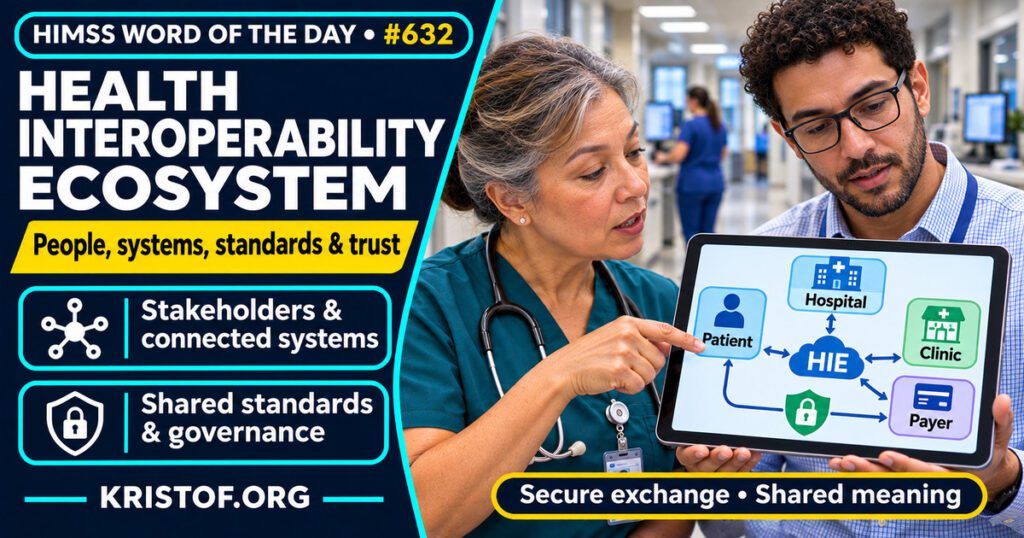
The HIMSS Dictionary describes the health interoperability ecosystem as the whole community of people, technologies, and workflows that need to move health information around, including structured data, including structured data, narrative text, and multimedia. Patients, clinicians, hospitals and health systems, researchers, payers, and suppliers are all named as possible stakeholders. According to the dictionary, each one helps create, exchange, or use health information. A well-functioning ecosystem gives them a shared information infrastructure, built on technical standards, policies, and protocols, so information can be captured, found, exchanged, and used securely.
The key idea is the difference in scope. Interoperability is a capability, the ability of systems to exchange and use information. The ecosystem is the larger environment where that capability either works or fails, because it includes the people and the rules as well as the software.
| Layer | What it contains | Example |
|---|---|---|
| Stakeholders | Patients, clinicians, health systems, payers, researchers, suppliers | A patient app, a hospital, a health plan |
| Systems | EHRs, exchanges, registries, apps, and other data holders | An EHR connected to a regional exchange |
| Standards | Technical formats and vocabularies that let systems understand one another | FHIR, USCDI |
| Policy and governance | Laws, agreements, and frameworks that define who may exchange what and how | TEFCA, the CMS Interoperability Framework |
| People and process | Workflows, training, consent practices, and data stewardship | Registration staff, nurses, analysts |
The table is a simplified teaching summary, not an official classification.
⚠️ Exam Alert: The health interoperability ecosystem is the whole environment of stakeholders, systems, and rules. Interoperability is one capability within it. A health information exchange is one kind of participant or service. TEFCA is one governance framework within the U.S. ecosystem, and health IT infrastructure is the technical layer under it.
🌐 Why It Matters: Real-World Healthcare IT Context
The ecosystem idea matters because most interoperability failures are not caused by a single interface. They come from gaps between stakeholders, such as who is allowed to share, who is paid to share, and who is responsible when data are wrong.
What current federal sources describe. Two federal efforts shape the U.S. ecosystem today, and both are written in terms of connecting many kinds of participants.
- ASTP/ONC describes TEFCA, the Trusted Exchange Framework and Common Agreement, as a nationwide framework for health information sharing. On its TEFCA page, the Qualified Health Information Networks, or QHINs, form the backbone and together create a network of networks. Participants such as hospitals, health systems, and public health agencies connect to QHINs, and some participants, such as regional exchanges, may have subparticipants. The page lists a Common Agreement, a Trusted Exchange Framework, and a QHIN Technical Framework as the main components, and it names the Sequoia Project as the current Recognized Coordinating Entity. Roles and names can change, so check the page for the current arrangement.
- In a June 26, 2026 release, HHS reported that records exchanged through TEFCA grew from 10 million to more than 1 billion in less than a year, and that ONC is conducting additional reviews of QHINs and their participants to check compliance. The text I read does not explain how a record is counted, and a count of records exchanged does not say how complete or useful the data were.
- CMS describes its Interoperability Framework as a voluntary blueprint for health data exchange. The page lists five criteria groups: patient access, provider access and delegation, data availability and standards, network connectivity and transparency, and identity, security, and trust. It also lists participant categories, including networks, providers, EHRs, payers, and patient-facing apps. A network that voluntarily meets the criteria can be listed as a CMS Aligned Network. The page says the effort is not intended to create new regulatory burdens, and I did not see a compliance deadline stated for participants.
These sources show two overlapping federal efforts. They do not say how the two will fit together over time, and policy in this area has been changing quickly, so the pages are worth rechecking before relying on them.
What studies show. Research on ecosystems is mostly descriptive or policy-oriented, which fits a concept that covers people and rules as well as software.
- Zayas-Cabán and colleagues (2020) describe an ONC-led effort that combined a literature and program review, key informant interviews, and a stakeholder workshop. It produced a policy agenda with nine priorities for using health IT and electronic health data in research, built around a vision of an optimized health information ecosystem for scientific discovery. This is a policy agenda, not a measured trial of outcomes.
- Balsari and colleagues (2018) proposed a federated, patient-centric, API-enabled health information ecosystem for India, drawing on 18 months of deliberations among stakeholders in India and the United States. It is a proposal written for a different country, so it shows design thinking, not evidence of results in the United States.
- Mahmood and colleagues (2023) interviewed 15 stakeholders in Pakistan. They found openness to sharing data, but also barriers that included regulatory frameworks, sharing platforms, interoperability, and limited human and infrastructure capacity. The sample is small and the setting differs from the United States, but the pattern, interest in sharing paired with gaps in governance and capacity, matches how the ecosystem concept is framed.
What I could not find. I did not find a single source that measures how well the whole U.S. ecosystem works from end to end, or that shows a count of records exchanged translating into better outcomes. Treat claims of ecosystem-wide success with caution until the measure is clear.
Common health interoperability ecosystem problems:
- Treating the ecosystem as only a technology problem
- Connecting systems without agreement on who may use the data
- Several overlapping networks and frameworks with unclear roles
- Incomplete or inconsistent patient identity matching
- Counting exchanges without checking usefulness or completeness
- Smaller organizations lacking staff or budget to join
What supports a healthy health interoperability ecosystem:
- Shared standards and a stable set of common data elements
- Clear governance and data sharing agreements
- Patient access that works across apps and networks
- Oversight of participants, with transparent reporting
- Training for the people who register, document, and reconcile data
- Capacity building for smaller and rural organizations
🏥 The Nurse’s Perspective: Clinical, Bedside, & Workflow
Nurses are rarely named in ecosystem diagrams, but they are the people who create much of the data that moves through it.
At the Bedside
Medication lists, allergies, vital signs, and assessments entered at the bedside are the content other organizations later receive. A nurse who documents consistently and completely improves the usefulness of what leaves the organization, even though the nurse never sees the exchange itself.
In Clinical Workflow
When outside records arrive, nurses and care coordinators often decide whether the information is current, relevant, and safe to act on. A reconciliation step that is unclear, or a record that cannot be matched to the right patient, becomes a workflow problem. Nurse informaticists help design the review steps so that outside data support care without adding unneeded alerts or duplicate entry.
In EHR Implementation (Go-Live Perspective)
During an Epic Go-Live, the ecosystem is visible in small ways: outside records that appear in a chart, a query that returns a different patient, or a patient app that shows data from a prior visit. At-the-elbow analysts hear these questions from nurses, and many of them involve identity, consent, and reconciliation, not connectivity. This post does not claim that any specific go-live had these issues. It shows why testing the paths between systems, and the human steps around them, belongs in readiness work.
🎓 CAHIMS / CPHIMS & HIMSS Perspective
CAHIMS Exam Domain Mapping
The ecosystem concept connects technology, policy, and people:
| CAHIMS Domain | How the Ecosystem Appears |
|---|---|
| Healthcare & Technology Environments | Stakeholders, networks, federal frameworks, and the policy setting |
| Clinical Informatics | Clinical data that is created, shared, reconciled, and reused |
| Healthcare Information & Systems Management | Standards, interfaces, identity matching, and exchange services |
| Management & Leadership | Governance, participation decisions, data sharing agreements, and oversight |
Key Terms to Know Alongside Health Interoperability Ecosystem
- Interoperability — the ability of systems to exchange information and use what is exchanged
- Health Information Exchange — electronic sharing of health information among organizations
- TEFCA — a federal framework for nationwide exchange through qualified networks
- FHIR — a standard for exchanging health data through modern web interfaces
- USCDI — a standardized set of data classes and elements for exchange
- Semantic interoperability — shared meaning of exchanged data, beyond format alone
HIMSS Organizational Position
HIMSS offers education and research on health information and technology topics through its Resource Center. Members can find related information on the HIMSS Resource Center page.
🧭 More HIMSS Word of The Day Terms
Related terms in the Interoperability and Standards series:
- Foundational Interoperability
- Longitudinal Health Record
- DEEDS (Data Elements for Emergency Department Systems)
Browse all Interoperability and Standards terms or the A–Z glossary.
🔗 Explore Further: External References
- CMS — Interoperability Framework https://www.cms.gov/initiatives/health-technology-ecosystem/overview/interoperability-framework
- ASTP/ONC — Trusted Exchange Framework and Common Agreement (TEFCA) https://healthit.gov/policy/tefca/
- HHS — ONC Strengthens TEFCA as One Billion Health Records Exchanged (June 26, 2026) https://www.hhs.gov/press-room/onc-strengthens-tefca-one-billion-health-records-exchanged.html
- Zayas-Cabán et al. (2020), JAMIA — National health information technology priorities for research: A policy and development agenda https://pubmed.ncbi.nlm.nih.gov/32090265/
- Balsari et al. (2018), Journal of Medical Internet Research — Reimagining Health Data Exchange: An Application Programming Interface-Enabled Roadmap for India https://pubmed.ncbi.nlm.nih.gov/30006325/
- Mahmood et al. (2023), BMJ Open — Health data ecosystem in Pakistan: a multisectoral qualitative assessment of needs and opportunities https://pubmed.ncbi.nlm.nih.gov/37734897/
- HIMSS — Resource Center https://www.himss.org/resource-center
Term source: HIMSS Dictionary of Health Information and Technology Terms, Acronyms, and Organizations, 6th Edition (2025). All definitions in this series are paraphrased for editorial purposes. Readers are encouraged to consult the primary source for exact language.
Eric Andrew Kristof, RN, CAHIMS is a Healthcare IT professional and HIMSS Arkansas Chapter member based in Hot Springs Village, AR, with hands-on Epic Go-Live experience and a diverse healthcare and IT background. He writes at kristof.org at the intersection of clinical care and healthcare technology.
Leave a Reply