By Eric Andrew Kristof, RN, CAHIMS | Healthcare IT Professional | HIMSS Arkansas Chapter Member
About This Series: The HIMSS Word of the Day is a running blog series drawing from the HIMSS Dictionary of Health Information and Technology Terms, Acronyms, and Organizations, 6th Edition (2025) — the authoritative reference for healthcare IT professionals and the primary study resource for CAHIMS and CPHIMS certification. Each post paraphrases the term in plain language, grounds it in real-world healthcare IT context, and adds a bedside nursing perspective you won’t find in a textbook.
📖 The Term: U.S. Core Data for Interoperability (USCDI)
Source: HIMSS Dictionary of Health Information and Technology Terms, Acronyms, and Organizations, 6th Edition (2025)
🔍 Plain-Language Definition
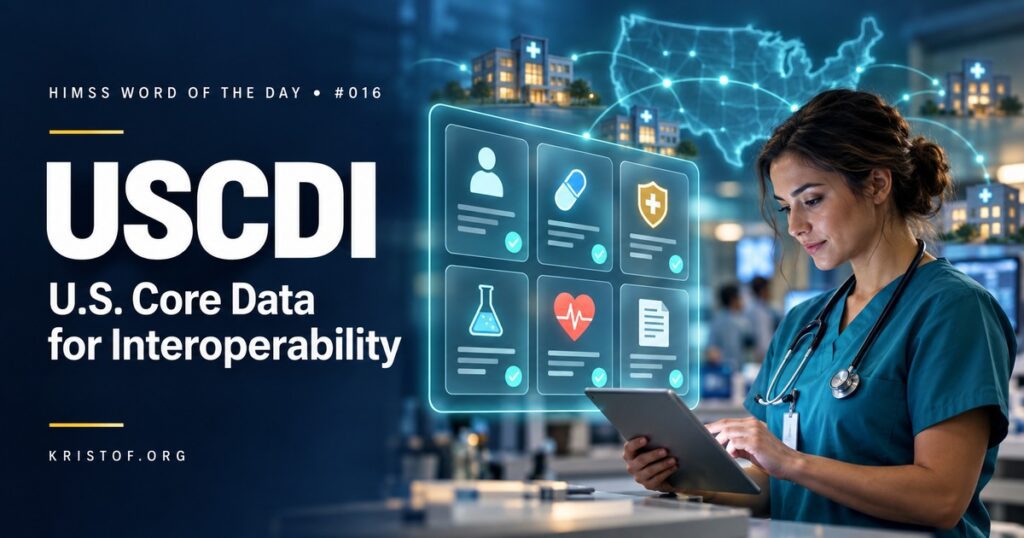
USCDI is the federal government’s standardized list of health data that certified health IT must be able to exchange. It answers a basic interoperability question: when two systems share a patient’s record, what information should be included, and in what coded form?
The HIMSS Dictionary describes USCDI as a common set of data classes, published by ONC (the federal health IT coordinator) as part of the broader push toward the Trusted Exchange Framework and Common Agreement (TEFCA), that are required for interoperable exchange. USCDI names those data classes, ties them to specific standards, and sets out a recurring process for reviewing and adding to them in later versions. It builds on and expands the earlier Common Clinical Data Set (CCDS).
USCDI is organized in two layers. A data class is a broad category, such as Medications. A data element is a specific item inside it, such as a medication’s dose. Each element points to a vocabulary standard so its meaning is consistent everywhere.
| Data Class (examples) | What It Covers | Typical Standard |
|---|---|---|
| Patient Demographics | Name, birth date, address, language, race, and ethnicity | Defined value sets |
| Problems | Active and historical conditions | SNOMED CT |
| Medications | Active medications and their details | RxNorm |
| Allergies and Intolerances | Substances and reactions | RxNorm and SNOMED CT |
| Laboratory | Tests and results | LOINC |
| Vital Signs | Blood pressure, heart rate, temperature, oxygen saturation, and more | LOINC |
| Clinical Notes | Discharge summaries, progress notes, consult notes, and others | LOINC document types |
| Immunizations | Vaccines administered | CVX |
⚠️ Exam Alert: Keep the layers straight. USCDI defines what data must be exchangeable. US Core is the HL7 FHIR implementation guide defining how USCDI data is represented in FHIR. C-CDA is the document format for exchanging summaries. TEFCA is the national framework governing who exchanges data and under what rules. CCDS was the predecessor to USCDI. A question asking which one is “a standardized set of data classes and elements” is asking about USCDI.
🌐 Why It Matters: Real-World Healthcare IT Context
USCDI turns “interoperability” from an aspiration into a checklist that software can be certified against.
The ONC Cures Act Final Rule (2020) replaced the Common Clinical Data Set with USCDI version 1 in the ONC Health IT Certification Program. That first version included sixteen data classes, among them clinical notes, provenance, and implantable device identifiers that CCDS had not required. Since then, ONC has published a new version roughly every year, each adding data classes and elements submitted and refined through public input.
Certification lags behind publication on purpose, so developers have time to build. The HTI-1 Final Rule made USCDI version 3 the baseline for certified health IT as of January 1, 2026. Later versions are already published, and ONC, now organized as part of the Assistant Secretary for Technology Policy (ASTP/ONC), lets developers adopt newer versions voluntarily.
USCDI also connects to information blocking. When the information blocking rules first took effect, the definition of electronic health information that had to be shared was temporarily limited to the USCDI data elements. That limit ended in October 2022, and the full scope of electronic health information now applies, but USCDI remained the baseline expectation.
Where USCDI helps:
- A predictable national floor of data every certified EHR can send and receive
- Coded data that keeps its meaning across organizations
- A public, recurring process for adding data that matters to patients and clinicians
- A shared target for FHIR APIs, C-CDA documents, and TEFCA exchange
- Domain-specific extensions, called USCDI+, for areas such as public health and quality
Where USCDI falls short:
- It sets a floor, not a ceiling, so many clinically important details remain outside it
- Version lag means certified systems trail the newest published version by years
- Data can be technically conformant yet incomplete or poorly documented at the source
- Local codes still need mapping before they meet USCDI expectations
🏥 The Nurse’s Perspective: Clinical, Bedside, & Workflow
A surprising share of USCDI is nursing data, and the quality of that data starts at the bedside.
At the Bedside
Vital signs, allergies and reactions, smoking status, immunizations, and many health status assessments are documented by nurses. Every time those findings are recorded in the structured fields mapped to USCDI, they become data that can travel to the patient’s next provider, to a public health registry, or to the patient’s own app.
When the same findings are buried in free-text notes, they may still be accurate, but they cannot move as reliably. The choice between a structured field and a narrative line is a small decision with national consequences.
In Clinical Workflow
At transitions of care, USCDI is what makes an outside record useful on arrival. A transfer packet built on USCDI data classes brings coded problems, medications, allergies, recent results, and notes together in a predictable shape. Nurses doing admission reconciliation benefit directly when outside data arrives coded rather than as a scanned image.
Nursing informatics has also advocated for nursing-relevant data in USCDI, including assessments of functional status, cognitive status, and social needs that shape discharge planning and care coordination. As those elements are added and adopted, more of the nurse’s assessment becomes portable.
In EHR Implementation (Go-Live Perspective)
During an Epic Go-Live, USCDI mostly lives in build decisions: which flowsheet rows map to which LOINC codes, how allergy reactions are coded, and which note types are shared. Getting those mappings right before cutover determines whether the organization’s data meets certification and exchange expectations afterward.
End-user support analysts see the results when outside records are incomplete, a note type does not appear in a shared summary, or a vital sign entered in a custom row never reaches the patient’s portal. Tracing those issues back to mapping rather than user error is part of keeping exchanged data trustworthy.
🎓 CAHIMS / CPHIMS & HIMSS Perspective
CAHIMS Exam Domain Mapping
USCDI is a high-yield interoperability topic on the CAHIMS exam:
| CAHIMS Domain | How USCDI Appears |
|---|---|
| Healthcare & Technology Environments | Cures Act Final Rule; HTI-1; ONC certification; information blocking; TEFCA; ASTP/ONC role |
| Clinical Informatics | Structured documentation of USCDI data; transitions of care; terminology standards for each data class |
| Healthcare Information & Systems Management | US Core FHIR profiles; C-CDA documents; terminology mapping; version upgrades |
| Management & Leadership | Regulatory compliance planning; data governance; vendor upgrade timelines |
Key Terms to Know Alongside USCDI
- CCDS (Common Clinical Data Set) — the earlier federal data set that USCDI replaced in certification
- US Core Implementation Guide — the HL7 FHIR guide that defines how USCDI data is exchanged through FHIR
- C-CDA (Consolidated Clinical Document Architecture) — the document standard used for summaries such as discharge and transition-of-care documents
- TEFCA — the national framework and common agreement for exchange across health information networks
- HTI-1 Final Rule — the ONC rule that made USCDI version 3 the certification baseline as of 2026
- USCDI+ — domain-specific extensions of USCDI for programs such as public health and quality measurement
HIMSS Organizational Position
HIMSS supports standards-based interoperability as a core policy priority and engages with federal agencies on rules that shape USCDI, certification, and TEFCA through its public policy work. Members can find interoperability guidance and research through the HIMSS Resource Center.
🔗 Explore Further: External References
- ONC — U.S. Core Data for Interoperability (USCDI) https://isp.healthit.gov/united-states-core-data-interoperability-uscdi
- ONC — HTI-1 Final Rule https://healthit.gov/regulations/hti-rules/hti-1-final-rule/
- ONC — Cures Act Final Rule https://healthit.gov/regulations/cures-act-final-rule/
- HL7 — US Core Implementation Guide https://hl7.org/fhir/us/core/
- ONC — Trusted Exchange Framework and Common Agreement (TEFCA) https://healthit.gov/policy/tefca/
- ONC — USCDI+ https://healthit.gov/standards-and-technology/uscdi-plus/
Term source: HIMSS Dictionary of Health Information and Technology Terms, Acronyms, and Organizations, 6th Edition (2025). All definitions in this series are paraphrased for editorial purposes. Readers are encouraged to consult the primary source for exact language.
Eric Andrew Kristof, RN, CAHIMS is a Healthcare IT professional and HIMSS Arkansas Chapter member based in Hot Springs Village, AR, with hands-on Epic Go-Live experience and a diverse healthcare and IT background. He writes at kristof.org at the intersection of clinical care and healthcare technology.
Leave a Reply