By Eric Andrew Kristof, RN, CAHIMS | Healthcare IT Professional | HIMSS Arkansas Chapter Member
About This Series: The HIMSS Word of the Day is a running blog series drawing from the HIMSS Dictionary of Health Information and Technology Terms, Acronyms, and Organizations, 6th Edition (2025) — the authoritative reference for healthcare IT professionals and the primary study resource for CAHIMS and CPHIMS certification. Each post paraphrases the term in plain language, grounds it in real-world healthcare IT context, and adds a bedside nursing perspective you won’t find in a textbook.
📖 The Term: Longitudinal Health Record
Source: HIMSS Dictionary of Health Information and Technology Terms, Acronyms, and Organizations, 6th Edition (2025)
🔍 Plain-Language Definition
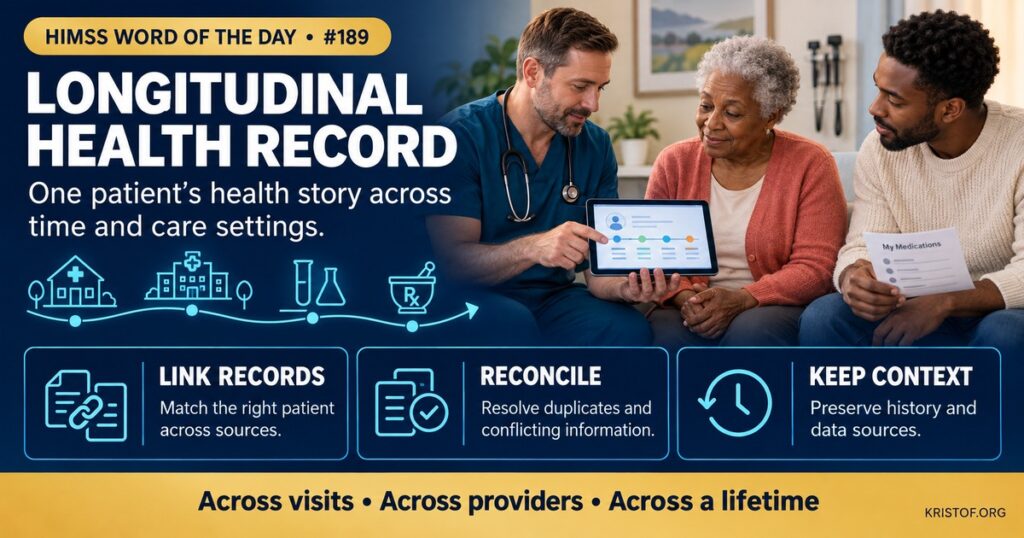
A longitudinal health record is a comprehensive, patient-centered collection of health information spanning a person’s care over time and across organizations, providers, and settings, rather than a record limited to a single encounter or institution.
The HIMSS Dictionary describes a longitudinal health record as a comprehensive clinical summary based on the patient’s experience over time, as opposed to records organized by encounter or by provider, and refers readers to the EHR.
| Record Type | Organized Around | Example |
|---|---|---|
| Encounter-Based Record | A single visit or admission | One hospital stay’s documentation |
| Provider- or Organization-Based EHR | Care within one organization | A health system’s EHR |
| Longitudinal Health Record | The patient over time and across organizations | Records from clinics, hospitals, labs, and pharmacies combined |
| Personal Health Record (PHR) | Information managed by the patient | An app aggregating records from multiple portals |
| Shared Care Record | Information shared among a community or region | A regional HIE summary view |
⚠️ Exam Alert: A longitudinal record is patient-centered and spans time and settings. An EHR is often organization-centered, though it may display outside information. Health information exchange and TEFCA help assemble longitudinal information. Patient matching is essential to link records correctly.
🌐 Why It Matters: Real-World Healthcare IT Context
People receive care from many sources over their lives: pediatricians, primary care practices, specialists, emergency departments, hospitals, pharmacies, laboratories, and home health agencies. When each holds only part of the story, clinicians may miss allergies, prior results, or important history, leading to duplicate tests, medication errors, and fragmented care.
A longitudinal view improves care. Clinicians who can see past diagnoses, medications, immunizations, imaging, and results make better decisions. Care transitions become safer, and patients avoid repeating their history at every visit. Population health and research also benefit from longitudinal data.
Several mechanisms help assemble longitudinal information. Health information exchanges share records within regions and networks. National frameworks, such as the Trusted Exchange Framework and Common Agreement, connect networks so organizations can query for records nationwide. EHR vendor networks allow exchange among their customers. FHIR-based APIs let patients gather their records in apps of their choice.
Standards make the data usable. The United States Core Data for Interoperability defines a common set of data classes and elements for exchange, and standards such as C-CDA documents and FHIR resources structure information so receiving systems can display and use it.
Patient matching is a fundamental challenge. Without a national patient identifier, systems must match records using demographics, and errors can lead to missing information or merging the wrong patients’ data.
Reconciliation is necessary. Outside information may duplicate, conflict with, or update local data. Clinicians must reconcile medications, allergies, and problems so the longitudinal view is accurate rather than cluttered. Provenance information helps clinicians understand where data came from.
Different settings need different views. An emergency clinician may need recent visits, allergies, and medications at a glance, while a primary care clinician may want long-term trends in labs and vital signs, and a care manager may focus on recent hospitalizations and social needs. Role-based summaries make the same longitudinal data useful to different users.
Volume can overwhelm. Retrieving years of documents from many sources can produce more information than clinicians can review. Summaries, deduplication, and intelligent display, increasingly supported by AI, help make longitudinal records usable.
Sensitive information requires care. Some longitudinal data, such as substance use disorder treatment records, reproductive health information, or behavioral health notes, may be subject to additional legal protections or patient preferences about sharing. Consent management and data segmentation allow systems to share most information while respecting these limits, though implementing them reliably remains challenging.
Patients are central. Patient access rights, portals, and apps allow individuals to view and share their longitudinal information, and some patients maintain personal health records to carry their history across providers.
Long-term continuity depends on data portability. When organizations replace EHRs, merge, or close, historical records must be preserved and remain accessible. Archiving strategies and data migration decisions determine whether a patient’s story stays intact over decades.
Common longitudinal record challenges:
- Incomplete participation in exchange networks
- Patient matching errors
- Duplicate and conflicting information
- Information overload for clinicians
- Varying data quality and standards use
- Privacy rules that limit sharing of sensitive data
What supports a useful longitudinal record:
- Broad participation in HIE and national networks
- Standards-based data such as USCDI, C-CDA, and FHIR
- Accurate patient matching and identity management
- Reconciliation workflows for outside information
- Summaries and deduplication tools
- Patient access to view and share information
🏥 The Nurse’s Perspective: Clinical, Bedside, & Workflow
Nurses help build and maintain the longitudinal record at every encounter.
Patients who carry medication lists, implanted device cards, or advance directive copies contribute to their own longitudinal record, and nurses can encourage these habits.
At the Bedside
Admission and intake assessments are opportunities to capture history that may not exist elsewhere, such as home medications, prior surgeries, allergies, and advance directives. Accurate, structured documentation adds valuable information to the patient’s longitudinal story.
Outside records retrieved through exchange can reveal allergies or recent hospitalizations the patient may not remember. Reviewing this information during assessment improves safety.
Documenting the source of information obtained verbally, such as a family member’s report of an allergy, helps future clinicians judge its reliability.
In Clinical Workflow
Medication reconciliation is a key longitudinal task. Nurses compare information from patients, outside records, and pharmacy history to create an accurate list that follows the patient across transitions.
Reconciling outside allergies and problems prevents duplicates and errors from accumulating in the record.
At discharge, sending complete summaries to the next provider extends the longitudinal record into the next setting.
Nurses can help patients access and use their records through portals and apps, empowering them to share history with new providers.
Patients transferring between facilities benefit when nurses confirm that key records, such as recent imaging and test results, are available to the receiving team.
In EHR Implementation (Go-Live Perspective)
During an Epic Go-Live, legacy data conversion, outside record retrieval, and reconciliation tools are configured. Decisions about which historical data to convert affect how complete the longitudinal record appears.
At-the-elbow support analysts help nurses locate outside records, reconcile incoming information, and send summaries in the new system.
🎓 CAHIMS / CPHIMS & HIMSS Perspective
CAHIMS Exam Domain Mapping
The longitudinal health record appears in interoperability and data management questions:
| CAHIMS Domain | How the Longitudinal Record Appears |
|---|---|
| Healthcare & Technology Environments | HIE, TEFCA, patient access policies |
| Clinical Informatics | Reconciliation, care transitions, intake documentation |
| Healthcare Information & Systems Management | Data standards, patient matching, data conversion, APIs |
| Management & Leadership | Exchange strategy, network participation, data governance |
Key Terms to Know Alongside Longitudinal Health Record
- Health Information Exchange (HIE) — electronic sharing of health information among organizations
- TEFCA — the national framework for exchange across networks
- USCDI — the standardized data set for exchange
- Patient Matching — linking records that belong to the same person
- Reconciliation — comparing and resolving information from different sources
- Personal Health Record (PHR) — a record managed by the patient
HIMSS Organizational Position
HIMSS supports nationwide interoperability and patient-centered records through its public policy work, education, and collaboration with IHE. Members can find related education and research through the HIMSS Resource Center.
🔗 Explore Further: External References
- ONC — Trusted Exchange Framework and Common Agreement (TEFCA) https://healthit.gov/policy/tefca/
- ONC — What Is HIE? https://healthit.gov/health-it-basics/hie/
- ONC — Interoperability Standards Platform (USCDI) https://isp.healthit.gov/
- ONC — Patient Identity and Patient Record Matching https://healthit.gov/standards-and-technology/patient-identity-and-patient-record-matching/
- HHS — Get It. Check It. Use It. (Your Right to Access) https://www.hhs.gov/hipaa/for-individuals/right-to-access/index.html
- HIMSS — Public Policy & Advocacy https://www.himss.org/public-policy-advocacy-overview
Term source: HIMSS Dictionary of Health Information and Technology Terms, Acronyms, and Organizations, 6th Edition (2025). All definitions in this series are paraphrased for editorial purposes. Readers are encouraged to consult the primary source for exact language.
Eric Andrew Kristof, RN, CAHIMS is a Healthcare IT professional and HIMSS Arkansas Chapter member based in Hot Springs Village, AR, with hands-on Epic Go-Live experience and a diverse healthcare and IT background. He writes at kristof.org at the intersection of clinical care and healthcare technology.
Leave a Reply