By Eric Andrew Kristof, RN, CAHIMS | Healthcare IT Professional | HIMSS Arkansas Chapter Member
About This Series: The HIMSS Word of The Day is a running blog series drawing from the HIMSS Dictionary of Health Information and Technology Terms, Acronyms, and Organizations, 6th Edition (2025) — the authoritative reference for healthcare IT professionals and the primary study resource for CAHIMS and CPHIMS certification. Each post paraphrases the term in plain language, grounds it in real-world healthcare IT context, and adds a bedside nursing perspective you won’t find in a textbook.
📖 The Term: DI (Diagnostic Imaging)
Source: HIMSS Dictionary of Health Information and Technology Terms, Acronyms, and Organizations, 6th Edition (2025)
🔍 Plain-Language Definition
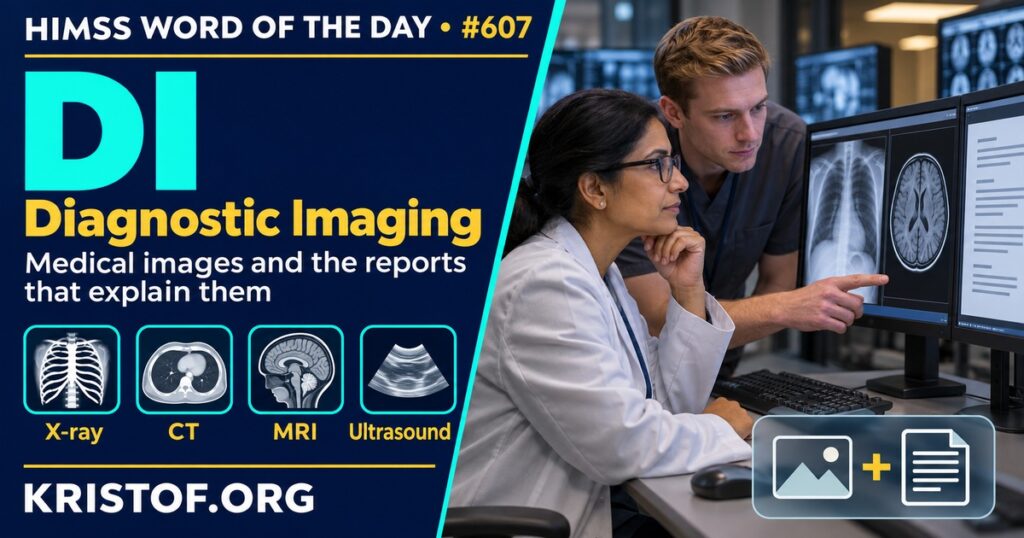
The HIMSS Dictionary lists DI (Diagnostic Imaging) as another name for medical imaging. It describes the term as covering the digital images and written reports that result from diagnostic studies, with x-rays, CT scans, and MRIs as examples.
The FDA‘s medical imaging page gives a broader, plainer definition: technologies used to view the human body in order to diagnose, monitor, or treat medical conditions, each providing different information about the area studied. That page lists ultrasound, x-ray imaging (including radiography, computed tomography, fluoroscopy, and mammography), and MRI. The FDA page states that its content was current as of August 28, 2018 and does not mention nuclear medicine, so it should be read as an overview, not a complete or current list of modalities.
| Item | Detail |
|---|---|
| Also called | Medical imaging (per the HIMSS Dictionary) |
| What it produces | Digital images and written reports from diagnostic studies |
| Common examples | X-ray, CT, MRI, and ultrasound |
| Core image standard | DICOM, which describes how medical images and related information are structured for exchange |
| Related systems | PACS, RIS, and the EHR, which store, route, or display the images and results |
⚠️ Exam Alert: Diagnostic imaging is the clinical activity and its products. It is not the same as PACS, which stores and displays images, RIS, which supports radiology workflow, DICOM, which is a standard, or a modality, which is the device that captures the image. In other medical writing, the letters DI can stand for unrelated terms such as drug-induced, so spelling the term out avoids confusion.
🌐 Why It Matters: Real-World Healthcare IT Context
Imaging studies create two kinds of output that health IT has to carry: the images themselves, which are large and structured, and the interpretation, which is text. Much of imaging informatics is about keeping those two connected, and connecting them to the rest of the record.
DICOM. The DICOM website calls the standard the international standard for medical images and related information. It says the standard specifies how images are structured so they can be exchanged while keeping the quality needed for clinical use, and that NEMA serves as the DICOM Secretariat. According to the site, DICOM was first published in 1993, is recognized by the International Organization for Standardization as ISO 12052, and is implemented in radiology, cardiology imaging, and radiotherapy devices, with growing use in ophthalmology and dentistry. The page focuses on image formats and does not describe communication protocols, so it is not used here to explain how images are transmitted.
Image exchange. A 2020 HIMSS-SIIM collaborative white paper by Persons and colleagues examines standards-based interoperability of medical images between organizations, patients, and providers. According to its abstract, it looks at three standards-based image exchange implementations, including the technology and standards used, the image types included, and the governance policies that define participation, access, and trust. A 2022 paper by Davis and Swenson places imaging interoperability in the larger context of health information exchange, and says the national networks it covers work within frameworks of standards published by IHE, DICOM, and HL7. According to the abstract, The Sequoia Project, Carequality, and eHealth Exchange have been separate companies since 2018. These are descriptions of approaches, and the abstracts do not compare them or give adoption figures.
Decision support and ordering. A 2024 study by Rosovsky and colleagues in the Journal of the American College of Radiology looked at a clinical decision support tool for ordering CT pulmonary angiograms in emergency departments, at nine hospitals in one health system. The study compared 12 months before and 12 months after implementation. It reported a 14.51% relative decrease in CTPA utilization, from 3.26% to 2.79% of ED visits, with yield unchanged (9.25% before and 8.92% after). The authors concluded that the CDS was associated with a significant reduction in utilization that was sustained for 12 months. Because this was a before-and-after comparison within one system, the result shows an association, not that the tool alone caused the change, and it may not apply elsewhere. These figures come from the abstract and are worth verifying against the paper.
Referrals and structured data. A 2026 paper by Palling and colleagues describes a conceptual information model for radiology referrals, built from about 2,500 radiological procedures and stakeholder interviews, with each principle mapped to SNOMED CT. The abstract says the model is a foundation for tools such as referral templates and describes implementing it in a radiology department as a next step, so its effect has not yet been evaluated in that paper.
Common diagnostic imaging problems:
- Treating images and reports as separate records that do not meet at the point of care
- Incomplete or inconsistent referral information, which the Palling abstract describes as a source of inefficiency and clinical risk
- Relying on an old modality list or an outdated definition
- Assuming image exchange works the same way between every pair of organizations
- Reading one before-and-after study as proof that a decision support tool will work everywhere
What supports diagnostic imaging informatics:
- DICOM for image structure and exchange
- Clear governance for who may access shared images
- Structured referral and reporting data that map to standard terminologies
- Decision support designed around validated rules and tracked after go-live
🏥 The Nurse’s Perspective: Clinical, Bedside, & Workflow
Nurses interact with diagnostic imaging at the points where an order, a patient, and a result meet.
At the Bedside
Nurses commonly prepare patients for studies, confirm identity and orders, and answer questions about what to expect. Screening questions, such as those about implanted devices, contrast, or pregnancy, differ by study and by local policy. A delay in a report or a missing image is often noticed first at the bedside, when a clinician asks where a result is.
In Clinical Workflow
Nurse informaticists and unit leaders often see the imaging workflow through order entry, scheduling, transport, and result notification. When a decision support prompt appears at ordering, the nurse may be the person who explains to a patient or family why a study was changed or deferred. The Rosovsky study applies to one system’s ED ordering tool, so it should not be read as a model for any other unit.
In EHR Implementation (Go-Live Perspective)
During an Epic Go-Live, analysts at the elbow hear imaging questions from nurses and clinicians, such as why an order did not route or where a report appears. Interface and viewer problems can look like clinical delays, so tracking the question and its route through ordering, imaging, and results helps the team find the source. This post does not claim that any specific go-live had an imaging problem.
🎓 CAHIMS / CPHIMS & HIMSS Perspective
CAHIMS Exam Domain Mapping
Diagnostic imaging links standards, systems, and clinical use:
| CAHIMS Domain | How Diagnostic Imaging Appears |
|---|---|
| Healthcare & Technology Environments | Imaging modalities, PACS, RIS, and DICOM |
| Clinical Informatics | Orders, reports, decision support, and structured data |
| Healthcare Information & Systems Management | Image exchange, storage, and result routing |
| Management & Leadership | Governance of shared images and review of decision support results |
Key Terms to Know Alongside Diagnostic Imaging
- PACS — a system that stores, retrieves, and displays medical images
- DICOM — the standard for structuring and exchanging medical images
- RIS — a system that supports radiology workflow such as scheduling and reporting
- Digital radiography — x-ray imaging that produces digital images
- Acquisition modality — the imaging device that captures the image
- Clinical decision support — tools that offer guidance at the point of care
HIMSS Organizational Position
HIMSS offers education and research on health information and technology topics through its Resource Center. Members can find related information on the HIMSS Resource Center page.
🧭 More HIMSS Word of The Day Terms
Related terms in the Clinical Informatics series:
Browse all Clinical Informatics terms or the A–Z glossary.
🔗 Explore Further: External References
- FDA — Medical Imaging (content current as of August 28, 2018) https://www.fda.gov/radiation-emitting-products/radiation-emitting-products-and-procedures/medical-imaging
- DICOM — About DICOM https://www.dicomstandard.org/about
- Persons et al. (2020), Journal of digital imaging — Interoperability and Considerations for Standards-Based Exchange of Medical Images: HIMSS-SIIM Collaborative White Paper https://pubmed.ncbi.nlm.nih.gov/31768898/
- Davis and Swenson (2022), Journal of digital imaging — How Carequality, The Sequoia Project, and eHealth Exchange Support the Interoperable Exchange of Health Data in the USA https://pubmed.ncbi.nlm.nih.gov/36070015/
- Rosovsky et al. (2024), Journal of the American College of Radiology : JACR — CT Pulmonary Angiogram Clinical Pretest Probability Tool: Impact on Emergency Department Utilization https://pubmed.ncbi.nlm.nih.gov/39134106/
- Palling et al. (2026), Studies in health technology and informatics — Designing an Information Model for Structured Referrals and Interoperable Data Exchange in Radiology https://pubmed.ncbi.nlm.nih.gov/42175085/
- HIMSS — Resource Center https://www.himss.org/resource-center
Term source: HIMSS Dictionary of Health Information and Technology Terms, Acronyms, and Organizations, 6th Edition (2025). All definitions in this series are paraphrased for editorial purposes. Readers are encouraged to consult the primary source for exact language.
Eric Andrew Kristof, RN, CAHIMS is a Healthcare IT professional and HIMSS Arkansas Chapter member based in Hot Springs Village, AR, with hands-on Epic Go-Live experience and a diverse healthcare and IT background. He writes at kristof.org at the intersection of clinical care and healthcare technology.
Leave a Reply