By Eric Andrew Kristof, RN, CAHIMS | Healthcare IT Professional | HIMSS Arkansas Chapter Member
About This Series: The HIMSS Word of The Day is a running blog series drawing from the HIMSS Dictionary of Health Information and Technology Terms, Acronyms, and Organizations, 6th Edition (2025) — the authoritative reference for healthcare IT professionals and the primary study resource for CAHIMS and CPHIMS certification. Each post paraphrases the term in plain language, grounds it in real-world healthcare IT context, and adds a bedside nursing perspective you won’t find in a textbook.
📖 The Term: QIO (Quality Improvement Organization)
Source: HIMSS Dictionary of Health Information and Technology Terms, Acronyms, and Organizations, 6th Edition (2025)
🔍 Plain-Language Definition
The HIMSS Dictionary describes a Quality Improvement Organization (QIO) as a group of quality specialists, clinicians, and consumers who work together to raise the quality of care that people receive. The entry is general and does not name a payer or a program. In United States health care, the term most often refers to contractors that the Centers for Medicare & Medicaid Services (CMS) engages through the Medicare QIO Program.
CMS’s fiscal year 2025 annual report to Congress describes that program as a statutory Medicare program, carried out by contractors in specific geographic or task areas that work with providers, practitioners, and beneficiaries. The report says the contractors are mostly private, not-for-profit organizations whose staff include physicians and other health care professionals.
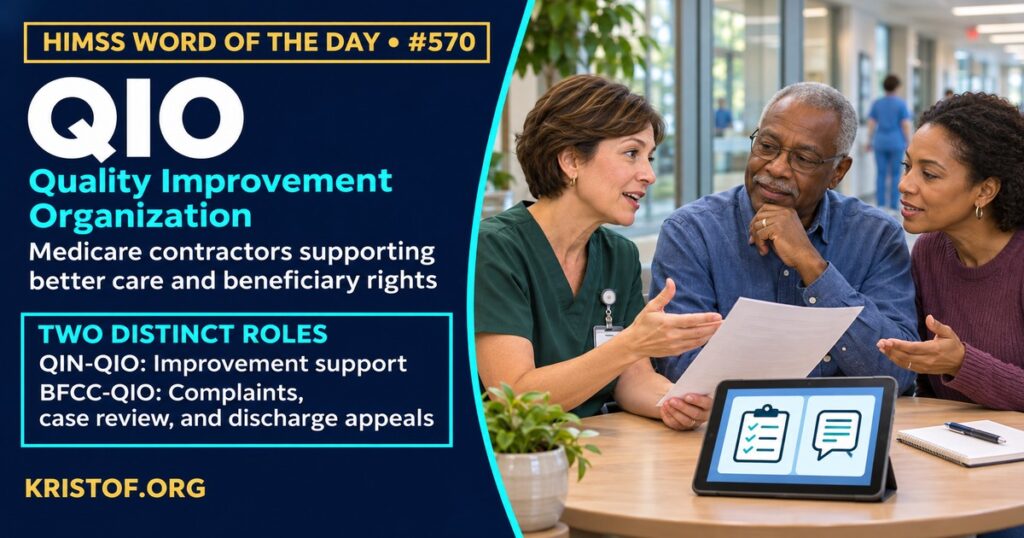
CMS’s QIO program page lists three initiatives: QIN-QIOs (Quality Innovation Network Quality Improvement Organizations), BFCC-QIOs (Beneficiary and Family Centered Care Quality Improvement Organizations), and a separate contract for American Indian and Alaska Native (AIAN) health care. The page describes the program as having two core functions, quality improvement support and case review.
| Contractor type | Main focus, as CMS describes it |
|---|---|
| QIN-QIO | Direct quality improvement support to nursing homes, hospitals, and physician offices |
| BFCC-QIO | Beneficiary complaints, rights, and case reviews such as discharge appeals |
| AIAN QIO | A separate QIO contract for American Indian and Alaska Native health care |
| Statement of Work (SOW) | The multi-year contract cycle that sets the QIO tasks and goals |
The table is a teaching sketch based on CMS’s own descriptions, not an official taxonomy.
⚠️ Exam Alert: A QIO is a CMS contractor, not a general term for any quality team. It differs from the broad practice of quality improvement, from an accrediting body such as The Joint Commission, and from CMS payment programs such as the Quality Payment Program. Within the program, QIN-QIOs and BFCC-QIOs do different work, so questions about complaints and appeals point to the BFCC side, while questions about technical assistance to providers point to the QIN side.
🌐 Why It Matters: Real-World Healthcare IT Context
Published evaluations of the QIO Program are mostly observational and describe earlier contract cycles, so they may not describe how the current cycle performs. Each article below was checked against its published abstract, and CMS’s own pages are treated as the program’s description of itself.
How the program is organized now. CMS’s program page lists QIN-QIO contracts for May 2025 to May 2030, BFCC-QIO contracts for May 2024 to April 2029, and the AIAN QIO contract for January 2025 to May 2030. The FY 2025 annual report calls the current cycle the 13th Statement of Work and says the QIN-QIO contracts were awarded in May 2025 to six contractors covering seven regions. Contract dates and structure change over time, so the current CMS page should be checked before relying on them.
An early national evaluation. Rollow and colleagues, in Annals of Internal Medicine (2006), compared performance on 41 quality measures across nursing homes, home health agencies, hospitals, and physician offices during the 7th Scope of Work. Improvement was seen in 34 of 41 measures, and for nursing home, home health, and physician office measures, providers that QIOs recruited for assistance improved more on 18 of 20 measures than providers that were not recruited. The authors note that selection bias, regression to the mean, and secular trends may have influenced the results, and describe the findings as consistent with an impact of the program. This is an observational study and does not prove cause.
A value estimate. Shih and colleagues, in Health Care Financing Review (2007), used a cost-utility analysis and estimated the QIO investment in nursing home quality improvement at $2,063 to $7,667 per quality-adjusted life year gained, which they described as good value, while stating that additional research is warranted. This is a model-based estimate from an older period, and the abstract does not state the dollar year, so the figures are best treated as approximate and checked against the paper.
A critique of targeting. Stevenson and Mor, in the Journal of the American Geriatrics Society (2009), analyzed how CMS targeted nursing homes in the 9th Statement of Work using two quality measures, pressure ulcers and restraint use. They found that about one in four facilities was targeted nationally, with about half of some states’ facilities targeted and almost none in others. They concluded that threshold values on individual measures are a blunt way to identify poorly performing homes and suggested supplemental strategies.
A recent local example. Stawarz and colleagues, in the Journal for Healthcare Quality (2026), reported a retrospective descriptive analysis of pharmacist-led vaccination clinics run by the Pennsylvania Pharmacists Care Network with Pennsylvania’s QIN-QIO. Across 68 clinics at 33 nursing homes, 19 pharmacies gave 4,938 vaccines, and average relative improvement rates were 46.3 percent for influenza, 41.4 percent for COVID-19, and 26.3 percent for pneumococcal vaccines. The abstract describes no comparison group and does not give baseline rates, so the result is encouraging but descriptive.
Common QIO problems:
- Treating “QIO” as one thing, when BFCC-QIOs and QIN-QIOs do different work
- Relying on the dictionary entry alone, which does not mention Medicare, contracts, or contractor types
- Applying results from earlier contract cycles to claims about the current program
- Reading observational findings as proof that QIO activity caused the improvement
- Using single-measure thresholds that may miss facilities that need help
- Confusing QIOs with CMS payment programs such as the Quality Payment Program
What supports QIO work:
- A statutory Medicare program with multi-year contracts, as the CMS annual report describes
- Technical assistance delivered directly to nursing homes, hospitals, and physician offices
- Separate BFCC contracts for complaints and appeals, which keep case review apart from improvement support
- Local partnerships, such as the Pennsylvania pharmacy collaboration described by Stawarz and colleagues
- A published cost-utility estimate that favored nursing home quality improvement work, with the caveats above
🏥 The Nurse’s Perspective: Clinical, Bedside, & Workflow
For nurses, QIOs appear mostly through patient rights and facility quality projects.
At the Bedside
BFCC-QIOs review beneficiary appeals of hospital discharge and other service decisions, and CMS’s annual report counts large numbers of such reviews. Bedside nurses may be the first to hear a patient or family question a discharge decision. In many hospitals, case managers and nurses help patients understand their appeal rights, and local policy and current CMS notice requirements govern the details.
In Clinical Workflow
Nursing home and hospital quality teams may take part in QIN-QIO projects on topics such as vaccination, as in the Pennsylvania example. Nurse leaders often supply the process knowledge, such as how clinics are scheduled and how resident records are checked. Nurse informaticists can help by identifying where the needed data live, how immunization status is documented, and who is responsible for each report.
In EHR Implementation (Go-Live Perspective)
During an Epic Go-Live, analysts at the elbow see how documentation fields and workflows shape later quality reports. When an organization takes part in a QIO project, project teams may be asked for quality-measure data, and whether those data come from the EHR depends on how the project is designed. Consistent discrete fields for items such as immunization status make that reporting easier, and any request should be confirmed with the project’s own measure definitions.
🎓 CAHIMS / CPHIMS & HIMSS Perspective
CAHIMS Exam Domain Mapping
The QIO connects federal quality programs, provider improvement work, and data reporting:
| CAHIMS Domain | How the QIO Appears |
|---|---|
| Healthcare & Technology Environments | CMS contractors, Medicare programs, and the organizations that deliver care |
| Clinical Informatics | Quality measures, documentation fields, and data used for improvement projects |
| Healthcare Information & Systems Management | Reporting, data sources, and contract-driven data requests |
| Management & Leadership | Quality improvement projects, partnerships, and working within contract cycles |
Key Terms to Know Alongside the QIO
- Quality improvement — systematic effort to improve care processes and outcomes
- Quality measures — standardized ways to assess care processes, outcomes, and patient experience
- Outcome measure — measure of the result of care, such as a health status change
- Value-based care — approach that links payment and performance to quality and cost
- SOW (Statement of Work) — document that defines the work, deliverables, and timeline of a contract
- Data quality — accuracy, completeness, and consistency of data for its intended use
HIMSS Organizational Position
HIMSS offers education and research on health information and technology topics through its Resource Center. Members can find related information on the HIMSS Resource Center page.
🧭 More HIMSS Word of The Day Terms
Related terms in the Healthcare Policy series:
- Covered Entity (HIPAA)
- MACRA (Medicare Access and CHIP Reauthorization Act of 2015)
- LSC (Life Safety Code)
- MDS (Minimum Data Set)
Browse all Healthcare Policy terms or the A–Z glossary.
🔗 Explore Further: External References
- Rollow et al. (2006), Annals of internal medicine — Assessment of the Medicare quality improvement organization program https://pubmed.ncbi.nlm.nih.gov/16908911/
- Shih et al. (2007), Health care financing review — Medicare’s quality improvement organization program value in nursing homes https://pubmed.ncbi.nlm.nih.gov/17645159/
- Stevenson and Mor (2009), Journal of the American Geriatrics Society — Targeting nursing homes under the Quality Improvement Organization program’s 9th statement of work https://pubmed.ncbi.nlm.nih.gov/19682119/
- Stawarz et al. (2026), Journal for healthcare quality — Improving Nursing Home Vaccination Rates: A Collaboration Between Community Pharmacies and a Quality Improvement Organization https://pubmed.ncbi.nlm.nih.gov/41641959/
- CMS — Quality Improvement Organizations https://www.cms.gov/medicare/quality/quality-improvement-organizations
- CMS — Annual Report to Congress, QIO Program, Fiscal Year 2025 https://www.cms.gov/files/document/annual-report-congress-qio-program-fiscal-year-2025.pdf
- HIMSS — Resource Center https://www.himss.org/resource-center
Term source: HIMSS Dictionary of Health Information and Technology Terms, Acronyms, and Organizations, 6th Edition (2025). All definitions in this series are paraphrased for editorial purposes. Readers are encouraged to consult the primary source for exact language.
Eric Andrew Kristof, RN, CAHIMS is a Healthcare IT professional and HIMSS Arkansas Chapter member based in Hot Springs Village, AR, with hands-on Epic Go-Live experience and a diverse healthcare and IT background. He writes at kristof.org at the intersection of clinical care and healthcare technology.
Leave a Reply