By Eric Andrew Kristof, RN, CAHIMS | Healthcare IT Professional | HIMSS Arkansas Chapter Member
About This Series: The HIMSS Word of The Day is a running blog series drawing from the HIMSS Dictionary of Health Information and Technology Terms, Acronyms, and Organizations, 6th Edition (2025) — the authoritative reference for healthcare IT professionals and the primary study resource for CAHIMS and CPHIMS certification. Each post paraphrases the term in plain language, grounds it in real-world healthcare IT context, and adds a bedside nursing perspective you won’t find in a textbook.
📖 The Term: WAN (Wide Area Network)
Source: HIMSS Dictionary of Health Information and Technology Terms, Acronyms, and Organizations, 6th Edition (2025)
🔍 Plain-Language Definition
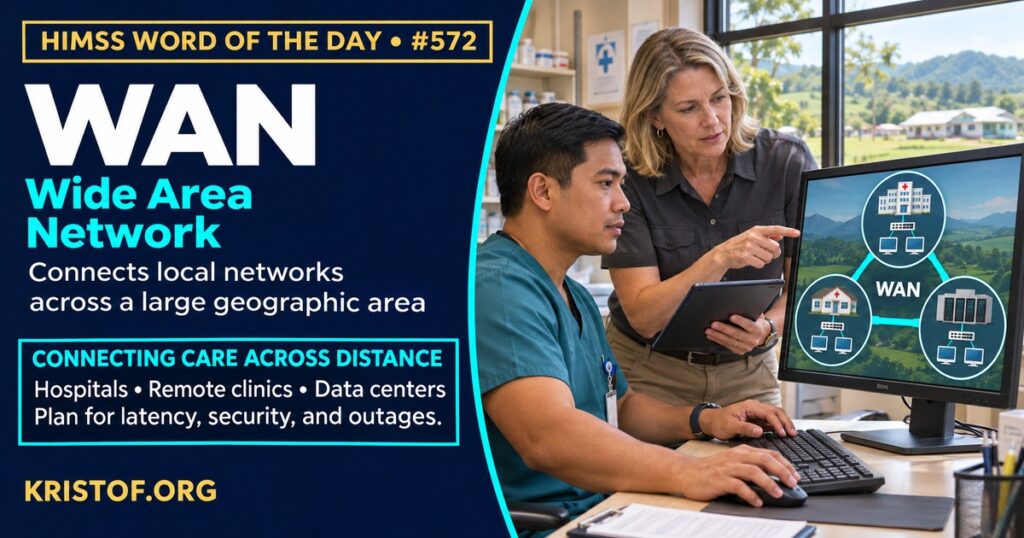
The HIMSS Dictionary describes a wide area network (WAN) as a network that covers a large geographic area and joins two or more local area networks. The entry says WANs are often built over public carrier networks such as telephone systems, though leased lines and satellite links can also be used, and it points readers to the related terms LAN, MAN, and WLAN.
The NIST glossary lists a definition drawn from NIST SP 800-82 Revision 3, which describes a WAN as a physical or logical network that provides data communications to a larger number of independent users and is usually spread over a larger geographic area than a local area network. The two descriptions agree on the main idea: a WAN is defined by reach and by the networks it connects, not by a single technology.
| Related term | How it relates to a WAN |
|---|---|
| LAN (Local Area Network) | A network covering a limited area such as one building or campus |
| MAN (Metropolitan Area Network) | A network covering a city or metropolitan region, named in the HIMSS entry as a related term |
| WLAN (Wireless Local Area Network) | A LAN that uses wireless connections |
| WAN | A network joining LANs across a larger geographic area |
| VPN (Virtual Private Network) | An encrypted connection carried over another network, which can run across a WAN |
The table is a teaching sketch and not an official taxonomy.
⚠️ Exam Alert: A WAN is defined by geographic reach and by joining local networks, so it differs from a LAN, a MAN, and a WLAN. A VPN is a way of protecting traffic across a network, not a network type. The internet can connect separate local networks, but the dictionary entry notes that WANs may also use leased lines or satellites, so a WAN is not simply the same thing as the internet.
🌐 Why It Matters: Real-World Healthcare IT Context
Published research that focuses on WANs in health care is limited. PubMed searches on the phrase returned many off-target results, including articles on agriculture, mining, and low-power wireless networks that share the wide-area wording. The three studies below are the closest fits found, and each has clear limits. For that reason, this post also relies on the NIST glossary and on HIPAA regulation text.
What HIPAA says about transmission. The transmission security standard in 45 CFR 164.312(e), as shown on Cornell’s Legal Information Institute site, calls for technical security measures to guard against unauthorized access to electronic protected health information sent over an electronic communications network. Two implementation specifications sit under it, integrity controls and encryption, and the page labels both addressable. Addressable does not mean optional. A proposed update to the Security Rule, published in January 2025, would remove the required and addressable labels, and secondary summaries from mid-2026 describe it as not yet final. Check HHS for the current status.
Latency and imaging. Langer and colleagues, in the Journal of Digital Imaging (2011), described an effort to make a picture archiving and communication system (PACS) feel local while pulling images across a 3,000-mile round-trip WAN link. They noted that PACS assume fast local networking and just-in-time image retrieval, while teleradiology has traditionally used a push model to cope with moderate bandwidth and high latency. Initial tests showed WAN performance lagging LAN performance by a factor of 30. After a 16-month effort, the gap fell to about 1.5 times slower. This is one group’s account from 2011 with a specific setup, so the numbers should not be expected to carry over to other organizations or to current networks.
Image transfer between hospitals. Neuhaus and colleagues, in the Journal of Medical Systems (2014), analyzed audit data from 2012 for MedSix, a web-based platform that moves DICOM image data between hospitals in a German regional trauma network. Twelve hospitals used it. According to the abstract, 87 percent of transfers were uploaded within 15 minutes, 82 percent of transfers were smaller than 200 megabytes, and a simulation of lossless compression suggested savings of about 50 percent in bandwidth. The authors concluded that electronic exchange could substitute for physical image exchange in the network. The abstract does not use the term WAN, so this is an example of wide-area image transfer rather than a WAN study. It covers one platform in one region over one year.
When shared infrastructure fails. Tully and colleagues, in JAMA Network Open (2025), scanned internet-facing services of 2,232 hospitals that used the Epic electronic health record before, during, and after the faulty CrowdStrike software update of July 19, 2024. Immediately after the update, 759 hospitals (34.0 percent) stopped responding to the scans, and the study identified 1,098 distinct network services with outages. The cause was a faulty security software update, not a WAN failure, and the method measured whether public-facing services responded, so it may not reflect clinical impact inside hospitals. It does show how widely one technology disruption can spread.
Common WAN problems:
- Assuming a WAN performs like a LAN, when latency and bandwidth limits can slow tools built for local networks, as Langer and colleagues describe
- Confusing a WAN with a LAN, a MAN, a WLAN, a VPN, or the internet
- Sending protected health information across shared networks without evaluating transmission safeguards
- Large imaging transfers that strain available bandwidth, which Neuhaus and colleagues addressed by comparing compression options
- Remote sites with no plan for working through a link outage
- Assuming an outage stays local when many organizations depend on the same technology, as the CrowdStrike study illustrates
What supports WAN use:
- Integrity controls and encryption for transmitted ePHI, which HIPAA lists as addressable specifications
- VPN or other encrypted connections, where an organization chooses them
- Tuning of TCP/IP behavior for high-latency links, as Langer and colleagues did for teleradiology
- Compression for large imaging datasets, as Neuhaus and colleagues analyzed
- Contingency plans that cover loss of a connection between sites
- Matching the design to the workflow, such as push or pull image delivery
🏥 The Nurse’s Perspective: Clinical, Bedside, & Workflow
For nurses, a WAN is the reason a remote clinic can reach the same chart as the main hospital, and its limits show up as delays.
At the Bedside
Nurses in clinics, remote sites, and telehealth settings rely on connections to central systems. When a connection slows or drops, the effect appears as slow chart loading, delayed images, or screens that will not refresh, and the site follows its downtime procedures. Noting the location, time, and screen involved gives the technical team useful detail.
In Clinical Workflow
Nurse informaticists help clarify which workflows need real-time access across sites, such as viewing images or reviewing results during a visit, and which can tolerate delay. That information supports network design conversations. It also supports contingency planning, since a site that loses its link needs a clear plan for continuing care and for entering information afterward.
In EHR Implementation (Go-Live Perspective)
During an Epic Go-Live, analysts at the elbow work at remote clinics as well as the main campus, and complaints from distant sites about slowness may point to connectivity rather than application build. Project teams usually test connections and performance from each site before go-live, though the specific arrangements vary by organization. Nurses who help test can try the same tasks from a remote site and from the hospital to show whether the experience differs.
🎓 CAHIMS / CPHIMS & HIMSS Perspective
CAHIMS Exam Domain Mapping
A WAN connects infrastructure, security, and care delivery across sites:
| CAHIMS Domain | How a WAN Appears |
|---|---|
| Healthcare & Technology Environments | Network types, connectivity between facilities, and HIPAA transmission security |
| Clinical Informatics | Access to records and images from remote sites and telehealth settings |
| Healthcare Information & Systems Management | Network design, performance, monitoring, and downtime planning |
| Management & Leadership | Vendor and carrier contracts, contingency planning, and budgeting |
Key Terms to Know Alongside a WAN
- VPN (Virtual Private Network) — encrypted connection carried over another network
- TCP/IP — the protocol suite that carries data across interconnected networks
- WLAN (Wireless Local Area Network) — a local network that uses wireless connections
- Firewall — a control that filters network traffic between networks
- Telehealth — delivery of health care services using telecommunications technology
- Cloud computing — on-demand access to shared computing and storage resources
HIMSS Organizational Position
HIMSS offers education and research on health information and technology topics through its Resource Center. Members can find related information on the HIMSS Resource Center page.
🧭 More HIMSS Word of The Day Terms
Related terms in the IT Infrastructure series:
Browse all IT Infrastructure terms or the A–Z glossary.
🔗 Explore Further: External References
- NIST — Computer Security Resource Center Glossary: wide area network https://csrc.nist.gov/glossary/term/wide_area_network
- 45 CFR 164.312 — Technical safeguards (Legal Information Institute, Cornell Law School) https://www.law.cornell.edu/cfr/text/45/164.312
- Langer et al. (2011), Journal of digital imaging — TCP/IP optimization over wide area networks: implications for teleradiology https://pubmed.ncbi.nlm.nih.gov/20544373/
- Neuhaus et al. (2014), Journal of medical systems — Characterization of image transfer patterns in a regional trauma network https://pubmed.ncbi.nlm.nih.gov/25265903/
- Tully et al. (2025), JAMA network open — Patient Care Technology Disruptions Associated With the CrowdStrike Outage https://pubmed.ncbi.nlm.nih.gov/40682764/
- HIMSS — Resource Center https://www.himss.org/resource-center
Term source: HIMSS Dictionary of Health Information and Technology Terms, Acronyms, and Organizations, 6th Edition (2025). All definitions in this series are paraphrased for editorial purposes. Readers are encouraged to consult the primary source for exact language.
Eric Andrew Kristof, RN, CAHIMS is a Healthcare IT professional and HIMSS Arkansas Chapter member based in Hot Springs Village, AR, with hands-on Epic Go-Live experience and a diverse healthcare and IT background. He writes at kristof.org at the intersection of clinical care and healthcare technology.
Leave a Reply