By Eric Andrew Kristof, RN, CAHIMS | Healthcare IT Professional | HIMSS Arkansas Chapter Member
About This Series: The HIMSS Word of The Day is a running blog series drawing from the HIMSS Dictionary of Health Information and Technology Terms, Acronyms, and Organizations, 6th Edition (2025) — the authoritative reference for healthcare IT professionals and the primary study resource for CAHIMS and CPHIMS certification. Each post paraphrases the term in plain language, grounds it in real-world healthcare IT context, and adds a bedside nursing perspective you won’t find in a textbook.
📖 The Term: Interface Terminology
Source: HIMSS Dictionary of Health Information and Technology Terms, Acronyms, and Organizations, 6th Edition (2025)
🔍 Plain-Language Definition
The HIMSS Dictionary describes interface terminologies as vocabularies that support communication between clinicians and software applications. They help practitioners express clinical thoughts, which might otherwise be typed as free text, in a formal, structured form that the application can store and use.
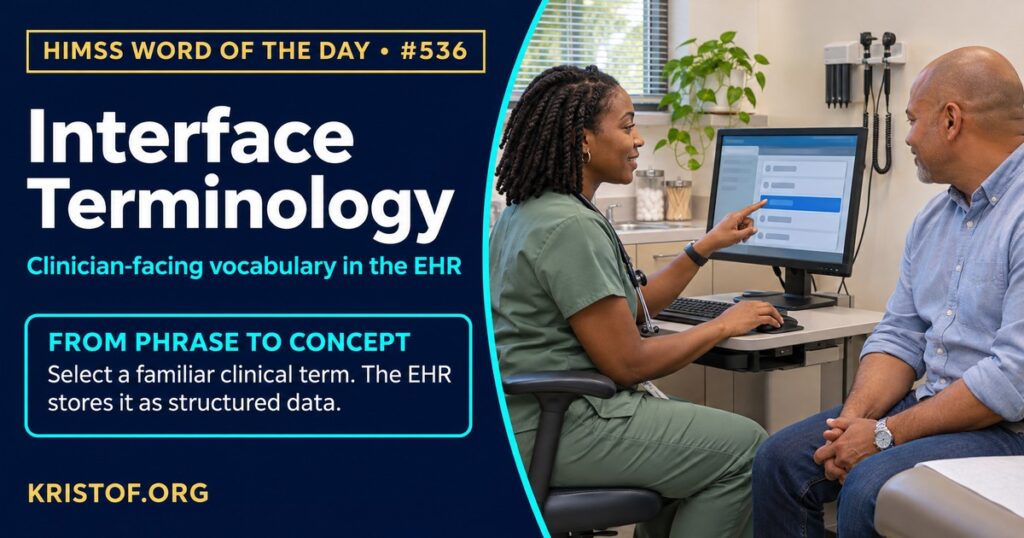
The idea is easiest to see at the point of documentation. A nurse or physician thinks in everyday clinical language, such as “shortness of breath when climbing stairs” or “left knee pain after a fall.” Software, though, needs defined data elements so it can search, trend, alert, and report. An interface terminology sits between the two. It offers phrases that feel natural to clinicians, such as the entries that appear in a diagnosis search box or a documentation pick-list, and it ties each phrase to a defined concept the system can work with.
Interface terminologies are one of several kinds of terminology tools. Schulz and colleagues (2017) distinguish three: interface terminologies, which represent the language used in a domain; reference terminologies such as SNOMED CT, which give context-free descriptions of classes of entities; and aggregation terminologies, which follow rules such as single hierarchies and disjoint classes. A classification such as ICD, which is commonly used for billing, fits the aggregation role. Each type serves a different purpose, which is why a simple one-to-one mapping between them is often not enough.
For health IT teams, the practical question is how local wording connects to the standards used for exchange and reporting. When EHR data are moved to a research warehouse or shared with another organization, the interface terms are usually transformed to standard codes. Every transformation is a chance to lose detail, so mapping quality shapes data quality.
| Terminology type | What it represents | Common example |
|---|---|---|
| Interface | Language clinicians use when entering data | Diagnosis pick-lists and search results |
| Reference | Context-free descriptions of concepts | SNOMED CT |
| Aggregation | Grouping for reporting and billing | ICD |
| Mapping | Link from one terminology to another | Local term to SNOMED CT or LOINC |
⚠️ Exam Alert: An interface terminology is the clinician-facing vocabulary used to enter data. A reference terminology such as SNOMED CT describes concepts for standard meaning and exchange. Do not confuse an interface terminology with a classification such as ICD (built for grouping and billing) or with a user interface (the screen itself).
🌐 Why It Matters: Real-World Healthcare IT Context
Evidence on interface terminologies comes mostly from implementation reports, mapping studies, and models for how terminologies fit together. Each source below was checked against its published abstract.
Rosenbloom and colleagues, in the Journal of the American Medical Informatics Association (2013), described a decade of effort to introduce an interface terminology called CHISL (Categorical Health Information Structured Lexicon) into practice at Vanderbilt University Medical Center, as part of a computer-based documentation application. Vanderbilt supports a range of documentation modes, from transcribed dictation to partial templates of free-form notes to strict structured data capture, and encourages clinicians to choose what they see as most appropriate for each situation. The authors report that CHISL occupies an important niche in that setting. They also report the challenges developers faced and observations about use. It is a single-institution experience report that does not review other work in the field.
Schulz and colleagues, in Studies in Health Technology and Informatics (2017), argued that unproductive competition among types of terminology should end. They say interface terminologies, which represent clinical jargon, must be linked to reference terminologies such as SNOMED CT to guarantee semantic interoperability, and that simple mappings between nodes are not enough because the three kinds of system represent different things. They propose a model for a better flow of standardized information across uses such as clinical research, epidemiology, care management, and reimbursement. It is a proposal, not a tested implementation.
Burrows and colleagues, in the AMIA Joint Summits on Translational Science Proceedings (2020), examined how diagnoses recorded with an interface terminology, Intelligent Medical Objects (IMO), were standardized for collaborative research. They compared a direct IMO-to-SNOMED CT crosswalk with a route through ICD-9-CM or ICD-10-CM followed by a UMLS mapping to SNOMED CT. For both ICD versions, only 24 to 27 percent of diagnosis codes mapped to the same SNOMED CT code that the direct crosswalk selected. The differences led to loss of granularity and laterality in the initial diagnosis. The study does not say which route is correct, only that the routes disagree.
Nikiema and colleagues, in JAMIA Open (2021), aligned the interface terminology of the Bordeaux university hospital laboratory (TLAB) to LOINC to make biological results easier to share and integrate. They found a small overlap between the words in TLAB and LOINC labels, yet 99.8 percent of TLAB entities were related to a LOINC analyte and 61.0 percent to a LOINC system. Among TLAB entities actually used in the hospital data warehouse, 55.4 percent were mapped to LOINC concepts. A manual review of all one-to-one mappings gave a precision of 0.59. The authors attribute the modest results partly to the poor quality of TLAB labels. The study is from one hospital.
Ranegger and colleagues, in Studies in Health Technology and Informatics (2024), mapped nursing interventions from the LEP Nursing interface terminology, which is widely used in Germany, Switzerland, and Austria, to SNOMED CT with support from the National Release Center Switzerland. The completed mapping covers 467 interventions from LEP Nursing Version 3.5.0, matched to pre-coordinated SNOMED CT procedures from the 2022-12-31 release. The work also led to 83 new submissions to the international SNOMED CT edition and seven to the Swiss extension. The authors plan to test the mapping for semantic interoperability in nursing practice, so its value in use is not yet reported.
Taken together, the sources show that interface terminologies serve clinicians well at the point of entry, that linking them to reference terminologies is necessary for exchange, and that mapping routes and label quality can change what the data finally say.
Common interface terminology problems:
- Local labels that are unclear, duplicated, or inconsistent
- Different mapping routes that give different standard codes
- Loss of detail such as granularity or laterality when terms are mapped
- Mappings that cover only part of the terms actually in use
- Free text that cannot be searched, counted, or used for alerts
- Specialty content, such as nursing interventions, that standards cover slowly
What supports effective interface terminologies:
- Clinician-friendly wording and search that match how people speak
- A clear link from each interface term to a reference concept
- Review of mappings by people who know both the clinical and the standard side
- Quality checks on local labels before mapping
- Governance that retires duplicates and manages requests for new terms
- Choice of documentation mode that fits the clinical situation
🏥 The Nurse’s Perspective: Clinical, Bedside, & Workflow
Nurses meet interface terminologies every time they search for a problem, pick a flowsheet row, or choose an intervention from a list, even though the term itself may never appear on the screen.
At the Bedside
Nurses document through pick-lists, search boxes, and flowsheet rows. When the available wording matches what was observed, entry is quick and the result is structured. When it does not, nurses may choose the closest phrase or write free text, and the detail may then be harder to find later. Reporting a missing or confusing term to the informatics team helps improve the list.
In Clinical Workflow
Nurse informaticists review local terms with terminology teams, point out duplicates, and flag gaps in nursing content. The mapping studies suggest why this work matters: a nursing intervention list is useful for exchange only if its terms are linked to a standard. Nurses with clinical expertise also help judge whether a mapped term still means what the bedside term meant.
In EHR Implementation (Go-Live Perspective)
During an Epic Go-Live, analysts at the elbow hear the same complaint in many forms: “I cannot find the diagnosis I want.” Each report is a clue about missing synonyms, search settings, or build choices. Capturing these reports and routing them to the terminology team lets the search list improve while the unit is still adapting.
🎓 CAHIMS / CPHIMS & HIMSS Perspective
CAHIMS Exam Domain Mapping
Interface terminologies connect clinical language, data standards, and governance:
| CAHIMS Domain | How Interface Terminology Appears |
|---|---|
| Healthcare & Technology Environments | Standards bodies, terminology services, and exchange needs |
| Clinical Informatics | Structured documentation, pick-lists, and clinical decision support inputs |
| Healthcare Information & Systems Management | Terminology mapping, ETL, data quality, and interfaces |
| Management & Leadership | Terminology governance, change requests, and clinician engagement |
Key Terms to Know Alongside Interface Terminology
- SNOMED CT — comprehensive clinical reference terminology for recording health information
- Reference Terminology — set of concepts with defined meanings, used to support consistent exchange
- ICD — classification of diseases used for statistics and billing
- LOINC — standard code system for laboratory and clinical observations
- Terminology Mapping — linking a term in one code system to the matching term in another
- Semantic Interoperability — exchange of data so that its meaning is preserved
HIMSS Organizational Position
HIMSS offers education and research on health information and technology topics through its Resource Center. Members can find related information on the HIMSS Resource Center page.
🧭 More HIMSS Word of The Day Terms
Related terms in the Interoperability and Standards series:
Browse all Interoperability and Standards terms or the A–Z glossary.
🔗 Explore Further: External References
- Rosenbloom et al. (2013), Journal of the American Medical Informatics Association — Implementing an interface terminology for structured clinical documentation https://pubmed.ncbi.nlm.nih.gov/23384817/
- Schulz et al. (2017), Studies in health technology and informatics — Interface Terminologies, Reference Terminologies and Aggregation Terminologies: A Strategy for Better Integration https://pubmed.ncbi.nlm.nih.gov/29295238/
- Burrows et al. (2020), AMIA Joint Summits on Translational Science proceedings — Standardizing Clinical Diagnoses: Evaluating Alternate Terminology Selection https://pubmed.ncbi.nlm.nih.gov/32477625/
- Nikiema et al. (2021), JAMIA open — Aligning an interface terminology to the Logical Observation Identifiers Names and Codes (LOINC) https://pubmed.ncbi.nlm.nih.gov/34131637/
- Ranegger et al. (2024), Studies in health technology and informatics — Semantic Interoperability of Nursing Data – Mapping an Interface Terminology to SNOMED CT https://pubmed.ncbi.nlm.nih.gov/39176619/
- HIMSS — Resource Center https://www.himss.org/resource-center
Term source: HIMSS Dictionary of Health Information and Technology Terms, Acronyms, and Organizations, 6th Edition (2025). All definitions in this series are paraphrased for editorial purposes. Readers are encouraged to consult the primary source for exact language.
Eric Andrew Kristof, RN, CAHIMS is a Healthcare IT professional and HIMSS Arkansas Chapter member based in Hot Springs Village, AR, with hands-on Epic Go-Live experience and a diverse healthcare and IT background. He writes at kristof.org at the intersection of clinical care and healthcare technology.
Leave a Reply