By Eric Andrew Kristof, RN, CAHIMS | Healthcare IT Professional | HIMSS Arkansas Chapter Member
About This Series: The HIMSS Word of The Day is a running blog series drawing from the HIMSS Dictionary of Health Information and Technology Terms, Acronyms, and Organizations, 6th Edition (2025) — the authoritative reference for healthcare IT professionals and the primary study resource for CAHIMS and CPHIMS certification. Each post paraphrases the term in plain language, grounds it in real-world healthcare IT context, and adds a bedside nursing perspective you won’t find in a textbook.
📖 The Term: CCMM (Continuity of Care Maturity Model)
Source: HIMSS Dictionary of Health Information and Technology Terms, Acronyms, and Organizations, 6th Edition (2025)
🔍 Plain-Language Definition
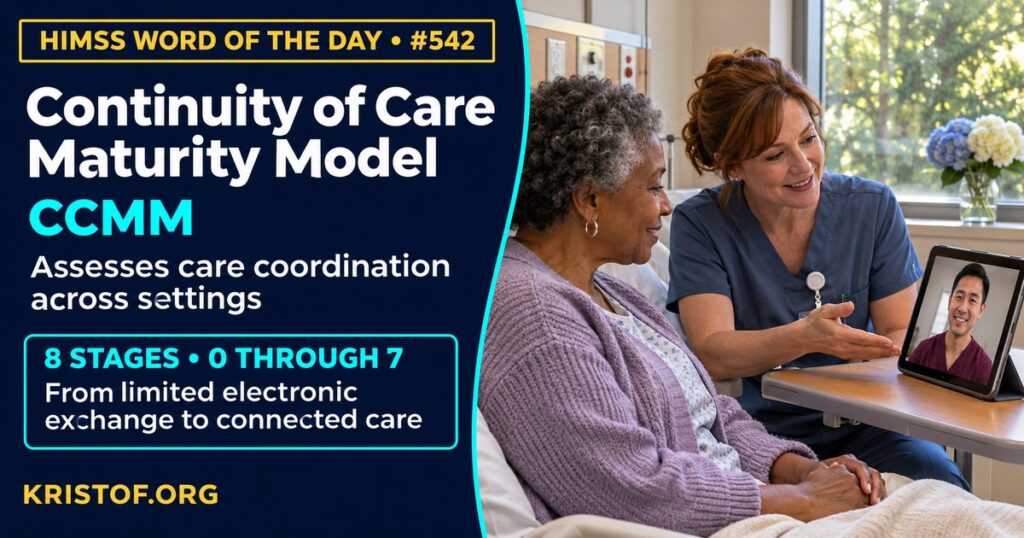
The HIMSS Dictionary describes the CCMM (Continuity of Care Maturity Model) as an eight-stage model, numbered 0 through 7, created by HIMSS Analytics. It shows how communication among clinicians in different settings can progress from little or no electronic exchange toward a connected, knowledge-driven network of care that spans many organizations. The Dictionary lists the alias “Continuity of Care Maturation Model,” and the literature also uses the shorthand CoCMM.
HIMSS describes the CCMM on its own site as a way to assess how an organization coordinates patient care across multiple sites, providers, and care settings. It places the model in a family of eight-stage models, each scored from Stage 0 to Stage 7, that also includes the Electronic Medical Record Adoption Model (EMRAM), the Analytics Maturity Assessment Model (AMAM), the Infrastructure Adoption Model (INFRAM), the Community Care Outcomes Maturity Model (C-COMM), and the Digital Imaging Adoption Model (DIAM). Where EMRAM looks inward at how a hospital uses its electronic record, the CCMM looks outward at how well information and responsibility move across the care continuum.
According to HIMSS, the model helps organizations assign responsibility for care coordination across leadership, clinicians, and technology teams. Its stages touch on compiling patient data from acute settings, external providers, and community care; building integrated care plans that follow multiple pathways; unifying longitudinal and financial data across sites; and letting patients give or withhold consent for providers to see their records. These are HIMSS’s own descriptions of what the model covers.
The stages, as HIMSS summarizes them, build on one another:
| Stage | HIMSS label | What HIMSS says it looks like |
|---|---|---|
| 0 | Limited or no e-communication | Data is isolated, and governance is informal and undocumented |
| 1 | Basic peer-to-peer data exchange | Few shared care plans outside the organization, basic alerts, some outside data in the record |
| 2 | Patient-centered clinical data using basic system-to-system exchange | Records open to internal care teams, limited EMR exchange, registries for all patients |
| 3 | Normalized patient record using structural interoperability | Clinical data integrated across entities, electronic referrals and consent, telemedicine |
| 4 | Care coordination based on actionable data | Shared care plans with task tracking, alerts, e-prescribing, all appropriate data open to the care team |
| 5 | Community-wide patient records using applied information | Community-wide records with integrated care plans and biosurveillance, patient data entry |
| 6 | Closed-loop care coordination across care team members | Dynamic records track closed-loop care delivery and multiple pathways, plus patient compliance |
| 7 | Knowledge-driven engagement for interconnected healthcare delivery | Fully coordinated care across settings, near real-time community records, aligned policies |
⚠️ Exam Alert: The CCMM rates how well care is coordinated across sites, providers, and settings. EMRAM rates how fully a hospital adopts and uses its electronic medical record. INFRAM rates infrastructure, AMAM rates analytics, and C-COMM rates community care outcomes. Do not confuse the CCMM with the Continuity of Care Document (CCD) or the Continuity of Care Record (CCR), which are document standards for summarizing a patient’s information, not maturity models.
🌐 Why It Matters: Real-World Healthcare IT Context
Care often breaks down at the edges, where a patient moves between a hospital, a clinic, a home health agency, and a long-term care facility. A maturity model gives an organization a common ladder for describing where it stands and what to build next. Direct research on the CCMM itself is thin, so the sources below include studies of the related EMRAM model and a review of maturity models in general. Each was checked against its published abstract, and the type of study is noted.
Model description. The HIMSS pages describe the stages and the areas of care coordination the model covers. They are promotional and descriptive, not independent evaluations, and they do not report outcome data for CCMM stages. One quote on the CCMM page, from a health CIO at the Government of Jersey, says the island completed the first national assessment using the model and that it showed clear opportunities to improve coordination. That is HIMSS’s published testimonial, not a study.
A direct application. Liu and colleagues, in Studies in Health Technology and Informatics (2025), described “Life Concerto,” an AI-enabled platform for communication among caregivers, health care providers, and family members in Taiwan. They say the CCMM highlights integrated, patient-centered care, yet fragmented communication, weak data integration, and a lack of real-time records persist in Taiwan. The platform used a BERT-based natural language processing system to classify keywords and messages, supported by expert-curated decision support algorithms. The pilot included 897 chat rooms and more than 2,167 users across 35 institutions, covering long-term care, home-based acute care, and dementia care. The authors report an interaction frequency of 5.5 times per week between patients and care teams, which they describe as significantly higher than traditional care, and a 66.4 percent reduction in dementia visit times. They also report that the platform reached CCMM Level 7. The abstract does not explain how those measures or the Level 7 assessment were carried out. This is a pilot report from the platform’s developers, and the authors name training requirements and resistance to change as barriers.
A sibling model and patient experience. Snowdon and colleagues, in the Journal of Patient Experience (2024), used HIMSS EMRAM data to measure digital maturity and HCAHPS survey data to measure patient experience in US hospitals. In their cross-sectional analysis, higher digital maturity was associated with stronger patient experience results, particularly for communication with nurses and doctors and communication about medicines and therapies. They also found differences between teaching and nonteaching hospitals and between urban and rural hospitals. This is an association, not proof that maturity caused better experience, and it concerns EMRAM rather than the CCMM.
A sibling model and performance. Remus and colleagues, in the Journal of Medical Internet Research (2026), linked EMRAM Stage 6 or 7 status to annual report data for 66 to 74 Dutch hospitals per year from 2017 to 2023, with up to 498 hospital-year observations. After adjusting for multiple testing, advanced digital maturity was not significantly associated with financial, operational, or workforce indicators. The authors conclude that technical maturity is necessary but not sufficient for performance gains. The setting was a highly digitalized health system, and the study again concerns EMRAM.
Maturity models in context. Mehta and colleagues, in BMC Health Services Research (2026), conducted a scoping review of 38 sources to map digital health maturity models and accreditation-linked standards. They identified HIMSS EMRAM among the prominent international frameworks, alongside NHS England’s What Good Looks Like, the WHO-PAHO IS4H framework, Joint Commission International standards, and Australian models. In comparing India’s draft digital health standards against these frameworks, they noted limited coverage of granular interoperability maturity assessment, among other gaps. The review’s focus was India’s standards, not the CCMM.
Taken together, the sources suggest that maturity models are widely used as planning tools, that the evidence tying stages to outcomes is mixed, and that evidence about the CCMM specifically is limited to a small number of reports.
Common CCMM problems:
- Treating the stage number as a quality score rather than a description of capability
- Assuming results from EMRAM studies apply to the CCMM
- Scoring technology while leaving governance, consent, and responsibility for coordination undefined
- Counting data exchange that exists on paper but is not used by clinicians
- Overlooking community partners, such as home health and long-term care, that hold part of the record
- Chasing a stage for its own sake without a clinical or operational goal
What supports CCMM progress:
- Clear owners for care coordination across leadership, clinicians, and technology teams
- Shared care plans that can be updated by every team member
- Structured, normalized data that outside partners can use
- Documented patient consent and a way for patients to see who has access
- Regular reassessment tied to specific goals and measures
- Honest reporting of results, including when higher maturity does not change outcomes
🏥 The Nurse’s Perspective: Clinical, Bedside, & Workflow
Nurses are often the first to notice a gap in continuity, because they see what arrives with the patient and what does not.
At the Bedside
Nurses on admission review what came from the previous setting, ask the patient and family what is missing, and call the sending facility when the record is incomplete. At discharge, they prepare the information that the next setting needs, such as medication changes, wound care, and follow-up appointments. When outside data is available in the record, they spend less time reconstructing history. When it is not, the same questions get asked again.
In Clinical Workflow
Care coordination is a shared task among nurses, case managers, social workers, physicians, pharmacists, and community partners. Nurse informaticists contribute to the CCMM conversation by describing how referrals, shared care plans, and consent are actually used on the unit. They flag steps where information leaves the record and moves by phone, fax, or paper, since those steps show where a stage description and daily practice differ.
In EHR Implementation (Go-Live Perspective)
During an Epic Go-Live, analysts at the elbow hear how well outside information is reaching the people who need it. They see where outside records are hard to find, where reconciliation takes too many clicks, and where consent or access questions stop a task. They log these issues with the clinical context, which gives the project team concrete examples when it decides what to improve next.
🎓 CAHIMS / CPHIMS & HIMSS Perspective
CAHIMS Exam Domain Mapping
The CCMM connects coordination, exchange, and governance:
| CAHIMS Domain | How the CCMM Appears |
|---|---|
| Healthcare & Technology Environments | Care settings, the care continuum, and the HIMSS maturity model family |
| Clinical Informatics | Shared care plans, care transitions, and patient data use at the point of care |
| Healthcare Information & Systems Management | Data exchange, normalization, consent management, and assessment methods |
| Management & Leadership | Ownership of care coordination, goal setting, and reporting results |
Key Terms to Know Alongside the CCMM
- EMRAM (Electronic Medical Record Adoption Model) — HIMSS model that rates hospital adoption and use of the electronic medical record
- Care Coordination — deliberate organization of patient care activities among those involved in a patient’s care
- Care Transition — movement of a patient between settings or levels of care
- Health Information Exchange (HIE) — electronic sharing of health information among organizations
- Interoperability — ability of systems to exchange and use information
- Patient Consent — a patient’s permission, or refusal, for providers to access or share the record
HIMSS Organizational Position
HIMSS offers education and research on health information and technology topics through its Resource Center. Members can find related information on the HIMSS Resource Center page.
🧭 More HIMSS Word of The Day Terms
Related terms in the Interoperability and Standards series:
- Fast Healthcare Interoperability Resources (FHIR)
- HIO (Health Information Organization)
- Direct Project (Direct Secure Messaging)
- Integration
Browse all Interoperability and Standards terms or the A–Z glossary.
🔗 Explore Further: External References
- HIMSS — Continuity of Care Maturity Model (CCMM) https://www.himss.org/maturity-models/ccmm
- HIMSS — Digital Transformation Maturity Models https://www.himss.org/maturity-models
- Liu et al. (2025), Studies in health technology and informatics — Transforming Geriatric Care: A HIMSS Level 7 Model for Holistic Patient-Centered Service Delivery (® Life Concerto) https://pubmed.ncbi.nlm.nih.gov/40776004/
- Snowdon et al. (2024), Journal of patient experience — Digital Maturity as a Strategy for Advancing Patient Experience in US Hospitals https://pubmed.ncbi.nlm.nih.gov/38361832/
- Remus et al. (2026), Journal of medical Internet research — Impact of Digitalization on Performance of Dutch Hospitals: Longitudinal Quantitative Study https://pubmed.ncbi.nlm.nih.gov/42809839/
- Mehta et al. (2026), BMC health services research — Mapping digital health maturity models and accreditation-linked standards: a scoping review to position the National Accreditation Board for Hospitals & Healthcare Providers (NABH) digital health standards of India https://pubmed.ncbi.nlm.nih.gov/41814351/
- HIMSS — Resource Center https://www.himss.org/resource-center
Term source: HIMSS Dictionary of Health Information and Technology Terms, Acronyms, and Organizations, 6th Edition (2025). All definitions in this series are paraphrased for editorial purposes. Readers are encouraged to consult the primary source for exact language.
Eric Andrew Kristof, RN, CAHIMS is a Healthcare IT professional and HIMSS Arkansas Chapter member based in Hot Springs Village, AR, with hands-on Epic Go-Live experience and a diverse healthcare and IT background. He writes at kristof.org at the intersection of clinical care and healthcare technology.
Leave a Reply