By Eric Andrew Kristof, RN, CAHIMS | Healthcare IT Professional | HIMSS Arkansas Chapter Member
About This Series: The HIMSS Word of the Day is a running blog series drawing from the HIMSS Dictionary of Health Information and Technology Terms, Acronyms, and Organizations, 6th Edition (2025) — the authoritative reference for healthcare IT professionals and the primary study resource for CAHIMS and CPHIMS certification. Each post paraphrases the term in plain language, grounds it in real-world healthcare IT context, and adds a bedside nursing perspective you won’t find in a textbook.
📖 The Term: Integrating the Healthcare Enterprise (IHE)
Source: HIMSS Dictionary of Health Information and Technology Terms, Acronyms, and Organizations, 6th Edition (2025)
🔍 Plain-Language Definition
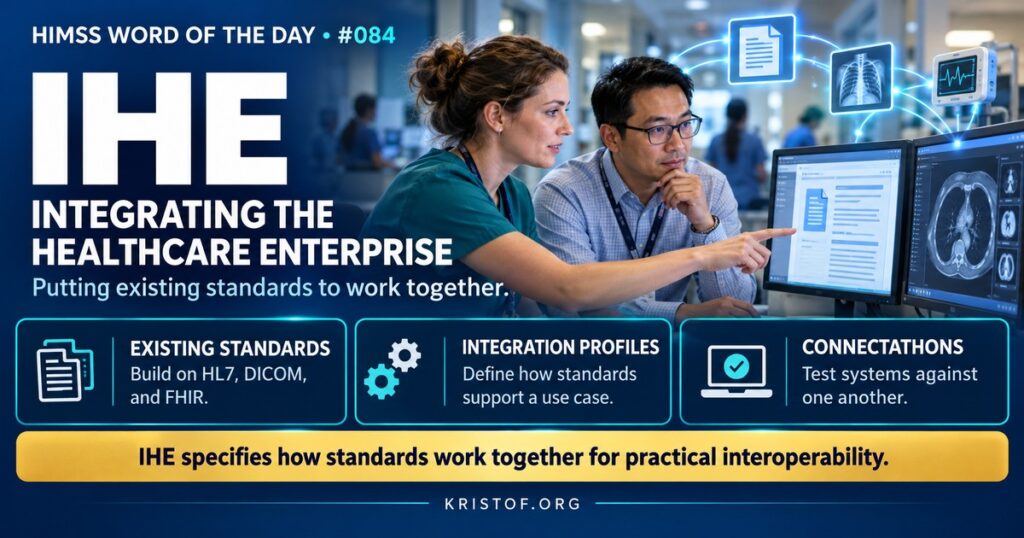
Integrating the Healthcare Enterprise (IHE) is an international initiative in which clinicians, health IT users, and vendors work together to make systems share information reliably. IHE does not create new base standards. Instead, it writes detailed specifications, called integration profiles, that explain how existing standards should be combined to solve specific clinical and operational problems.
The HIMSS Dictionary describes IHE as a joint effort of clinicians and industry to make healthcare computer systems better at sharing information. It explains that IHE encourages organizations to apply existing standards, DICOM and HL7 among them, together and consistently to meet specific clinical needs, and that systems built according to IHE communicate better, are easier to implement, and help care providers use information more effectively.
IHE was launched in 1998 by HIMSS and the Radiological Society of North America (RSNA), which is why many of its earliest profiles focus on radiology workflow.
| IHE Building Block | What It Is | Example |
|---|---|---|
| Domain | A clinical or technical area with its own committees | Radiology, IT Infrastructure, Patient Care Coordination, Laboratory, Cardiology |
| Integration Profile | A specification describing a use case and how standards are combined to support it | XDS for cross-enterprise document sharing |
| Actor | A system role within a profile | Document Source, Document Registry, Document Consumer |
| Transaction | A defined exchange between actors using specific standards | Registering a document’s metadata in a registry |
| Technical Framework | The published collection of profiles, actors, and transactions for a domain | IT Infrastructure Technical Framework |
| Connectathon | A testing event where vendors test their products against each other | Multiple EHR and HIE vendors exchanging documents in live tests |
⚠️ Exam Alert: HL7 and DICOM are standards. IHE publishes integration profiles that specify how to use those standards together for a use case. A vendor’s IHE Integration Statement declares which profiles and actors a product supports. The Connectathon is where implementations are tested against each other. If a question asks which organization coordinates the use of existing standards rather than creating them, the answer is IHE.
🌐 Why It Matters: Real-World Healthcare IT Context
Standards leave room for interpretation. Two systems can both claim to support HL7 or DICOM and still fail to exchange information correctly, because they made different choices about optional fields, codes, or sequences. IHE profiles narrow those choices, describing exactly what each system must send, receive, and do in a particular scenario.
Several IHE profiles underpin health information exchange. Cross-Enterprise Document Sharing (XDS) and Cross-Community Access (XCA) support sharing clinical documents across organizations and communities. Patient Identifier Cross-referencing (PIX) and Patient Demographics Query (PDQ) help systems find and link patient identities. Audit Trail and Node Authentication (ATNA) defines security auditing and authentication between systems. Many health information exchange networks and national programs use these profiles.
Imaging remains a core area. Radiology profiles such as Scheduled Workflow coordinate orders, worklists, image acquisition, and reporting across RIS, PACS, and modalities, and imaging sharing profiles support exchanging studies between organizations.
IHE has expanded into FHIR as well, publishing profiles that use FHIR for mobile and web-based access to documents, patient identity, and other services.
Profiles also support patient safety and security. Consistent identity cross-referencing reduces the chance that a document attaches to the wrong patient, and audit profiles create records of who accessed or exchanged data across organizations. When exchange networks require these capabilities, IHE profiles often provide the specification.
The Connectathon is IHE’s testing engine. Vendors bring their systems and test them against other vendors’ systems using IHE profiles, with monitors verifying results. Successful testing gives buyers more confidence that products will work together in practice.
Common IHE-related challenges:
- Purchasing products without specifying required IHE profiles
- Assuming an integration statement guarantees seamless integration
- Local customizations that drift from the profile
- Limited staff familiarity with profile details
- Profiles implemented partially or with optional features omitted
- Keeping up with new FHIR-based profiles
Participation is open. Healthcare organizations, vendors, and individuals can join IHE committees, comment on draft profiles, and propose new work, which helps keep profiles grounded in real clinical needs. National deployment committees support adoption in specific countries.
How organizations benefit from IHE:
- Requiring specific profiles and actors in procurement
- Reviewing vendors’ integration statements and Connectathon results
- Using profiles as the starting point for interface specifications
- Participating in national exchange networks built on IHE profiles
- Reducing custom interface work and long-term maintenance
- Building on proven patterns for imaging and document exchange
🏥 The Nurse’s Perspective: Clinical, Bedside, & Workflow
Nurses do not work with IHE profiles directly, but IHE shapes how information reaches them from other systems and organizations.
At the Bedside
When a nurse opens outside records from another hospital, views a prior imaging study from a different facility, or sees a discharge summary that arrived from a referring practice, IHE profiles often sit underneath that exchange. Profiles for document sharing and patient identity help make sure the right documents attach to the right patient.
Imaging workflows also rely on IHE. When an imaging order flows to the radiology system, appears on the scanner’s worklist, and links the resulting images back to the order, IHE radiology profiles help coordinate those steps across vendors.
Medication administration and pump integration have IHE work as well, describing how infusion orders can be sent to pumps and how pump data returns to the record, which can reduce manual programming steps at the bedside.
In Clinical Workflow
Patient care devices are another IHE domain. Profiles for device data communication help monitors, pumps, and other equipment send information to clinical systems in consistent ways, supporting device integration that reduces manual transcription for nurses.
When outside information is missing or attached to the wrong patient, the underlying cause may be an identity or exchange issue rather than a user error. Reporting these problems helps integration and HIE teams investigate.
In EHR Implementation (Go-Live Perspective)
During an Epic implementation, connections to health information exchanges, national networks, imaging systems, and devices often rely on IHE profiles. Integration teams configure and test these connections, verifying that documents, identities, and images flow correctly.
At-the-elbow support analysts may hear that outside records or prior images are missing after Go-Live. Capturing the patient, the expected source, and the type of information helps integration teams determine whether a query, identity match, or configuration issue is responsible.
🎓 CAHIMS / CPHIMS & HIMSS Perspective
CAHIMS Exam Domain Mapping
IHE is a classic interoperability topic on the CAHIMS exam:
| CAHIMS Domain | How IHE Appears |
|---|---|
| Healthcare & Technology Environments | Standards organizations; HIMSS and RSNA roles; national exchange infrastructure |
| Clinical Informatics | Outside records and images in clinical workflow; device integration |
| Healthcare Information & Systems Management | Integration profiles, actors, transactions, Connectathons, integration statements |
| Management & Leadership | Procurement requirements, vendor evaluation, interoperability strategy |
Key Terms to Know Alongside IHE
- Integration Profile — an IHE specification describing how standards are used together for a specific use case
- Technical Framework — the published set of IHE profiles, actors, and transactions for a domain
- Connectathon — an IHE testing event where vendors verify interoperability with one another
- XDS (Cross-Enterprise Document Sharing) — an IHE profile for sharing clinical documents across organizations
- PIX and PDQ — IHE profiles for cross-referencing patient identifiers and querying patient demographics
- Integration Statement — a vendor document listing the IHE profiles and actors a product supports
HIMSS Organizational Position
HIMSS cofounded IHE with RSNA in 1998 and continues to support it as a key mechanism for turning standards into practical interoperability. Members can find related education and research through the HIMSS Resource Center.
🔗 Explore Further: External References
- IHE International — About IHE https://www.ihe.net/about_ihe/
- IHE International — Profiles https://www.ihe.net/resources/profiles/
- IHE Profiles (Published Specifications) https://profiles.ihe.net/
- IHE International — Radiology Domain https://www.ihe.net/ihe_domains/radiology/
- HL7 International — Homepage https://www.hl7.org/
- DICOM Standard — About DICOM https://www.dicomstandard.org/about
Term source: HIMSS Dictionary of Health Information and Technology Terms, Acronyms, and Organizations, 6th Edition (2025). All definitions in this series are paraphrased for editorial purposes. Readers are encouraged to consult the primary source for exact language.
Eric Andrew Kristof, RN, CAHIMS is a Healthcare IT professional and HIMSS Arkansas Chapter member based in Hot Springs Village, AR, with hands-on Epic Go-Live experience and a diverse healthcare and IT background. He writes at kristof.org at the intersection of clinical care and healthcare technology.
Leave a Reply