By Eric Andrew Kristof, RN, CAHIMS | Healthcare IT Professional | HIMSS Arkansas Chapter Member
About This Series: The HIMSS Word of The Day is a running blog series drawing from the HIMSS Dictionary of Health Information and Technology Terms, Acronyms, and Organizations, 6th Edition (2025) — the authoritative reference for healthcare IT professionals and the primary study resource for CAHIMS and CPHIMS certification. Each post paraphrases the term in plain language, grounds it in real-world healthcare IT context, and adds a bedside nursing perspective you won’t find in a textbook.
📖 The Term: Biosurveillance
Source: HIMSS Dictionary of Health Information and Technology Terms, Acronyms, and Organizations, 6th Edition (2025)
🔍 Plain-Language Definition
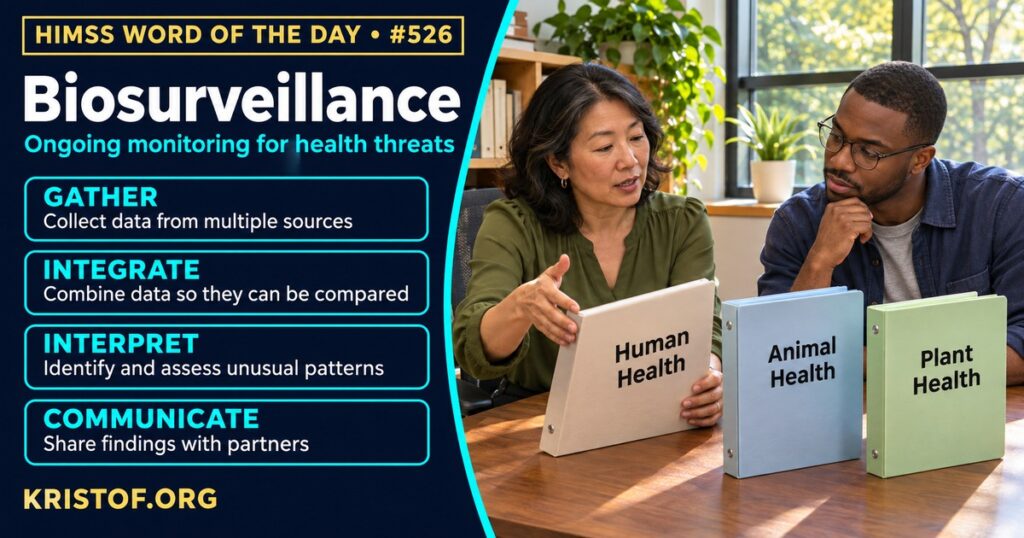
The HIMSS Dictionary defines biosurveillance as a cycle of collecting, combining, interpreting, and sharing information that bears on disease activity and on threats to the health of people, animals, or plants. It spans a wide range of activities, from standard epidemiologic practice to advanced technology systems that use complex algorithms.
The definition has four verbs worth noticing. Gathering means collecting data from clinics, laboratories, emergency departments, pharmacies, animal health programs, and other sources. Integrating means bringing those sources together so that they can be compared. Interpreting means deciding what a pattern means and whether it is unusual. Communicating means getting the right information to the people who must act. A system that stops at the first step has data but not surveillance.
Health information technology feeds each step. Electronic health records supply diagnosis codes, notes, orders, and results. Laboratory systems report test results. Public health agencies receive electronic case reports and run detection algorithms. Newer methods apply natural language processing to clinical notes, and sampling programs use leftover clinical specimens to learn what substances or pathogens are circulating. The “human, animal, or plant” wording signals a One Health view in which threats are tracked across species and environments.
Biosurveillance overlaps with outbreak management, which is the information work once a specific outbreak is under investigation, and with syndromic surveillance, which watches symptom patterns before diagnoses are confirmed. Biosurveillance is the broader, always-on function.
| Step | What happens |
|---|---|
| Gather | Collect data from clinical, laboratory, and other sources |
| Integrate | Combine and standardize sources so they can be compared |
| Interpret | Detect unusual patterns and judge what they mean |
| Communicate | Share findings with decision makers and partners |
⚠️ Exam Alert: Biosurveillance is the gathering, integrating, interpreting, and communicating of information that signals disease activity or health threats in people, animals, or plants. It is ongoing monitoring, while outbreak management is the response data work for a specific event. Do not confuse it with cybersecurity surveillance, which monitors networks, or with biometrics, which identifies people by body traits.
🌐 Why It Matters: Real-World Healthcare IT Context
Studies of biosurveillance show how new data sources and methods are being tested and where practical barriers remain. Each source below was checked against its published abstract.
McMurry and colleagues, in the Journal of Medical Internet Research (2024), tested an AI-based natural language processing pipeline for detecting COVID-19 symptoms in physician notes from a pediatric emergency department. The retrospective cohort covered 85,678 ED encounters from March 2020 to May 2022, including 4 percent (3,420) with COVID-19. Three experts labeled 226 notes as a gold standard. NLP identified encounters with any of the COVID-19 symptoms more accurately (F1-score 0.796) than ICD-10 codes (F1-score 0.451). The study came from a single children’s hospital and focused on one disease, so results may not carry over to other settings or conditions.
Callahan and colleagues, in Military Medicine (2026), explored a large language model-based topic modeling tool, TopicGPT, to find themes in clinical notes about emerging pathogens. They processed 1,841 documents from Veterans Affairs records, sampled across cohorts that included outbreak-related notes for Zika, leptospirosis, COVID-19, and mpox. The most frequent topic category in each cohort was “Infectious Disease,” and expert review found that 61.5 percent of sampled topics were appropriately represented. The authors note the method needs optimization before it can provide timely analysis of high-volume documents. It is an exploratory evaluation.
Kang and colleagues, in Health Security (2023), assessed the readiness of government agencies in South Korea for an integrated biosurveillance system. They invited 100 officials, and 34 responded (a 34.0 percent response rate). Information sharing between agencies was frequent, but the type of information shared and stored differed, and sharing mostly concerned prevention activities, with no respondents reporting sharing of recovery-related information. The authors call an agency-integrated biosurveillance system crucial for pandemic preparedness. The response rate and sample are small, so the survey gives a snapshot.
Wiens and colleagues, in Public Health Reports (2021), described a Minnesota pilot that collected near-real-time data on emergency department visits for drug overdose and substance misuse and tested leftover clinical specimens for more than 250 drugs or metabolites. Specimens from six EDs represented 239 clinical encounters. Methamphetamine was detected in 67.4 percent of encounters but suspected in only 45.6 percent. At least one opioid was detected in 42.5 percent but suspected in 29.7 percent, and 44.4 percent of encounters had more than one substance detected. The authors conclude that ED surveillance enhanced by toxicology testing can provide local situational awareness.
Bates and colleagues, in Public Health Reports (2025), piloted nonfatal overdose biosurveillance using residual urine specimens from emergency department patients at two Wisconsin hospitals from August 2022 to February 2024. Of 79 patients, 72 percent had polysubstance use, 48 percent had substance use disorder, and 43 percent had a mental health history. Synthetic opioids were positively associated with a history of overdose (odds ratio 3.86). The pilot is small, so the associations are preliminary.
Taken together, these studies show that biosurveillance depends on more than collecting data. Method choice, specimen availability, and agreements for information sharing all shape what can be seen and how quickly.
Common biosurveillance problems:
- Reliance on coded data that misses symptoms recorded only in notes
- Differences in what agencies share, store, and call a case
- Delays between a signal and action
- Limited laboratory capacity or specimen access
- Privacy and consent questions around specimens and notes
- Methods that are promising but not yet validated at scale
What supports effective biosurveillance:
- Combining structured data with text analysis, with expert checks
- Agreed data standards and sharing across agencies and sectors
- Clear case definitions that can be updated as threats change
- Laboratory testing to confirm what clinicians suspect
- Clear communication paths from analysts to decision makers
- Governance for privacy, security, and ethical use
🏥 The Nurse’s Perspective: Clinical, Bedside, & Workflow
Nurses contribute to biosurveillance every day through what they ask, observe, and document, even when they never see the surveillance system.
At the Bedside
Accurate documentation of symptoms, travel and exposure history, vaccination status, and test collection gives surveillance systems data they can use. Unusual patterns, such as several patients with the same complaint, are often noticed at the bedside before they appear in a report. Specimen collection and labeling done well keep laboratory data trustworthy.
In Clinical Workflow
Nurse informaticists help shape how symptoms and exposures are captured so that they are structured when possible and clear when entered as text. They work with infection prevention, laboratory, and public health teams on reportable condition workflows. Staff who understand why a field matters are more likely to complete it consistently.
In EHR Implementation (Go-Live Perspective)
During an Epic Go-Live, analysts at the elbow can see whether screening questions and exposure fields are placed where nurses naturally record them. Fields that are hard to find or duplicate other documentation may be skipped, leaving gaps in the data that surveillance depends on. Adjusting placement early helps both care and public health reporting.
🎓 CAHIMS / CPHIMS & HIMSS Perspective
CAHIMS Exam Domain Mapping
Biosurveillance connects public health, data, and clinical documentation:
| CAHIMS Domain | How Biosurveillance Appears |
|---|---|
| Healthcare & Technology Environments | Public health agencies, reporting, and health security |
| Clinical Informatics | Case definitions, NLP, and structured symptom capture |
| Healthcare Information & Systems Management | Data integration, standards, privacy, and security |
| Management & Leadership | Preparedness planning, partnerships, and governance |
Key Terms to Know Alongside Biosurveillance
- Outbreak Management — capture and handling of information during an outbreak investigation and response
- Syndromic Surveillance — monitoring symptom patterns to detect events before confirmation
- Natural Language Processing — computer analysis of human language in text
- Case Definition — criteria used to decide who counts as a case
- Reportable Condition — disease or event that providers must report to public health authorities
- One Health — approach that links human, animal, and environmental health
HIMSS Organizational Position
HIMSS offers education and research on health information and technology topics through its Resource Center. Members can find related information on the HIMSS Resource Center page.
🧭 More HIMSS Word of The Day Terms
Related terms in the Data and Analytics series:
Browse all Data and Analytics terms or the A–Z glossary.
🔗 Explore Further: External References
- McMurry et al. (2024), Journal of medical Internet research — Moving Biosurveillance Beyond Coded Data Using AI for Symptom Detection From Physician Notes: Retrospective Cohort Study https://pubmed.ncbi.nlm.nih.gov/38573752/
- Callahan et al. (2026), Military medicine — Exploring TopicGPT for Identification of Themes of Emerging Pathogens in Biosurveillance Data https://pubmed.ncbi.nlm.nih.gov/42560256/
- Kang et al. (2023), Health security — Required Elements for an Integrated Biosurveillance Platform: A Capacity and Needs Assessment of the Central Government in the Republic of Korea https://pubmed.ncbi.nlm.nih.gov/36888540/
- Wiens et al. (2021), Public health reports — Biosurveillance of Drug Overdoses and Substance Misuse Treated in Selected Emergency Departments in Minnesota, 2017-2020 https://pubmed.ncbi.nlm.nih.gov/34726980/
- Bates et al. (2025), Public health reports — Nonfatal Overdose Biosurveillance: A Cross-Sectional Pilot Study https://pubmed.ncbi.nlm.nih.gov/40937595/
- HIMSS — Resource Center https://www.himss.org/resource-center
Term source: HIMSS Dictionary of Health Information and Technology Terms, Acronyms, and Organizations, 6th Edition (2025). All definitions in this series are paraphrased for editorial purposes. Readers are encouraged to consult the primary source for exact language.
Eric Andrew Kristof, RN, CAHIMS is a Healthcare IT professional and HIMSS Arkansas Chapter member based in Hot Springs Village, AR, with hands-on Epic Go-Live experience and a diverse healthcare and IT background. He writes at kristof.org at the intersection of clinical care and healthcare technology.
Leave a Reply