By Eric Andrew Kristof, RN, CAHIMS | Healthcare IT Professional | HIMSS Arkansas Chapter Member
About This Series: The HIMSS Word of The Day is a running blog series drawing from the HIMSS Dictionary of Health Information and Technology Terms, Acronyms, and Organizations, 6th Edition (2025) — the authoritative reference for healthcare IT professionals and the primary study resource for CAHIMS and CPHIMS certification. Each post paraphrases the term in plain language, grounds it in real-world healthcare IT context, and adds a bedside nursing perspective you won’t find in a textbook.
📖 The Term: BRFSS (Behavioral Risk Factor Surveillance System)
Source: HIMSS Dictionary of Health Information and Technology Terms, Acronyms, and Organizations, 6th Edition (2025)
🔍 Plain-Language Definition
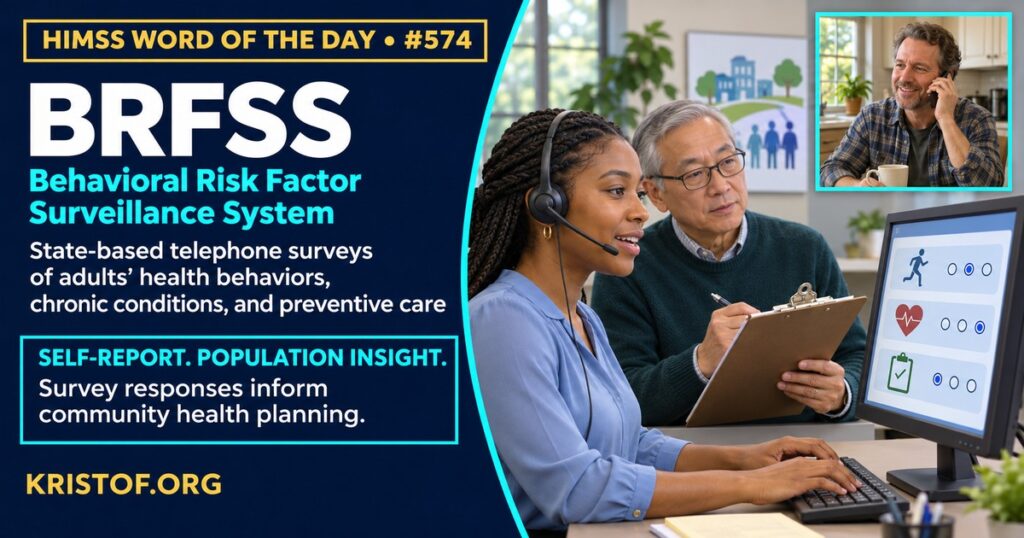
The HIMSS Dictionary describes the Behavioral Risk Factor Surveillance System (BRFSS) as a system of state telephone surveys that asks U.S. adults about the behaviors that put their health at risk, the chronic illnesses they report, and whether they use preventive care. The entry says it began in 1984 with 15 states and now collects data in all 50 states, the District of Columbia, and three U.S. territories. CDC’s own BRFSS page matches that description and adds that the system gathers more than 400,000 adult interviews per year.
In practice, state and territorial health departments run the surveys with technical help from CDC. Interviewers use a standard core questionnaire that every state asks, optional modules, and questions that individual states add. Since 2011, the surveys have included both landline and cell phone interviews, which CDC’s data quality reports describe as standard protocol.
| Related term | How it relates to BRFSS |
|---|---|
| Public health surveillance | Ongoing collection and use of population health data, the purpose BRFSS serves |
| Self-reported data | Information respondents give about themselves, not measured by an examiner |
| Core questionnaire | The standard question set asked in every participating state |
| Optional module | A set of extra questions that states may choose to add |
| Weighting | Statistical adjustment so survey results reflect the adult population |
The table is a teaching sketch and not an official taxonomy.
⚠️ Exam Alert: BRFSS is a survey, not an EHR feed, a claims database, or a registry. Its data are self-reported and state-based, collected by telephone from a sample of adults, so they describe populations and cannot be linked to an individual patient chart. It also differs from surveys that include physical examination, such as the National Health and Nutrition Examination Survey (NHANES), where measurements are taken instead of reported. The word “surveillance” in the name refers to ongoing population monitoring.
🌐 Why It Matters: Real-World Healthcare IT Context
BRFSS matters to health IT because many analytics projects borrow its prevalence figures as a benchmark. The PubMed searches run for this post found published work on its validity, its methods, and its optional modules. Each article was checked against its published abstract, and the study type is noted. CDC statements are labeled as CDC’s own.
Does self-report hold up? Pierannunzi and colleagues, in BMC Medical Research Methodology (2013), reviewed publications from 2004 through 2011 that tested the reliability and validity of BRFSS measures and rated each one against a rubric. They concluded that BRFSS prevalence rates were comparable to those of other national surveys that rely on self-report, but less similar to surveys that add physical measures. The authors noted that research was sparse for some health topics, and that question and mode differences limited the comparisons. This was a review of studies up to 2011, so it predates the methods used in later years.
A concrete example of bias. Zhao and colleagues, in Preventing Chronic Disease (2023), adjusted self-reported body mass index from the 2020 BRFSS using measured data from NHANES and a validated bias-correction method. Self-report put the prevalence of severe obesity at 5.3 percent, while the bias-corrected estimate was 8.8 percent, an underestimate of about 40 percent by the authors’ calculation. State-level bias-corrected estimates ranged from 5.5 percent to 13.2 percent. This is one measure in one year, and the correction itself relies on modeling assumptions.
Nonresponse to a sensitive module. Hsia and Town, in AJPM Focus (2025), examined the optional social determinants and health equity module introduced in 2022. Some respondents who completed the core survey did not answer any module questions, and the highest nonresponse rates were in Florida (29.3 percent), California (26.4 percent), and New Jersey (25.6 percent). The authors built state-level adjustment factors to reduce the resulting bias. The study covered 2022 data from the states that used the module.
What CDC says about a methods change. In a 2012 Morbidity and Mortality Weekly Report article, Pierannunzi and colleagues described the 2011 changes: adding cell phone-only households and replacing poststratification weighting with raking. The authors expected estimates for some indicators of poor health and risky behavior to rise in most states, with the size of the change varying by question and state, and warned that comparisons across the change could show differences that come from the method and not from real changes in behavior.
Response rates. CDC’s 2025 Summary Data Quality Report lists a median response rate of 43.3 percent across states and territories. This is CDC’s own figure, and the report explains how it was calculated.
Common BRFSS problems:
- Self-report bias, as the BMI example shows for severe obesity
- A 2025 median response rate of 43.3 percent, which means many sampled people do not respond
- A trend break at 2011, when cell phone sampling and raking weighting were introduced
- Item nonresponse in optional modules, such as the 2022 social determinants module
- Optional modules and state-added questions that differ by state, which can limit cross-state comparison
- Treating a population survey as if it were clinical or EHR data
What supports using BRFSS well:
- A standard core questionnaire asked in every participating state
- Annual CDC data quality reports that document response rates and methods
- A dual-frame design with landline and cell phone samples since 2011
- A published literature on validity, with the 2013 review finding comparability to other self-report surveys
- Weighting and published adjustment methods that analysts can apply
- State-level estimates that local health agencies and health systems can use for planning
🏥 The Nurse’s Perspective: Clinical, Bedside, & Workflow
For nurses, BRFSS shows up in community health planning and in public health and population health work.
At the Bedside
BRFSS does not change bedside documentation, but its topics are familiar ones: smoking, alcohol use, physical activity, chronic conditions, and preventive services such as screening. Nurses who counsel patients on those topics are working on the same behaviors the survey tracks in the population. A patient’s answer to a screening question in a chart is a different kind of data from a survey response given by telephone.
In Clinical Workflow
Nurses in public health, population health, and quality roles may use state BRFSS estimates for program planning, grant applications, and community needs assessments. Two habits help. Check which year and which weighting a figure comes from, because the 2011 change affects trend comparisons. Also check whether a number is self-reported before comparing it with measured clinic data, since the severe obesity example shows how far the two can differ.
In EHR Implementation (Go-Live Perspective)
During an Epic Go-Live, analysts at the elbow see how structured fields become reports. When a health system later compares its own EHR-based rates for smoking status or body mass index with BRFSS estimates, differences are expected because one source is measured or documented in a clinical encounter and the other is reported by a survey sample. A nurse informaticist can help by documenting which fields feed a population dashboard and by flagging that survey benchmarks need careful labeling.
🎓 CAHIMS / CPHIMS & HIMSS Perspective
CAHIMS Exam Domain Mapping
BRFSS connects public health data sources, analytics, and data quality:
| CAHIMS Domain | How BRFSS Appears |
|---|---|
| Healthcare & Technology Environments | Public health agencies and surveillance systems as data sources outside the EHR |
| Clinical Informatics | Population measures, self-reported versus measured data, and benchmarking |
| Healthcare Information & Systems Management | Data quality, sampling, weighting, and nonresponse as analytic concerns |
| Management & Leadership | Using population data for planning, community partnerships, and reporting |
Key Terms to Know Alongside BRFSS
- Biosurveillance — ongoing monitoring of health data to detect threats early
- Disease registry — organized collection of data about people with a specific condition
- Social determinants of health — nonmedical conditions that shape health outcomes
- Immunization information systems — confidential databases that track vaccination records
- Data quality — accuracy, completeness, and consistency of data for its intended use
- Quality measures — standardized measures of care performance
HIMSS Organizational Position
HIMSS offers education and research on health information and technology topics through its Resource Center. Members can find related information on the HIMSS Resource Center page.
🧭 More HIMSS Word of The Day Terms
Related terms in the Data and Analytics series:
Browse all Data and Analytics terms or the A–Z glossary.
🔗 Explore Further: External References
- Pierannunzi et al. (2013), BMC medical research methodology — A systematic review of publications assessing reliability and validity of the Behavioral Risk Factor Surveillance System (BRFSS), 2004-2011 https://pubmed.ncbi.nlm.nih.gov/23522349/
- Zhao et al. (2023), Preventing chronic disease — State-Specific Prevalence of Severe Obesity Among Adults in the US Using Bias Correction of Self-Reported Body Mass Index https://pubmed.ncbi.nlm.nih.gov/37441752/
- Hsia and Town (2025), AJPM focus — Use of Nonresponse Adjustment Factors for the Social Determinants and Health Equity Module in the Behavioral Risk Factor Surveillance System, 2022 https://pubmed.ncbi.nlm.nih.gov/40688468/
- Pierannunzi et al. (2012), MMWR — Methodologic Changes in the Behavioral Risk Factor Surveillance System in 2011 and Potential Effects on Prevalence Estimates https://www.cdc.gov/mmwr/preview/mmwrhtml/mm6122a3.htm
- CDC — Behavioral Risk Factor Surveillance System (BRFSS) https://www.cdc.gov/brfss/index.html
- CDC — The Behavioral Risk Factor Surveillance System’s 2025 Summary Data Quality Report https://www.cdc.gov/brfss/annual_data/2025/pdf/2025-DQR-508.pdf
- HIMSS — Resource Center https://www.himss.org/resource-center
Term source: HIMSS Dictionary of Health Information and Technology Terms, Acronyms, and Organizations, 6th Edition (2025). All definitions in this series are paraphrased for editorial purposes. Readers are encouraged to consult the primary source for exact language.
Eric Andrew Kristof, RN, CAHIMS is a Healthcare IT professional and HIMSS Arkansas Chapter member based in Hot Springs Village, AR, with hands-on Epic Go-Live experience and a diverse healthcare and IT background. He writes at kristof.org at the intersection of clinical care and healthcare technology.
Leave a Reply