By Eric Andrew Kristof, RN, CAHIMS | Healthcare IT Professional | HIMSS Arkansas Chapter Member
About This Series: The HIMSS Word of The Day is a running blog series drawing from the HIMSS Dictionary of Health Information and Technology Terms, Acronyms, and Organizations, 6th Edition (2025) — the authoritative reference for healthcare IT professionals and the primary study resource for CAHIMS and CPHIMS certification. Each post paraphrases the term in plain language, grounds it in real-world healthcare IT context, and adds a bedside nursing perspective you won’t find in a textbook.
📖 The Term: EC (Eligible Clinician)
Source: HIMSS Dictionary of Health Information and Technology Terms, Acronyms, and Organizations, 6th Edition (2025)
🔍 Plain-Language Definition
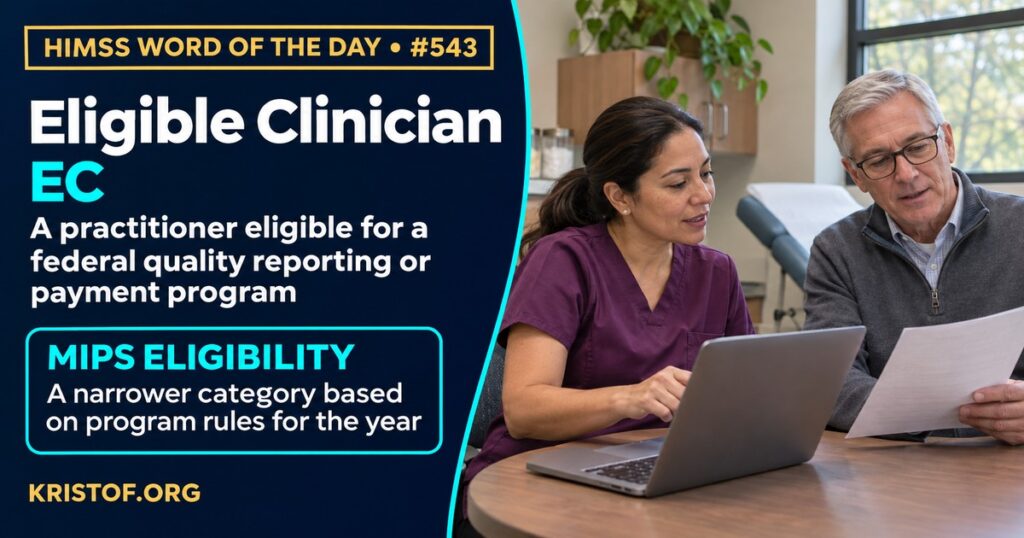
The HIMSS Dictionary, citing the Centers for Medicare & Medicaid Services (CMS), defines an EC (Eligible Clinician) as a physician or other health care practitioner who may join a federal program that adjusts payment or collects quality data, or who is required to join one. For the Merit-based Incentive Payment System (MIPS), the Dictionary adds that the MIPS-eligible group includes physicians, PAs, NPs, CNSs, and CRNAs. The abbreviation EC can also stand for “electronic commerce” in the Dictionary, so context matters.
The federal regulations make a distinction that the short definition can blur. In the Code of Federal Regulations text for the Quality Payment Program (42 CFR 414.1305, as shown on the Cornell Legal Information Institute site), an eligible clinician is an “eligible professional” as defined in section 1848(k)(3) of the Social Security Act, identified by a unique combination of Taxpayer Identification Number (TIN) and National Provider Identifier (NPI). The text says that includes physicians, a group of practitioners described in section 1842(b)(18)(C) of the Act, physical or occupational therapists and qualified speech-language pathologists, and qualified audiologists.
A MIPS eligible clinician is a narrower, program-specific term, and it changes over time. According to the same regulation, it covered physicians, PAs, NPs, CNSs, and CRNAs for the 2019 and 2020 payment years. For 2021 through 2023, it added physical and occupational therapists, speech-language pathologists, audiologists, clinical psychologists, and registered dietitians or nutrition professionals. For the 2024 payment year and later, it adds clinical social workers and certified nurse midwives. Groups that include these clinicians are also covered.
Being an eligible clinician does not always mean being a MIPS eligible clinician. Under 42 CFR 414.1310, the regulation excludes some eligible clinicians for a given year: those who are qualifying APM participants, those who are partial qualifying APM participants and do not elect to take part in MIPS, and those who do not exceed the low-volume threshold. New Medicare-enrolled clinicians are not treated as MIPS eligible until the following year. Beginning with the 2021 payment year, a clinician or group that exceeds some but not all of the low-volume criteria may elect to participate. Eligible clinicians who are not MIPS eligible may report voluntarily, but no MIPS payment adjustment applies to them.
Health IT teams feel the definition in several places. Eligibility is tied to TIN and NPI records, groups are defined by clinicians who reassigned billing rights to a TIN, and a group’s Promoting Interoperability data must be aggregated across all MIPS eligible clinicians in the TIN for whom the group has certified EHR technology (CEHRT) data.
| Term | What it means | Where it is defined |
|---|---|---|
| Eligible clinician | Eligible professional identified by TIN and NPI, such as a physician, therapist, or audiologist | 42 CFR 414.1305 |
| MIPS eligible clinician | Clinician types covered by MIPS for a payment year, minus exclusions | 42 CFR 414.1305 and 414.1310 |
| Group | A single TIN with two or more eligible clinicians, at least one of them MIPS eligible | 42 CFR 414.1305 |
| Voluntary reporter | Eligible clinician who is not MIPS eligible but chooses to report; no payment adjustment applies | 42 CFR 414.1310 |
⚠️ Exam Alert: An eligible clinician is the broader regulatory class of practitioners, and a MIPS eligible clinician is a narrower group subject to MIPS payment adjustments after exclusions. Do not confuse an eligible clinician (EC) with an eligible professional (EP), the older Meaningful Use term that the regulation now uses as the basis of the definition, or with an eligible hospital (EH), which is a facility, not a practitioner.
🌐 Why It Matters: Real-World Healthcare IT Context
For anyone who supports quality reporting, the practical question is who is in the program, who is not, and what the program costs the people in it. Each source below was checked against its published text or abstract, and the type of study is noted. The regulation text is a snapshot, so current-year eligibility should always be confirmed with CMS before it is used for planning.
The regulatory text. The two Code of Federal Regulations sections above set out the definitions, the clinician types by payment year, the exclusions, and the rules for groups. They are the legal basis for the Dictionary’s short entry. The copies read for this post are the versions published by Cornell’s Legal Information Institute, so the current rule year at CMS should be checked before it is relied upon.
Participation and payment across specialties. Gettel and colleagues, in Medical Care (2022), conducted a cross-sectional analysis of the 2018 MIPS program. In that year, 558,296 clinicians participated across the 35 specialties assessed. Clinicians reporting as individuals had a lower median overall performance score (80.0) than those reporting as groups (96.3), who in turn scored lower than those reporting within MIPS APMs (100.0). Median payment adjustments followed the same order: +0.7 percent for individuals, +1.5 percent for groups, and +1.7 percent for APM participants. Within a subset of 202,685 clinicians across 12 specialties that commonly use qualified clinical data registries, those reporting at least one registry measure had higher scores and adjustments than those reporting none. This describes a single performance year and does not show why the differences arose.
Reporting pathway and payment. Letchuman and colleagues, in Proceedings (Baylor University Medical Center) (2026), analyzed 2023 CMS data for 291,121 clinicians across 29 specialties using coarsened exact matching and weighted quantile regression. APM participation ranged from 7.6 percent in dermatology to 40.6 percent in hospital medicine. Across nearly all specialties, clinicians participating through an APM had higher predicted payment adjustments than comparable group-reporting clinicians, with adjusted differences from $100 for obstetrics/gynecology to $2,327 for radiation oncology. The authors say this suggests that reimbursement reflects the pathway used to report as well as performance, and they cite estimated MIPS participation costs of several thousand dollars per physician per year. This is an observational analysis of physician specialties in one year, and the authors present their conclusions as suggestions.
Documentation burden. Nguyen and colleagues, in the Journal of Evaluation in Clinical Practice (2023), used 2021 National Electronic Health Records Survey data from 1,801 office-based US physicians. After adjusting for physician age, specialty, sex, practice characteristics, and other factors, MIPS participation was associated with greater odds of spending more hours on after-hours documentation (odds ratio 1.44, 95 percent confidence interval 1.06 to 1.95). The authors say participation may increase the burden and that physicians may need more resources to report efficiently. This is a cross-sectional survey, so it shows an association, and it covers physicians rather than other eligible clinician types.
Taken together, the sources show that the eligible clinician definition has real consequences: it decides who reports, how scores and adjustments are earned, and where reporting work lands.
Common eligible clinician problems:
- Treating “eligible clinician” and “MIPS eligible clinician” as the same thing
- Using a prior year’s clinician types or thresholds for the current year
- Mismatched TIN and NPI records that place a clinician in the wrong group
- Missing that a clinician has been excluded as a qualifying APM participant or because of the low-volume threshold
- Confusing eligible clinicians (EC) with eligible professionals (EP) and eligible hospitals (EH)
- Leaving reporting work to a few clinicians without staff or tools to support it
What supports accurate eligibility and reporting:
- Checking the current-year eligibility and exclusion rules on the CMS Quality Payment Program site
- Clean provider rosters with correct TIN and NPI information
- Clear ownership of reporting, including the Promoting Interoperability category and CEHRT data
- Registry and EHR tools that reduce manual abstraction and after-hours documentation
- Group and APM reporting choices based on current data rather than habit
- Training for clinicians and staff on what the program counts
🏥 The Nurse’s Perspective: Clinical, Bedside, & Workflow
Nurses meet this term in two ways: as advanced practice clinicians who may be named in the regulation, and as the staff who support the reporting.
At the Bedside
The regulatory text names several advanced practice nurses: NPs, CNSs, and CRNAs, plus certified nurse midwives from the 2024 payment year. It does not list staff registered nurses. At the bedside, the measures and workflows that feed quality reporting still touch nursing documentation, so the program shapes nursing work even where nurses are not themselves the eligible clinicians.
In Clinical Workflow
Nurse informaticists often help practices decide where data for quality measures is captured and who checks it. When a practice’s reporting depends on structured fields, nurses and medical assistants see the effect on their daily documentation. The survey on after-hours documentation suggests that reporting work can fall outside the clinic day, so workflow design that reduces rework matters for clinicians and for the staff who support them.
In EHR Implementation (Go-Live Perspective)
During an Epic Go-Live, analysts at the elbow help clinicians who need to record the right data in the right place so it counts later in quality reports. They note which providers see patients under which billing arrangements, since clinician type, group membership, and measure responsibility depend on accurate roster information. Early checks of those details prevent confusion after the project team steps back.
🎓 CAHIMS / CPHIMS & HIMSS Perspective
CAHIMS Exam Domain Mapping
Eligible clinician status connects policy, data, and operations:
| CAHIMS Domain | How Eligible Clinician Appears |
|---|---|
| Healthcare & Technology Environments | Medicare payment programs, the Quality Payment Program, and value-based payment |
| Clinical Informatics | Quality measures, clinician types, and documentation tied to reporting |
| Healthcare Information & Systems Management | Provider rosters, TIN and NPI data, CEHRT, and registry reporting |
| Management & Leadership | Reporting strategy, group and APM choices, and workload planning |
Key Terms to Know Alongside Eligible Clinician
- MIPS (Merit-based Incentive Payment System) — Medicare program that adjusts payment based on clinician performance
- QPP (Quality Payment Program) — CMS program that includes MIPS and advanced alternative payment models
- NPI (National Provider Identifier) — unique identifier for health care providers
- CEHRT (Certified EHR Technology) — EHR technology that meets federal certification criteria
- Low-volume threshold — criteria that exclude clinicians with limited Medicare activity from MIPS
- Qualifying APM Participant (QP) — clinician in an advanced APM who meets payment or patient thresholds and is excluded from MIPS
HIMSS Organizational Position
HIMSS offers education and research on health information and technology topics through its Resource Center. Members can find related information on the HIMSS Resource Center page.
🧭 More HIMSS Word of The Day Terms
Related terms in the Value-Based Care series:
- Care Coordination
- VM (Value Modifier)
- QCDR (Qualified Clinical Data Registry)
- RVU (Relative Value Unit)
Browse all Value-Based Care terms or the A–Z glossary.
🔗 Explore Further: External References
- U.S. Government — 42 CFR § 414.1305: Definitions (Merit-Based Incentive Payment System and Alternative Payment Model Incentive) https://www.law.cornell.edu/cfr/text/42/414.1305
- U.S. Government — 42 CFR § 414.1310: Applicability https://www.law.cornell.edu/cfr/text/42/414.1310
- Gettel et al. (2022), Medical care — The 2018 Merit-based Incentive Payment System: Participation, Performance, and Payment Across Specialties https://pubmed.ncbi.nlm.nih.gov/35030565/
- Letchuman et al. (2026), Proceedings (Baylor University. Medical Center) — Payment adjustments by physician specialty and participation type in the Merit-Based Incentive Payment System https://pubmed.ncbi.nlm.nih.gov/42657815/
- Nguyen et al. (2023), Journal of evaluation in clinical practice — Merit-based incentive payment system participation and after-hours documentation among US office-based physicians: Findings from the 2021 National Electronic Health Records Survey https://pubmed.ncbi.nlm.nih.gov/36416004/
- HIMSS — Resource Center https://www.himss.org/resource-center
Term source: HIMSS Dictionary of Health Information and Technology Terms, Acronyms, and Organizations, 6th Edition (2025). All definitions in this series are paraphrased for editorial purposes. Readers are encouraged to consult the primary source for exact language.
Eric Andrew Kristof, RN, CAHIMS is a Healthcare IT professional and HIMSS Arkansas Chapter member based in Hot Springs Village, AR, with hands-on Epic Go-Live experience and a diverse healthcare and IT background. He writes at kristof.org at the intersection of clinical care and healthcare technology.
Leave a Reply