By Eric Andrew Kristof, RN, CAHIMS | Healthcare IT Professional | HIMSS Arkansas Chapter Member
About This Series: The HIMSS Word of The Day is a running blog series drawing from the HIMSS Dictionary of Health Information and Technology Terms, Acronyms, and Organizations, 6th Edition (2025) — the authoritative reference for healthcare IT professionals and the primary study resource for CAHIMS and CPHIMS certification. Each post paraphrases the term in plain language, grounds it in real-world healthcare IT context, and adds a bedside nursing perspective you won’t find in a textbook.
📖 The Term: BTRIS (Biomedical Translational Research Information System)
Source: HIMSS Dictionary of Health Information and Technology Terms, Acronyms, and Organizations, 6th Edition (2025)
🔍 Plain-Language Definition
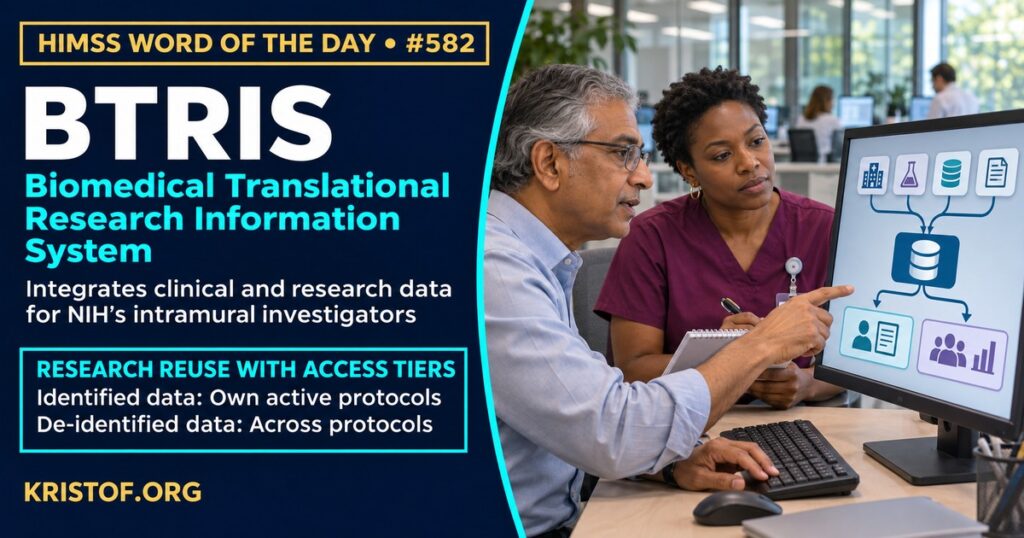
The HIMSS Dictionary describes BTRIS, the Biomedical Translational Research Information System, as a data resource for the intramural research community at the National Institutes of Health (NIH). It pulls research data from the NIH Clinical Center, along with other institutes and centers across NIH, into one place. Clinical investigators can see identifiable data only for the subjects enrolled in their own active protocols, whereas any NIH investigator can look at data stripped of personal identifiers across all protocols. The entry says the data reach back to 1976.
The NIH Clinical Center’s BTRIS page, read for this post, gives a very similar description and lists the main ways people use the system. The page shows no review date, so the current details are worth confirming with the Clinical Center.
| Part of BTRIS named on the NIH page | What it is for |
|---|---|
| Active Protocols | Access for intramural team members associated with a protocol |
| Hypothesis Generation | Querying of de-identified data across protocols |
| Subject Attribution | A preferences application where users confirm a subject’s link to an active protocol and set notification and permission thresholds for secondary use of data |
| Clinical Trials Reporting | Help assembling and formatting data for federal trial reporting requirements, with the option to upload filing files to ClinicalTrials.gov |
The table reflects the NIH page’s own list and is a summary, not an official specification.
⚠️ Exam Alert: BTRIS is a research data repository for NIH’s intramural community, not the live electronic health record and not a public database. The identified and de-identified paths are different: one is limited to a clinician’s own active protocols, and the other removes personal identifiers and covers all protocols. Do not confuse it with ClinicalTrials.gov, which is a public registry, or with a general clinical data warehouse, which BTRIS is one example of.
🌐 Why It Matters: Real-World Healthcare IT Context
Several of the papers below were written by the NIH team that built the system, so they describe its design more than they test it independently. The NIH Clinical Center page and these papers are the sources used here, and the numbers in older papers describe the system as it was then.
How it was built. Cimino and Ayres, in Studies in Health Technology and Informatics (2010), described BTRIS as being developed to consolidate clinical research data that had been held in many separate databases across NIH, which they noted includes 27 institutes and centers. At that point it held more than 300 million rows from three institutes, with data from 1976 onward. Two design features stood out: a Research Entities Dictionary that unifies the controlled terminologies used by the source systems, and a hybrid data model that combines parts of the source data models with entity-attribute-value tables. Cimino and colleagues, in the Journal of Biomedical Informatics (2014), reported on the system after five years of development and operation. They described a repository, programs that load data from NIH electronic health records and research data management systems, a coding ontology, and user tools for identified data from individual studies and for data without identifiers across all studies. These are the developers’ own accounts from 2010 and 2014, so the sizes and contents have likely changed.
Making the data usable. Cimino (2015), in Studies in Health Technology and Informatics, used human blood type data from BTRIS to show a method for representing varied source data in its most basic form so that it can be combined. In applying the method to actual patient data, the author found a 2 percent incidence of changed blood types, and the abstract says the reasons were left for a future study. Pan and Cimino, in the AMIA Annual Symposium Proceedings (2015), addressed laboratory tests performed at outside laboratories that arrive labeled only as an outside test, with the real test name sitting in a free-text field. Their multi-step approach mapped such results to LOINC codes for the Research Entities Dictionary and produced a reference table for the extract-transform-load (ETL) process. Both are single-repository case studies, and they show the kind of cleanup that secondary use of clinical data can require.
Reusing the data for discovery. Sun and colleagues, in the Proceedings of the IEEE International Conference on Bioinformatics and Biomedicine (2023), analyzed drugs administered to glioblastoma patients in BTRIS and fitted penalized Cox proportional hazards models to look for drugs associated with higher survival. They identified several candidates for further evaluation with other data types and laboratory experiments. This is exploratory work on observational data, so the findings point to hypotheses and do not show that any drug helps.
Common BTRIS-related problems:
- Treating a research repository as if it were the live clinical record
- Assuming data from different source systems use the same terms, formats, and meanings
- Free-text results, such as outside laboratory tests, that are hard to find until they are standardized
- Reading identified and de-identified access as the same permission
- Relying on an old paper’s figures, such as row counts, as if they described the current system
- Drawing treatment conclusions from exploratory analyses of observational data
What supports reliable research data reuse:
- A single controlled terminology for data coming from many source systems, as the Research Entities Dictionary does
- Mapping of local results to standard codes such as LOINC, as Pan and Cimino describe
- Access tiers that match the user’s role, as the NIH page describes for identified and de-identified data
- Checks on data quality, such as the blood type work that surfaced unexpected changes
- Attention to how subjects are linked to protocols and to what secondary use is permitted
- Treating exploratory findings as leads for further study
🏥 The Nurse’s Perspective: Clinical, Bedside, & Workflow
For nurses, BTRIS is a reminder that what is charted at the bedside can be reused for research long after the shift ends.
At the Bedside
Nurses and research nurses record vital signs, medication administration, and assessments that may later be combined with other data for studies. Documentation in structured fields is easier to reuse than free text, which is one reason the outside laboratory example matters. Careful, consistent entries help future analyses mean what the nurse intended.
In Clinical Workflow
Nurse informaticists and research staff help keep protocol information accurate, since access to identified data depends on the link between a subject and an active protocol. Questions about what data may be reused, and for what purpose, usually involve research governance and privacy teams as well. Clear roles reduce confusion about who can see which data.
In EHR Implementation (Go-Live Perspective)
During an Epic Go-Live, analysts at the elbow focus on care delivery, yet build choices such as how a result is coded affect what later reaches a research repository. Organizations that feed a research data resource often plan the mapping of local terms to standard codes alongside the build, though specific arrangements vary. Nurses who test workflows can flag places where free text is used for data that research teams would want in a structured field.
🎓 CAHIMS / CPHIMS & HIMSS Perspective
CAHIMS Exam Domain Mapping
BTRIS connects research data, terminology, and privacy:
| CAHIMS Domain | How BTRIS Appears |
|---|---|
| Healthcare & Technology Environments | Research data repositories, federal research settings, and clinical research data sources |
| Clinical Informatics | Secondary use of clinical data, terminology mapping, and data quality |
| Healthcare Information & Systems Management | Data loading, access control, de-identified and identified data, and reporting |
| Management & Leadership | Data governance, permissions for secondary use, and research compliance |
Key Terms to Know Alongside BTRIS
- CDW (Clinical Data Warehouse) — a repository that integrates clinical data from several source systems for analysis
- ETL (Extraction, Transformation, Loading) — the process of pulling data from sources, reshaping it, and loading it into a target system
- LOINC (Logical Observation Identifiers Names and Codes) — a code system for laboratory and clinical observations
- De-identified health information — data from which identifying details have been removed under a defined standard
- Metadata — descriptive information about data, such as its source and meaning
- Interoperability — the ability of systems to exchange and use information
HIMSS Organizational Position
HIMSS offers education and research on health information and technology topics through its Resource Center. Members can find related information on the HIMSS Resource Center page.
🧭 More HIMSS Word of The Day Terms
Related terms in the Data and Analytics series:
- Data Visualization
- GIGO (Garbage In, Garbage Out)
- Atomic Data
- USHIK (United States Health Information Knowledgebase)
Browse all Data and Analytics terms or the A–Z glossary.
🔗 Explore Further: External References
- NIH Clinical Center — BTRIS (Biomedical Translational Research Information System) https://www.cc.nih.gov/btris
- Cimino and Ayres (2010), Studies in health technology and informatics — The clinical research data repository of the US National Institutes of Health https://pubmed.ncbi.nlm.nih.gov/20841894/
- Cimino et al. (2014), Journal of biomedical informatics — The National Institutes of Health’s Biomedical Translational Research Information System (BTRIS): design, contents, functionality and experience to date https://pubmed.ncbi.nlm.nih.gov/24262893/
- Cimino (2015), Studies in health technology and informatics — Normalization of Phenotypic Data from a Clinical Data Warehouse: Case Study of Heterogeneous Blood Type Data with Surprising Results https://pubmed.ncbi.nlm.nih.gov/26262113/
- Pan and Cimino (2015), AMIA Annual Symposium proceedings — Identifying the Clinical Laboratory Tests from Unspecified “Other Lab Test” Data for Secondary Use https://pubmed.ncbi.nlm.nih.gov/26958239/
- Sun et al. (2023), Proceedings. IEEE International Conference on Bioinformatics and Biomedicine — Mining NIH BTRIS Data for Drug Repurposing: A Case Study of Glioblastoma https://pubmed.ncbi.nlm.nih.gov/40959833/
- HIMSS — Resource Center https://www.himss.org/resource-center
Term source: HIMSS Dictionary of Health Information and Technology Terms, Acronyms, and Organizations, 6th Edition (2025). All definitions in this series are paraphrased for editorial purposes. Readers are encouraged to consult the primary source for exact language.
Eric Andrew Kristof, RN, CAHIMS is a Healthcare IT professional and HIMSS Arkansas Chapter member based in Hot Springs Village, AR, with hands-on Epic Go-Live experience and a diverse healthcare and IT background. He writes at kristof.org at the intersection of clinical care and healthcare technology.
Leave a Reply