By Eric Andrew Kristof, RN, CAHIMS | Healthcare IT Professional | HIMSS Arkansas Chapter Member
About This Series: The HIMSS Word of The Day is a running blog series drawing from the HIMSS Dictionary of Health Information and Technology Terms, Acronyms, and Organizations, 6th Edition (2025) — the authoritative reference for healthcare IT professionals and the primary study resource for CAHIMS and CPHIMS certification. Each post paraphrases the term in plain language, grounds it in real-world healthcare IT context, and adds a bedside nursing perspective you won’t find in a textbook.
📖 The Term: QMS (Quality Management System)
Source: HIMSS Dictionary of Health Information and Technology Terms, Acronyms, and Organizations, 6th Edition (2025)
🔍 Plain-Language Definition
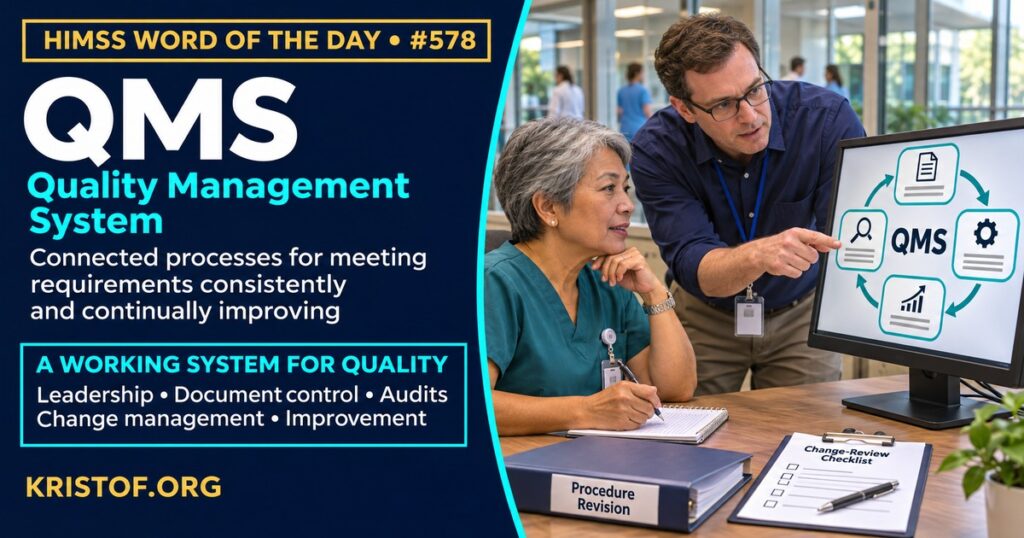
The HIMSS Dictionary describes a quality management system (QMS) as a set of business processes organized around meeting customer requirements consistently and improving customer satisfaction. The entry adds that a QMS fits the organization’s purpose and strategic direction.
The best-known requirements standard for a QMS is ISO 9001. ISO states that ISO 9001 specifies requirements for establishing, maintaining, and continually improving a QMS, and that it applies to organizations of any size or sector. ISO’s page for the 2026 edition says the sixth edition was published on 16 September 2026 and lists the 2015 edition as previously withdrawn. ISO describes a related standard, ISO 13485, as designed for the medical devices industry with a focus on regulatory compliance.
| Related term | How it relates to a QMS |
|---|---|
| ISO 9001 | General requirements standard for a QMS, usable by organizations of any size or sector |
| ISO 13485 | QMS standard designed for the medical devices industry |
| FDA QMSR | U.S. device manufacturing regulation that incorporates ISO 13485:2016 by reference |
| Quality improvement | The ongoing work of improving processes and outcomes that a QMS supports |
| Standard operating procedure | A documented procedure, one common building block of a QMS |
The table is a teaching sketch and not an official taxonomy.
⚠️ Exam Alert: A QMS is the management system of an organization, not a single quality project or a certificate. It differs from quality improvement, which is the activity of improving care, from an accreditation survey by a body such as The Joint Commission, and from quality measures, which are the metrics. ISO 9001 is general, while ISO 13485 and the FDA QMSR address medical device manufacturing.
🌐 Why It Matters: Real-World Healthcare IT Context
Evidence on quality management systems in healthcare is mostly descriptive and comes from single organizations, so the studies below are best read as examples. Each was checked against its published abstract, and the standards and regulatory points come from ISO and FDA pages.
Two 2026 changes to check. ISO’s page lists ISO 9001:2026 as published on 16 September 2026. Studies that describe certification to ISO 9001 before that date refer to the earlier edition, and transition arrangements for certified organizations were not confirmed in the sources reviewed, so they should be checked with a certification body. FDA’s Quality Management System Regulation (QMSR), which the FDA page says amends 21 CFR Part 820 by incorporating ISO 13485:2016 by reference, took effect on February 2, 2026. The FDA page describes the rule as amending the device current good manufacturing practice requirements and does not discuss software, so whether a given health IT product is a regulated device is a separate regulatory question.
A software example. Lagerburg and colleagues, in Frontiers in Digital Health (2025), described building a QMS based on ISO 13485:2016 for an in-house developed prediction model that qualified as medical software under the European Medical Device Regulation. Of 32 elements and sub-elements, 6 (19 percent) were judged not applicable. For the applicable ones, the data science team’s existing documentation was sufficient for 32 percent, incomplete for 23 percent, and completely lacking for 45 percent. The authors concluded that a QMS developed with physical products in mind can be used for medical software, and said it takes less effort when structured software development is already in place. This is one team’s experience under the European regulation and does not describe the U.S. rule.
An outcomes association. Shakoor and colleagues, in the International Journal for Quality in Health Care (2026), analyzed five years of quality assurance data at one cardiac center in Pakistan, with three regional hospitals as a comparison group. After ISO 9001 certification in February 2022, they reported that monthly mortality within 48 hours fell from 2.8 to 1.9 percent, hospital-acquired infections from 3.2 to 2.0 percent, and mean length of stay from 6.2 to 4.7 days, and their difference-in-differences model estimated net reductions of 30 percent in infections and 20 percent in length of stay. The authors say the certification was undertaken alongside investment in leadership, safety culture, and data, and that a learning QMS, not a certificate, drives the gains. It is a retrospective, single-center analysis, so it shows an association and cannot isolate the certificate’s effect.
A descriptive implementation. Arnedo and colleagues, in the International Journal for Quality in Health Care (2026), described an ISO 9001-based QMS in a hospital simulation center, with data from audit reports, key performance indicators, incident logs, and satisfaction surveys. They reported incidents falling from 125 to 57 cases, survey participation rising from 56.8 percent to over 99 percent, and stronger governance. This is a descriptive case study without a comparison group.
Common elements. Pillai and Fox, in Frontiers in Bioengineering and Biotechnology (2025), reviewed 12 fundamental aspects of laboratory quality management systems. They note that frameworks vary but share common elements, such as document and records management, change management, and a path for continual improvement. The article is a review of laboratory systems, not of health IT departments.
Common QMS problems:
- Treating the QMS as paperwork or a certificate instead of a working system for improvement
- Confusing ISO 9001, ISO 13485, and the FDA QMSR, which differ in scope
- Citing an older ISO 9001 edition without checking the current one
- Assuming certification caused better outcomes when the evidence is observational
- Incomplete or missing documentation, as the software example found for many elements
- Assuming a health IT product is a regulated device, or that it is not, without a regulatory review
What supports a QMS:
- A requirements structure that, as ISO’s page lists, covers context, leadership, planning, support, operation, and performance evaluation
- Existing structured development and documentation practices that can be folded into the QMS, as Lagerburg and colleagues describe
- Leadership, safety culture, and data use alongside any certification, as Shakoor and colleagues emphasize
- Audits, key performance indicators, and incident logs as data sources, as in the simulation center example
- Document control, change management, and continual improvement, which Pillai and Fox describe as common elements
🏥 The Nurse’s Perspective: Clinical, Bedside, & Workflow
For nurses, a QMS is usually visible as policies, audits, and incident reporting rather than as a named system.
At the Bedside
Policies, procedures, and safety checklists are often part of an organization’s wider quality system. Bedside nurses see it when an incident report leads to a changed procedure, when an audit looks at documentation, or when a unit receives feedback on its performance. Understanding that these pieces are meant to fit together can make reporting feel more purposeful.
In Clinical Workflow
Nurse leaders often own pieces of the system, such as unit audits, policy review, and incident follow-up. The simulation center example shows the kinds of data a QMS can use: audit reports, performance indicators, incident logs, and satisfaction surveys. Nurse informaticists can help by making those data easy to pull from the EHR and by clarifying who reviews them.
In EHR Implementation (Go-Live Perspective)
During an Epic Go-Live, analysts at the elbow see how change control, testing records, and training documentation affect the stability of the build. Where an IT department or a vendor follows a documented QMS, those records are part of how changes are approved and tracked, though how formal this is varies by organization. A clinical analyst who understands the process can ask the right questions about who approved a change and where the evidence is kept.
🎓 CAHIMS / CPHIMS & HIMSS Perspective
CAHIMS Exam Domain Mapping
The QMS connects quality processes, regulation, and management of health IT work:
| CAHIMS Domain | How the QMS Appears |
|---|---|
| Healthcare & Technology Environments | Standards bodies, device regulation, and accreditation in healthcare |
| Clinical Informatics | Quality data, incident reporting, and clinical documentation processes |
| Healthcare Information & Systems Management | Document control, change management, and software development processes |
| Management & Leadership | Leadership commitment, audits, and continual improvement |
Key Terms to Know Alongside the QMS
- Quality improvement — systematic effort to improve care processes and outcomes
- Standard operating procedure — documented, step-by-step instructions for a routine task
- Accreditation — formal recognition that an organization meets defined standards
- Risk management — identifying, assessing, and reducing risks
- Medical device — product intended for diagnosis, treatment, or monitoring that may be regulated
- SDLC (Systems Development Life Cycle) — phases of planning, building, testing, and maintaining a system
HIMSS Organizational Position
HIMSS offers education and research on health information and technology topics through its Resource Center. Members can find related information on the HIMSS Resource Center page.
🧭 More HIMSS Word of The Day Terms
Related terms in the Project and Change Management series:
Browse all Project and Change Management terms or the A–Z glossary.
🔗 Explore Further: External References
- ISO — ISO 9001:2026 Quality management systems — Requirements https://www.iso.org/standard/9001
- FDA — Quality Management System Regulation: Frequently Asked Questions https://www.fda.gov/medical-devices/quality-management-system-regulation-qmsr/quality-management-system-regulation-frequently-asked-questions
- Lagerburg et al. (2025), Frontiers in digital health — Applying and validating a quality management system for in-house developed medical software https://pubmed.ncbi.nlm.nih.gov/40236607/
- Shakoor et al. (2026), International journal for quality in health care — ISO 9001 and JCI preparedness as drivers of quality improvement at a tertiary cardiac care center: a 5-year analysis from Pakistan https://pubmed.ncbi.nlm.nih.gov/42773502/
- Arnedo et al. (2026), International journal for quality in health care — Implementing an ISO 9001-based quality management system in a clinical simulation center: integration of training delivery, governance, and research https://pubmed.ncbi.nlm.nih.gov/42271630/
- Pillai and Fox (2025), Frontiers in bioengineering and biotechnology — Laboratory quality management system fundamentals https://pubmed.ncbi.nlm.nih.gov/40470502/
- HIMSS — Resource Center https://www.himss.org/resource-center
Term source: HIMSS Dictionary of Health Information and Technology Terms, Acronyms, and Organizations, 6th Edition (2025). All definitions in this series are paraphrased for editorial purposes. Readers are encouraged to consult the primary source for exact language.
Eric Andrew Kristof, RN, CAHIMS is a Healthcare IT professional and HIMSS Arkansas Chapter member based in Hot Springs Village, AR, with hands-on Epic Go-Live experience and a diverse healthcare and IT background. He writes at kristof.org at the intersection of clinical care and healthcare technology.
Leave a Reply