By Eric Andrew Kristof, RN, CAHIMS | Healthcare IT Professional | HIMSS Arkansas Chapter Member
About This Series: The HIMSS Word of The Day is a running blog series drawing from the HIMSS Dictionary of Health Information and Technology Terms, Acronyms, and Organizations, 6th Edition (2025) — the authoritative reference for healthcare IT professionals and the primary study resource for CAHIMS and CPHIMS certification. Each post paraphrases the term in plain language, grounds it in real-world healthcare IT context, and adds a bedside nursing perspective you won’t find in a textbook.
📖 The Term: REC (Regional Extension Center)
Source: HIMSS Dictionary of Health Information and Technology Terms, Acronyms, and Organizations, 6th Edition (2025)
🔍 Plain-Language Definition
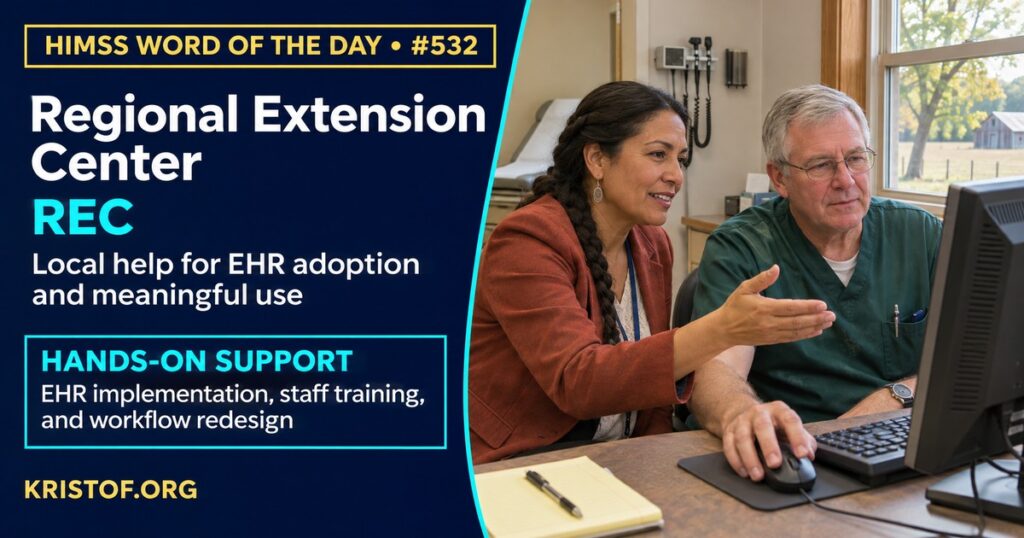
The HIMSS Dictionary describes regional extension centers (RECs) as organizations the Office of the National Coordinator for Health Information Technology (ONC) set up under the HITECH Act, a law that was included in the 2009 stimulus legislation (ARRA). Their job was to serve local communities with technical assistance, guidance, and best-practice information so that health care providers could meet the federal bar for meaningful use of certified EHR systems.
ONC describes the program as providing technical assistance in areas such as EHR implementation and project management, training, vendor selection and financial consultation, workflow redesign, and privacy and security. It prioritized small primary care practices, practices with a large share of Medicaid or uninsured patients, community health centers, rural health clinics, and critical access hospitals. In other words, RECs aimed to reach providers least likely to have in-house IT expertise.
The idea was a hands-on, regional model. A national incentive program could pay providers for meaningful use, but a solo physician or a rural clinic still needed help choosing a product, setting up workflows, training staff, and meeting the program’s measures. RECs supplied that help through local staff who knew the practices and communities involved. The funding was time-limited (one evaluation notes it was scheduled to end in 2014), which is part of why its lessons are still studied.
For a health IT student, RECs illustrate a core point: technology adoption depends on people, process, and support, not only on software and payment incentives. The same themes recur in current work on implementation, optimization, and digital equity.
| Element | Meaning |
|---|---|
| Sponsor | ONC, under the HITECH Act |
| Goal | Help providers adopt and meaningfully use certified EHRs |
| Services | Implementation, training, vendor selection, workflow, privacy and security |
| Priority settings | Small practices, community health centers, rural clinics, critical access hospitals |
| Model | Regional organizations that offered hands-on technical assistance |
⚠️ Exam Alert: A regional extension center (REC) was an ONC-supported, HITECH-funded organization that gave local technical assistance for EHR adoption and meaningful use. Do not confuse an REC with a health information exchange (HIE), which moves data between organizations, or with CMS, which ran the incentive payments. RECs helped providers get ready; they did not pay incentives.
🌐 Why It Matters: Real-World Healthcare IT Context
Evaluations of the REC program describe its reach, its effect on rural and underserved practices, and the support practices still needed. Each source below was checked against its published abstract, and the ONC page was read directly.
Lynch and colleagues, in Health Services Research (2014), assessed the program’s progress toward supporting over 100,000 providers in small, rural, and underserved practices. Using monitoring and evaluation data collected from January 2010 through June 2013 on 62 REC programs, they found that RECs recruited almost 134,000 primary care providers, or 44 percent of the nation’s primary care providers. Of those, 86 percent were using an EHR with advanced functionality and almost half (48 percent) had demonstrated meaningful use. Eighty-three percent of federally qualified health centers and 78 percent of critical access hospitals were participating with a REC. It is a descriptive study without a comparison group, so it shows reach and progress rather than the program’s causal effect.
Casey and colleagues, in the Journal of Rural Health (2014), examined the role of RECs in helping rural physician practices adopt EHRs and achieve meaningful use. County-level regression using ONC data showed that REC participants were disproportionately rural and more likely to come from high-poverty, low-employment communities. Two case-study RECs had long-standing relationships with rural providers and staff expertise in quality improvement and EHR implementation, and rural providers reported that REC assistance was invaluable. The authors noted that REC federal funding was scheduled to end in 2014 and that practices without EHRs might need ongoing assistance.
Samuel, in the Journal of the American Medical Informatics Association (2014), studied area-level factors associated with EHR adoption and meaningful use among REC-enrolled primary care providers across 2,715 counties. Average county-level EHR adoption was 87.5 percent and meaningful use 54.2 percent. Community health center presence and Medicaid enrollment concentration were positively associated with adoption, while health professional shortage area status and minority concentration were negatively associated with both adoption and meaningful use. The author concluded that disparities in low-resource and underserved areas remain a concern. It is an ecological, county-level analysis, so it describes areas rather than individual practices.
Heisey-Grove and colleagues, in Medical Care (2014), summarized challenges to EHR adoption and meaningful use reported by 55 RECs, covering over 19,000 issues for more than 43,000 unique providers. Provider engagement and administrative issues were common across groups, the clinical summaries measure was the most challenging meaningful use measure, and challenges varied by practice setting and stage of adoption. The issues were self-reported by RECs, so they reflect what the centers tracked.
Green and colleagues, in the Annals of Family Medicine (2015), conducted a qualitative study of federally qualified health centers and other priority practices in Michigan to identify barriers to maintaining meaningful use after REC assistance ended. They concluded that maintaining EHR technology and using it for quality improvement will require ongoing expert technical support, leadership, and change management support. Practices not affiliated with larger systems lacked access to expertise, funds, and leverage with vendors, and rural practices were at particular risk of falling on the wrong side of a digital divide. The study took place in one state with a qualitative design.
Taken together, the sources show that a regional, hands-on model reached many small and rural practices, that local conditions shaped results, and that adoption support does not end at go-live.
Common EHR adoption support problems:
- Small practices with little IT expertise or time
- Provider engagement and administrative workload
- Measures or workflows that are hard to meet in a specific setting
- Rural and underserved areas with fewer local experts
- Support that ends before practices can sustain the system alone
- Unequal results across communities
What supports successful adoption:
- Local advisors who know the practice and community
- Help with vendor selection, workflow redesign, and training
- Attention to provider engagement and leadership
- Targeting resources to underserved and rural practices
- Ongoing technical and change management support after go-live
- Tracking issues to see which settings need what help
🏥 The Nurse’s Perspective: Clinical, Bedside, & Workflow
Nurses in small practices, clinics, and rural hospitals often take on much of the practical work of an EHR project, and that is where an REC’s help showed up.
At the Bedside
In critical access hospitals and clinics, nurses document, order, and administer care in the new system while keeping patients safe. Local help with workflows, training, and troubleshooting shortens the learning curve and lowers frustration.
In Clinical Workflow
Nurse informaticists and clinic nurses often serve as the link between vendors, advisors, and staff. They map the current workflow, test the new one, and teach colleagues. The REC model of hands-on advisors offered a lesson that still holds: staff do better when someone who knows their setting helps them through the change.
In EHR Implementation (Go-Live Perspective)
During an Epic Go-Live, at-the-elbow support is a form of the same idea: experienced people stand next to staff while they learn the system. The studies of RECs suggest that support is also needed after go-live, for upgrades, optimization, and measures, especially in settings with limited staff.
🎓 CAHIMS / CPHIMS & HIMSS Perspective
CAHIMS Exam Domain Mapping
The REC program connects policy, implementation, and equity:
| CAHIMS Domain | How RECs Appear |
|---|---|
| Healthcare & Technology Environments | HITECH Act, ONC, federal incentives, and practice settings |
| Clinical Informatics | Workflow redesign, EHR use, and quality improvement |
| Healthcare Information & Systems Management | Vendor selection, implementation, training, and support |
| Management & Leadership | Change management, project management, and workforce capacity |
Key Terms to Know Alongside REC
- HITECH Act — 2009 law that funded health IT adoption programs and strengthened HIPAA enforcement
- Meaningful Use — federal incentive program that set EHR use requirements
- Certified EHR Technology (CEHRT) — EHR that meets federal certification criteria
- ONC — Office of the National Coordinator for Health Information Technology
- Critical-Access Hospital — small rural hospital with special Medicare designation
- Federally Qualified Health Center — community health center with federal funding and designation
HIMSS Organizational Position
HIMSS offers education and research on health information and technology topics through its Resource Center. Members can find related information on the HIMSS Resource Center page.
🧭 More HIMSS Word of The Day Terms
Related terms in the Healthcare Policy series:
- Payer
- CMS Promoting Interoperability Programs
- HITAC (Health Information Technology Advisory Committee)
- MyHealthEData
Browse all Healthcare Policy terms or the A–Z glossary.
🔗 Explore Further: External References
- Lynch et al. (2014), Health services research — The Health IT Regional Extension Center Program: evolution and lessons for health care transformation https://pubmed.ncbi.nlm.nih.gov/24359032/
- Casey et al. (2014), The Journal of rural health — Rural primary care practices and meaningful use of electronic health records: the role of Regional Extension Centers https://pubmed.ncbi.nlm.nih.gov/24118180/
- Samuel (2014), Journal of the American Medical Informatics Association — Area-level factors associated with electronic health record adoption and meaningful use in the Regional Extension Center Program https://pubmed.ncbi.nlm.nih.gov/24798687/
- Heisey-Grove et al. (2014), Medical care — A national study of challenges to electronic health record adoption and meaningful use https://pubmed.ncbi.nlm.nih.gov/24309669/
- Green et al. (2015), Annals of family medicine — Sustaining “meaningful use” of health information technology in low-resource practices https://pubmed.ncbi.nlm.nih.gov/25583887/
- ONC — Final Report: Evaluation of the Regional Extension Center Program https://healthit.gov/resources/final-report-evalution-regional-extension-center-program/
- HIMSS — Resource Center https://www.himss.org/resource-center
Term source: HIMSS Dictionary of Health Information and Technology Terms, Acronyms, and Organizations, 6th Edition (2025). All definitions in this series are paraphrased for editorial purposes. Readers are encouraged to consult the primary source for exact language.
Eric Andrew Kristof, RN, CAHIMS is a Healthcare IT professional and HIMSS Arkansas Chapter member based in Hot Springs Village, AR, with hands-on Epic Go-Live experience and a diverse healthcare and IT background. He writes at kristof.org at the intersection of clinical care and healthcare technology.
Leave a Reply