By Eric Andrew Kristof, RN, CAHIMS | Healthcare IT Professional | HIMSS Arkansas Chapter Member
About This Series: The HIMSS Word of The Day is a running blog series drawing from the HIMSS Dictionary of Health Information and Technology Terms, Acronyms, and Organizations, 6th Edition (2025) — the authoritative reference for healthcare IT professionals and the primary study resource for CAHIMS and CPHIMS certification. Each post paraphrases the term in plain language, grounds it in real-world healthcare IT context, and adds a bedside nursing perspective you won’t find in a textbook.
📖 The Term: LVT (Low-Volume Threshold)
Source: HIMSS Dictionary of Health Information and Technology Terms, Acronyms, and Organizations, 6th Edition (2025)
🔍 Plain-Language Definition
The HIMSS Dictionary describes the low-volume threshold (LVT) as a volume test within the Quality Payment Program (QPP) that is tied to Medicare Part B and to eligibility for the Merit-based Incentive Payment System (MIPS). The entry prints two figures: Part B allowed charges of $30,000 and a count of 100 Medicare patients. Those figures are out of date. CMS adjusts the threshold by performance year, and a 2017 commentary on the MIPS final rule (Manchikanti and colleagues) describes CMS as having raised the low-volume threshold, so a printed reference can lag the rules.
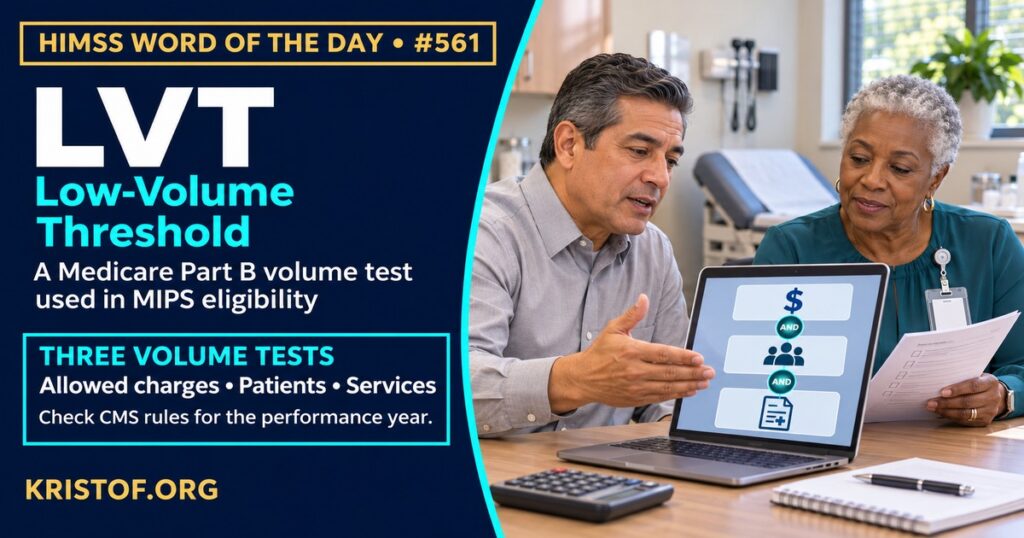
For the 2026 performance year, CMS’s small practice FAQ says a clinician exceeds the threshold only by meeting all three of these tests: billing more than $90,000 for Part B professional services under the Physician Fee Schedule, serving more than 200 Medicare Part B patients, and furnishing more than 200 covered professional services to those patients. A clinician who does not exceed all three is not required to report as an individual. Always confirm the figures for the year in question on the CMS site, because they can change.
| Related term | How it relates to the LVT |
|---|---|
| MIPS eligible clinician | A clinician of an eligible type who meets the participation rules, including the threshold |
| Qualifying APM Participant (QP) | A clinician identified through an advanced alternative payment model, who is not a MIPS eligible clinician under the FAQ’s rules |
| Small practice | A practice of 15 or fewer clinicians under one tax ID, a separate status from the LVT |
| MIPS Determination Period | The two 12-month claims windows CMS uses to check eligibility |
| Group reporting | A practice choice to submit aggregated data for all clinicians under its tax ID |
The table is a teaching sketch and not an official taxonomy.
⚠️ Exam Alert: The LVT is a Medicare Part B volume test, not a measure of practice size and not a quality score. It differs from small practice status (15 or fewer clinicians), from Qualifying APM Participant status, and from the MIPS payment adjustment itself. Two traps recur. First, the three tests are joined by AND for 2026, so missing any one of them means the clinician does not exceed the threshold. Second, a clinician can fall below the threshold individually and still be scored if the practice chooses to report as a group.
🌐 Why It Matters: Real-World Healthcare IT Context
Direct research on the LVT itself is limited. The PubMed searches run for this post found no peer-reviewed study centered on the threshold, so the sources below examine MIPS participation and burden, which is what the threshold shapes. Each article was checked against its published abstract, and the study type is noted. The 2026 figures come from CMS’s own FAQ and are CMS’s statements.
What the 2026 rules say. CMS’s small practice FAQ lists four conditions for a clinician to be required to report: an eligible clinician type, Medicare enrollment before January 1, 2026, no identification as a Qualifying APM Participant, and exceeding the low-volume threshold as an individual. Eligibility is evaluated at the individual and practice level for each tax ID, using Part B claims from two 12-month segments, October 1, 2024 through September 30, 2025 and October 1, 2025 through September 30, 2026. The FAQ says final eligibility for the second segment is not available until December 2026, so a practice can be working from preliminary results for most of the year.
Who is outside the value-based models. Everhart and colleagues, in Health Affairs (2025), built a longitudinal cohort of clinicians who billed Part B services from 2017 through 2022. The share they classed as QPP exempt, with no value-based payment model participation in Part B, rose from 27.5 percent in 2017 to 38.1 percent in 2022. Participation in traditional MIPS fell from 46.3 percent to 26.7 percent, while participation in two-sided accountable care organizations rose from 7.3 percent to 22.2 percent. The study is descriptive and does not isolate the effect of the threshold, so the link to the LVT is an inference, not a finding.
What participation costs. Khullar and colleagues, in JAMA Health Forum (2021), interviewed leaders of 30 physician practices about 2019 costs. The mean cost per physician was $12,811, and the interquartile range ran from $2,861 to $17,715. Physicians and staff together spent about 201.7 hours per physician each year on MIPS-related work, with medical assistants and nursing staff accounting for about 99.2 hours. This was a small qualitative study of independent practices in one year, and about half of the practices were in a MIPS alternative payment model.
What practice leaders say. In a companion interview study in the Journal of General Internal Medicine (2021), Khullar and colleagues reported six themes from the same 30 practices, including substantial administrative burden made worse by yearly program changes, incentives that were small compared with the effort, and mixed views on whether MIPS improves care. Some leaders said their practices took part mainly to avoid penalties. Read together with the threshold, these accounts suggest why the line between required and not required matters to small practices, though the studies did not examine the LVT directly.
Common LVT problems:
- Quoting an old threshold, such as the figures in the Dictionary, instead of the current year’s
- Reading the three tests as “any one” when the 2026 FAQ requires all three to be exceeded
- Assuming that being below the threshold individually means a clinician will not be scored, when group reporting can include that clinician
- Confusing the threshold with small practice status or with Qualifying APM Participant status
- Working from preliminary eligibility results, since the FAQ says the second claims segment is not final until December 2026
- Assuming a new clinician is automatically in or out, when CMS ties the requirement to Medicare enrollment dates
What supports clear LVT decisions:
- The CMS Quality Payment Program Participation Status Tool, which the FAQ describes as the place to check eligibility by NPI
- Tax-ID-level eligibility downloads for practice managers who sign in to the QPP website, as the FAQ describes
- A clear practice decision each year on group versus individual reporting
- Awareness of the small practice special status, which the FAQ ties to 15 or fewer clinicians under one tax ID
- An annual calendar tied to the two Determination Period segments
🏥 The Nurse’s Perspective: Clinical, Bedside, & Workflow
For nurses, the LVT matters most for advanced practice nurses and for the quality and informatics staff who support them.
At the Bedside
Bedside registered nurses do not appear on the CMS list of eligible clinician types, so the threshold does not change their direct work. It still shapes the practices where they work. The CMS FAQ lists nurse practitioners, clinical nurse specialists, certified registered nurse anesthetists, and certified nurse midwives among the eligible clinician types, so a practice with those clinicians may have reporting duties that depend on the numbers above.
In Clinical Workflow
In practices that bill Part B, nurses often carry quality reporting tasks such as documenting measures, closing care gaps, and confirming that structured data are captured. A nurse in a quality or practice management role can help by checking the Participation Status Tool each year and by learning whether the practice reports as a group. Because group reporting can bring in clinicians who are not individually required to report, documentation habits can matter for the whole practice, not only for the clinicians above the threshold.
In EHR Implementation (Go-Live Perspective)
During an Epic Go-Live, analysts at the elbow often learn that data fields built for billing or quality reports are the same ones clinicians use every day. For MIPS, the practical test cases are accurate clinician identifiers and tax ID mapping, claim data that feed eligibility, and the structured fields that quality measures read. A nurse informaticist can also ask who owns the yearly eligibility check, since it depends on CMS claims data and the practice’s own reporting choices, not on the EHR alone.
🎓 CAHIMS / CPHIMS & HIMSS Perspective
CAHIMS Exam Domain Mapping
The LVT links payment policy, quality reporting, and practice management:
| CAHIMS Domain | How the LVT Appears |
|---|---|
| Healthcare & Technology Environments | Medicare Part B, the Quality Payment Program, and how federal payment policy shapes health IT demand |
| Clinical Informatics | Quality measures and structured data that MIPS reporting depends on |
| Healthcare Information & Systems Management | Eligibility checks, tax ID and clinician identifier data, and reporting workflows |
| Management & Leadership | Group versus individual reporting decisions and the cost of participation |
Key Terms to Know Alongside LVT
- MIPS (Merit-based Incentive Payment System) — Medicare program that adjusts payment based on reported performance
- MACRA (Medicare Access and CHIP Reauthorization Act) — 2015 law that created the Quality Payment Program
- Advanced APM — alternative payment model that can qualify a clinician for QP status
- Value-based care — payment approach that links reimbursement to quality and cost
- CEHRT (Certified EHR Technology) — certified electronic health record technology used in MIPS reporting
- eCQM (Electronic Clinical Quality Measure) — quality measure calculated from electronic health record data
HIMSS Organizational Position
HIMSS offers education and research on health information and technology topics through its Resource Center. Members can find related information on the HIMSS Resource Center page.
🧭 More HIMSS Word of The Day Terms
Related terms in the Value-Based Care series:
Browse all Value-Based Care terms or the A–Z glossary.
🔗 Explore Further: External References
- Everhart et al. (2025), Health affairs (Project Hope) — Changes In Clinicians’ Participation Across Medicare Value-Based Payment Models, 2017-22 https://pubmed.ncbi.nlm.nih.gov/40758933/
- Khullar et al. (2021), JAMA health forum — Time and Financial Costs for Physician Practices to Participate in the Medicare Merit-based Incentive Payment System: A Qualitative Study https://pubmed.ncbi.nlm.nih.gov/35977308/
- Khullar et al. (2021), Journal of general internal medicine — Physician Practice Leaders’ Perceptions of Medicare’s Merit-Based Incentive Payment System (MIPS) https://pubmed.ncbi.nlm.nih.gov/33835310/
- Manchikanti et al. (2017), Pain physician — Merit-Based Incentive Payment System: Meaningful Changes in the Final Rule Brings Cautious Optimism https://pubmed.ncbi.nlm.nih.gov/28072793/
- CMS Quality Payment Program — 2026 MIPS Small Practice Eligibility and Participation Frequently Asked Questions https://qpp-cm-prod-content.s3.amazonaws.com/uploads/3605/2026-Small-Practice-Eligibility-FAQ.pdf
- HIMSS — Resource Center https://www.himss.org/resource-center
Term source: HIMSS Dictionary of Health Information and Technology Terms, Acronyms, and Organizations, 6th Edition (2025). All definitions in this series are paraphrased for editorial purposes. Readers are encouraged to consult the primary source for exact language.
Eric Andrew Kristof, RN, CAHIMS is a Healthcare IT professional and HIMSS Arkansas Chapter member based in Hot Springs Village, AR, with hands-on Epic Go-Live experience and a diverse healthcare and IT background. He writes at kristof.org at the intersection of clinical care and healthcare technology.
Leave a Reply