By Eric Andrew Kristof, RN, CAHIMS | Healthcare IT Professional | HIMSS Arkansas Chapter Member
About This Series: The HIMSS Word of The Day is a running blog series drawing from the HIMSS Dictionary of Health Information and Technology Terms, Acronyms, and Organizations, 6th Edition (2025) — the authoritative reference for healthcare IT professionals and the primary study resource for CAHIMS and CPHIMS certification. Each post paraphrases the term in plain language, grounds it in real-world healthcare IT context, and adds a bedside nursing perspective you won’t find in a textbook.
📖 The Term: PNDS (Perioperative Nursing Data Set)
Source: HIMSS Dictionary of Health Information and Technology Terms, Acronyms, and Organizations, 6th Edition (2025)
🔍 Plain-Language Definition
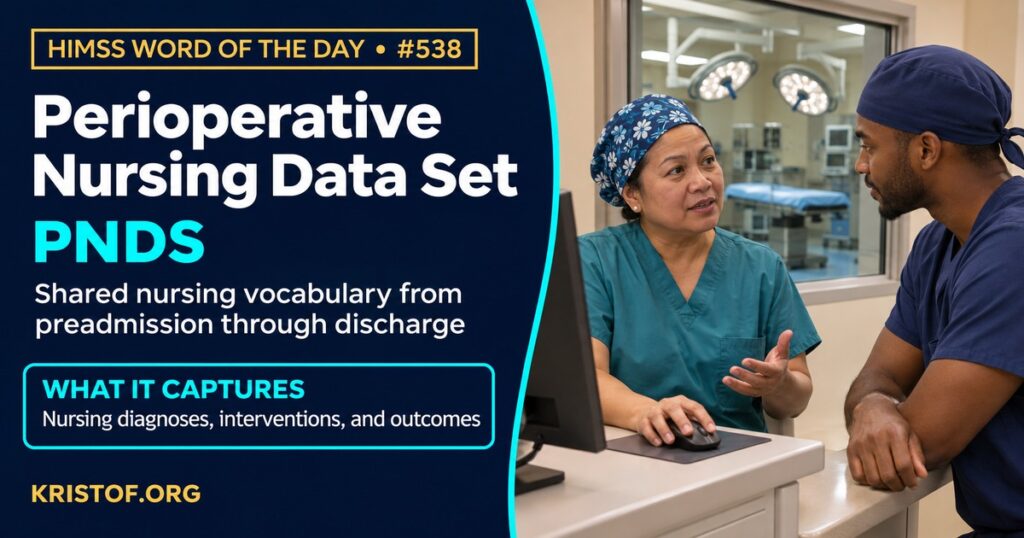
The HIMSS Dictionary describes the Perioperative Nursing Data Set (PNDS) as a standardized nursing vocabulary built for the perioperative patient experience, running from preadmission through discharge. It contains three kinds of content: nursing diagnoses, nursing interventions, and outcomes that are sensitive to the quality of nursing care.
The PNDS comes from AORN, the Association of periOperative Registered Nurses, and the sources in this post call it a nursing language that gives perioperative nurses shared terms for describing their work. A standardized vocabulary matters in the operating room for the same reason it matters elsewhere in health IT. If one nurse writes “patient at risk for injury related to positioning” and another uses a different phrase for the same concern, the information cannot be counted, compared, or used for decision support. Shared terms let documentation be structured in the EHR, searched, and linked to outcomes.
Petersen and Kleiner (2011) describe the PNDS as a representation of perioperative nursing knowledge made up of data elements and definitions that show the nurse’s influence on patient outcomes. They note that a standard of this kind needs ongoing maintenance and periodic review as practice changes, which is why it has been published in several editions.
The PNDS is one of several standardized nursing terminologies. A 2014 systematic review (Tastan and colleagues) counted five sets recognized by the American Nurses Association: the NANDA-I, NIC, and NOC family, the Omaha System, the International Classification for Nursing Practice, the Clinical Care Classification, and the PNDS. Its focus on surgical care sets it apart from the others.
| Element | What it provides |
|---|---|
| Nursing diagnoses | Standard names for patient problems and risks |
| Nursing interventions | Standard names for care delivered |
| Nurse-sensitive outcomes | Measures of results linked to nursing care |
| Scope | Preadmission through discharge in perioperative care |
| Health IT use | Structured documentation and data comparison in the EHR |
⚠️ Exam Alert: The PNDS is a perioperative nursing vocabulary of diagnoses, interventions, and outcomes. NANDA-I, NIC, and NOC are separate sets covering nursing diagnoses, interventions, and outcomes more broadly. Do not confuse the PNDS with SNOMED CT (a broad clinical reference terminology) or with ICD (a classification used for statistics and billing).
🌐 Why It Matters: Real-World Healthcare IT Context
The published evidence on the PNDS is older than for most terms in this series. The six sources below were published between 2006 and 2014, so they describe early adoption, translation, and validation, not current practice. Each was checked against its published abstract.
Doyle, in the AORN Journal (2006), described how Jackson Health System in Miami moved to an electronic medical record and integrated the PNDS into it. The author says that a universal nursing language such as the PNDS lets nurses document the care they give, show the value of their role in the operating room, and explain how their actions meet National Patient Safety Goals. It is a description of one organization’s transition, and the abstract reports no measured outcomes.
Park and colleagues, in the AORN Journal (2007), reported that researchers in South Korea translated the PNDS into Korean and tested it. They surveyed 142 nurses and analyzed the narrative nursing notes of 20 surgical patients from two tertiary hospitals in Seoul, mapping the notes with the PNDS. Nurses found it useful, and the researchers recommended additions, including action-related statements, to improve its usefulness in Korean perioperative settings. The patient sample was small, and the setting was two hospitals.
Junttila and colleagues, in the International Journal of Nursing Terminologies and Classifications (2010), tested the nursing diagnoses of the first Finnish version of the PNDS in perioperative documentation. Nurses used the diagnoses in four operating departments with 250 patients. During surgery the diagnoses focused on physiological concerns, and after surgery the focus shifted to recovery. The findings revealed the importance of safety-related routines in perioperative care, and the authors concluded that the diagnoses were sensitive in describing the rationale for perioperative care.
Petersen and Kleiner, in the AORN Journal (2011), described the evolution and revision of the PNDS. The third edition, published in 2010, underwent content validation by experts in clinical practice, vocabulary development, and informatics. The authors say the goal was to help perioperative nurses use the PNDS in a meaningful way and to promote standardized implementation in both written documentation and the electronic health record. This article describes a revision process and does not evaluate patient results.
Morton and colleagues, in the AORN Journal (2013), established the data elements for the health system domain of the PNDS. AORN members were asked to confirm the clarity, necessity, measurability, and accuracy of each proposed element. The resulting domain has 114 data elements with definitions. The authors say that when integrated into an electronic health record, these elements can be used to identify, compare, and evaluate the context in which care is delivered across settings.
Tastan and colleagues, in the International Journal of Nursing Studies (2014), systematically reviewed evidence for the five American Nurses Association-recognized standardized nursing terminologies. From 1,257 publications retrieved through March 2012, 312 articles were reviewed in full. Most (72.4 percent) were descriptive, 18.9 percent were observational, and 8.7 percent were intervention studies. The PNDS accounted for 1.6 percent of the 312 reports, compared with 72.1 percent for the NANDA-I, NIC, and NOC family. The reviewers found evidence supporting successful EHR integration for two sets, the NANDA-I, NIC, and NOC family and the Omaha System, and they called for stronger study designs across the terminologies.
Taken together, the sources show that the PNDS has been used and tested in several countries, that its content has been revised and validated, and that evidence for its effects on outcomes remains thin. The 1.6 percent share in the review points to a small research base compared with other nursing terminologies.
Common PNDS problems:
- Terms that do not translate or measure well in another country
- Outcomes that are hard to measure in local practice
- Documentation that remains free text and cannot be compared
- Limited research on effects on patient outcomes
- Content that needs regular revision as practice changes
- Differences between the vocabulary and what the EHR build allows
What supports effective PNDS use:
- Validation of terms with local nurses before adoption
- Integration of diagnoses, interventions, and outcomes into EHR documentation
- Clear definitions for each data element
- Periodic review of the vocabulary as practice evolves
- Training so nurses document consistently
- Reporting that links documented care to patient outcomes
🏥 The Nurse’s Perspective: Clinical, Bedside, & Workflow
In the operating room, nurses document safety checks, positioning, counts, and care across the preoperative, intraoperative, and postoperative phases, and a shared vocabulary shapes how that work becomes data.
At the Bedside
Perioperative nurses assess, plan, and document care that spans preadmission to recovery. Standard terms for diagnoses, such as risk related to positioning or skin integrity, and for interventions make hand-offs clearer and give the next team a consistent picture of what was done. The Finnish study suggests such terms can describe the reasons for care in each phase.
In Clinical Workflow
Nurse informaticists and perioperative leaders work with a surgical documentation build to decide where standard terms appear: pick-lists, flowsheet rows, care plans, and reports. Comparing documentation across rooms and sites depends on consistent terms, and translation studies show that local review of wording matters. The Korean study found that nurses saw value in the vocabulary while recommending additions to fit their practice.
In EHR Implementation (Go-Live Perspective)
During an Epic Go-Live, perioperative areas bring dense documentation needs: timeouts, counts, implants, positioning, and device data. Analysts at the elbow listen for places where the build does not match how nurses describe their work, such as missing options or terms that are hard to find. Fixes made early keep documentation consistent and usable for later reports.
🎓 CAHIMS / CPHIMS & HIMSS Perspective
CAHIMS Exam Domain Mapping
The PNDS connects nursing practice, standards, and documentation:
| CAHIMS Domain | How the PNDS Appears |
|---|---|
| Healthcare & Technology Environments | Perioperative settings, professional associations, and standards bodies |
| Clinical Informatics | Nursing diagnoses, interventions, outcomes, and structured documentation |
| Healthcare Information & Systems Management | EHR build, data elements, and reporting from documentation |
| Management & Leadership | Governance of terminology, training, and quality measurement |
Key Terms to Know Alongside PNDS
- Standardized Nursing Terminology — agreed vocabulary for naming nursing diagnoses, interventions, and outcomes
- NANDA-I — set of standard nursing diagnoses
- NIC (Nursing Interventions Classification) — standard list of nursing interventions
- NOC (Nursing Outcomes Classification) — standard list of nursing outcomes
- Nurse-Sensitive Outcome — patient result influenced by the quality of nursing care
- SNOMED CT — broad clinical reference terminology that can include nursing concepts
HIMSS Organizational Position
HIMSS offers education and research on health information and technology topics through its Resource Center. Members can find related information on the HIMSS Resource Center page.
🧭 More HIMSS Word of The Day Terms
Related terms in the Clinical Informatics series:
- Data Governance
- Nursing Minimum Data Set (NMDS)
- Anesthesia Information Management System (AIMS)
- Radiology Information System (RIS)
Browse all Clinical Informatics terms or the A–Z glossary.
🔗 Explore Further: External References
- Doyle (2006), AORN journal — Promoting standardized nursing language using an electronic medical record system https://pubmed.ncbi.nlm.nih.gov/16821672/
- Park et al. (2007), AORN journal — The Perioperative Nursing Data Set in Korean: translation, validation, and testing https://pubmed.ncbi.nlm.nih.gov/17822646/
- Junttila et al. (2010), International journal of nursing terminologies and classifications — The use of nursing diagnoses in perioperative documentation https://pubmed.ncbi.nlm.nih.gov/20500612/
- Petersen and Kleiner (2011), AORN journal — Evolution and revision of the Perioperative Nursing Data Set https://pubmed.ncbi.nlm.nih.gov/21193085/
- Morton et al. (2013), AORN journal — Validation of the data elements for the health system domain of the PNDS https://pubmed.ncbi.nlm.nih.gov/23806594/
- Tastan et al. (2014), International journal of nursing studies — Evidence for the existing American Nurses Association-recognized standardized nursing terminologies: a systematic review https://pubmed.ncbi.nlm.nih.gov/24412062/
- HIMSS — Resource Center https://www.himss.org/resource-center
Term source: HIMSS Dictionary of Health Information and Technology Terms, Acronyms, and Organizations, 6th Edition (2025). All definitions in this series are paraphrased for editorial purposes. Readers are encouraged to consult the primary source for exact language.
Eric Andrew Kristof, RN, CAHIMS is a Healthcare IT professional and HIMSS Arkansas Chapter member based in Hot Springs Village, AR, with hands-on Epic Go-Live experience and a diverse healthcare and IT background. He writes at kristof.org at the intersection of clinical care and healthcare technology.
Leave a Reply