By Eric Andrew Kristof, RN, CAHIMS | Healthcare IT Professional | HIMSS Arkansas Chapter Member
About This Series: The HIMSS Word of The Day is a running blog series drawing from the HIMSS Dictionary of Health Information and Technology Terms, Acronyms, and Organizations, 6th Edition (2025) — the authoritative reference for healthcare IT professionals and the primary study resource for CAHIMS and CPHIMS certification. Each post paraphrases the term in plain language, grounds it in real-world healthcare IT context, and adds a bedside nursing perspective you won’t find in a textbook.
📖 The Term: BH (Behavioral Health)
Source: HIMSS Dictionary of Health Information and Technology Terms, Acronyms, and Organizations, 6th Edition (2025)
🔍 Plain-Language Definition
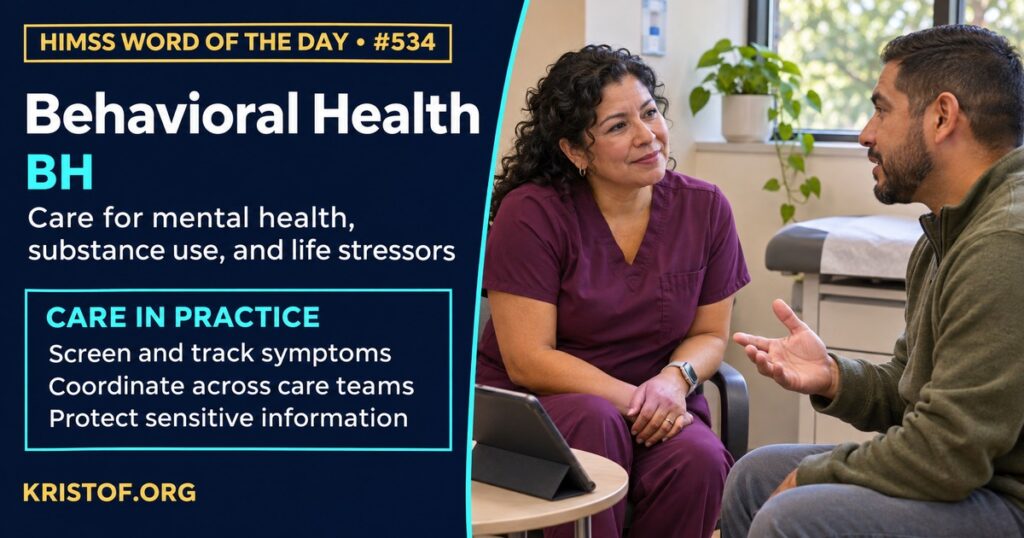
The HIMSS Dictionary describes behavioral health (BH) as a broad area spanning mental health conditions, problematic substance use, personal crises and stressors, and bodily symptoms linked to stress. Behavioral healthcare is the work of preventing, diagnosing, and treating those conditions. The term is wider than “mental illness” alone, and it reflects the view that emotional, behavioral, and physical health interact.
For health IT, behavioral health raises distinctive questions. Care is delivered by many types of clinicians, including primary care physicians and nurses, psychiatrists, psychologists, counselors, social workers, peer supporters, and care managers. Care often happens across settings: a primary care clinic, an emergency department, a specialty program, a school, or a video visit. Assessment relies heavily on structured questionnaires and the clinician’s narrative, which makes both structured data and notes important. And information is sensitive: patients may worry about confidentiality, and some substance use treatment records carry additional protections.
Several health IT themes recur. Measurement-based care uses regular symptom scales to guide treatment, and depends on workflows and tools that collect, score, and display the scores. The collaborative care model pairs primary care with a care manager and psychiatric consultant, and needs registries and shared records. Telehealth extends reach, especially where specialists are scarce. Interoperability matters because behavioral health information has often been stored apart from the rest of the record. Each of these touches design choices in the EHR, privacy controls, and support for teams that cross organizational lines.
| Theme | Health IT connection |
|---|---|
| Measurement-based care | Questionnaires, scoring, trending, and feedback in the record |
| Collaborative care | Registries, shared plans, and team communication |
| Telehealth | Video and phone visits, scheduling, and documentation |
| Interoperability | Sharing behavioral health data with other providers while respecting privacy rules |
| Digital tools | Apps, web platforms, and automated outreach |
⚠️ Exam Alert: Behavioral health covers mental health and substance use conditions plus life stressors and stress-related symptoms. The DSM supplies diagnostic criteria, while ICD supplies codes. Do not confuse behavioral health (the field of care) with behavioral informatics or behavior change interventions, and note that substance use treatment records may have extra privacy protections under separate rules.
🌐 Why It Matters: Real-World Healthcare IT Context
Evidence on behavioral health and health IT covers measurement tools, care models, and delivery by telehealth. Each source below was checked against its published abstract.
Lewis and colleagues, in JAMA Psychiatry (2019), reviewed the implementation of measurement-based care (MBC), the systematic evaluation of patient symptoms to inform treatment. They report that MBC can speed improvement and help detect deteriorating patients, yet typically fewer than 20 percent of behavioral health practitioners use it. Barriers occur at patient, practitioner, organization, and system levels, and strategies include measurement feedback systems, local champions, learning collaboratives, and leadership training. Among the authors’ research priorities is streamlining measurement feedback systems and enhancing EHR interoperability. It is a narrative review.
Moon and colleagues, in JMIR Mental Health (2022), conducted a scoping review of digital and mobile health technology used to augment the collaborative care model in primary care. Of 3,982 nonduplicate reports, 20 were included. Technologies included apps, websites, web platforms, telephone-based interactive voice recordings, and mobile sensor data. Satisfaction results were positive, but some interventions increased provider workload, and in the seven studies (35 percent) that measured clinical outcomes, differences were absent or modest. The authors found technology worked best when built into existing workflows without relying on patient or provider initiative.
Whitfield and colleagues, in the Journal of the Academy of Consultation-Liaison Psychiatry (2022), systematically reviewed randomized trials of remote collaborative care teams. From 13,211 articles, nine trials met inclusion criteria, with sample sizes from 191 to 704 patients. The trials collectively showed remote collaborative care to be effective for depression, anxiety, and PTSD in primary care and specialty settings. The authors say organizations may have more flexibility in building teams than previously thought. The included studies were conducted from 2000 to 2014, so telehealth practices have since changed.
Lombardi and colleagues, in Community Mental Health Journal (2024), surveyed administrators of federally qualified health centers about integrated behavioral health delivered by telehealth during COVID-19. Of 46 administrators, 14 (30.4 percent) reported delivering integrated behavioral health by telecommunication before the pandemic, and afterward almost all (44, or 95.7 percent) did. Interviews with nine administrators produced themes: telehealth was essential, core components of integrated care were affected, payment parity was a concern, and telehealth helped address workforce issues. Without co-location, warm handoffs and other core components were limited. The sample is small and from one period.
Arora and colleagues, in Clinical Pediatrics (2023), reported a mostly virtual collaborative behavioral health model in a community pediatric network, implemented in 18 practices (48 primary care practitioners serving about 150,000 patients) in two cohorts. Using pre-program and post-program surveys, they found significantly increased confidence in behavioral health knowledge and skills and more provision of target services, while barriers of resources, time, and staff were unchanged. The outcomes are practitioner-reported rather than patient outcomes.
Taken together, the sources show that behavioral health care benefits from structured measurement and team-based models, that technology helps most when it fits existing workflows, and that telehealth has changed access while leaving some core components harder to deliver.
Common behavioral health IT problems:
- Low use of symptom measures that could guide treatment
- Behavioral health information stored apart from the rest of the record
- Tools that add workload or depend on patient initiative
- Privacy concerns and complex rules for sensitive records
- Limited co-location and warm handoffs in virtual models
- Payment and policy uncertainty around telehealth
What supports effective behavioral health care:
- Measurement-based care built into workflows with feedback in the record
- Registries and shared plans for collaborative care teams
- Telehealth options that preserve handoffs and team contact
- Integration with existing workflows rather than separate portals
- Clear privacy controls and patient communication
- Local champions, training, and leadership support
🏥 The Nurse’s Perspective: Clinical, Bedside, & Workflow
Nurses in every setting care for people with behavioral health needs, and many carry out the screening, monitoring, and coordination that the studies describe.
At the Bedside
Nurses screen for depression, anxiety, suicide risk, and substance use, and they notice changes in mood and behavior. Calm, respectful communication and accurate documentation support safe care. Nurses also help patients and families understand the care plan and where to turn for help.
In Clinical Workflow
Nurse care managers and informaticists are central to collaborative care and measurement-based care. They help design screening flowsheets, track scores over time, and make sure results reach the person who needs them. They also help with telehealth visits and with referral and follow-up, so patients are not lost between settings.
In EHR Implementation (Go-Live Perspective)
During an Epic Go-Live, behavioral health areas bring special workflows: safety observations, restricted note access, specialized assessments, and group or telehealth visits. Analysts at the elbow listen for places where privacy settings block needed information or where screening tools are hard to find. Fixing these early supports both care quality and confidentiality.
🎓 CAHIMS / CPHIMS & HIMSS Perspective
CAHIMS Exam Domain Mapping
Behavioral health connects clinical practice, privacy, and care models:
| CAHIMS Domain | How Behavioral Health Appears |
|---|---|
| Healthcare & Technology Environments | Care settings, payment policy, and telehealth |
| Clinical Informatics | Screening tools, measurement-based care, and care team workflows |
| Healthcare Information & Systems Management | Privacy controls, interoperability, and data governance |
| Management & Leadership | Program design, workforce, and change management |
Key Terms to Know Alongside Behavioral Health
- DSM — manual of diagnostic criteria for mental disorders
- Collaborative Care Model — team-based primary care approach with a care manager and psychiatric consultant
- Measurement-Based Care — use of regular symptom measures to guide treatment
- Telehealth — delivery of care by telecommunications technology
- Care Coordination — organizing care activities across people and settings
- Consent — patient permission for the use or sharing of health information
HIMSS Organizational Position
HIMSS offers education and research on health information and technology topics through its Resource Center. Members can find related information on the HIMSS Resource Center page.
🧭 More HIMSS Word of The Day Terms
Related terms in the Clinical Informatics series:
Browse all Clinical Informatics terms or the A–Z glossary.
🔗 Explore Further: External References
- Lewis et al. (2019), JAMA psychiatry — Implementing Measurement-Based Care in Behavioral Health: A Review https://pubmed.ncbi.nlm.nih.gov/30566197/
- Moon et al. (2022), JMIR mental health — Digital and Mobile Health Technology in Collaborative Behavioral Health Care: Scoping Review https://pubmed.ncbi.nlm.nih.gov/35171105/
- Whitfield et al. (2022), Journal of the Academy of Consultation-Liaison Psychiatry — Remote Collaborative Care With Off-Site Behavioral Health Care Managers: A Systematic Review of Clinical Trials https://pubmed.ncbi.nlm.nih.gov/34389509/
- Lombardi et al. (2024), Community mental health journal — Federally Qualified Health Centers Use of Telehealth to Deliver Integrated Behavioral Health Care During COVID-19 https://pubmed.ncbi.nlm.nih.gov/36547816/
- Arora et al. (2023), Clinical pediatrics — Virtual Collaborative Behavioral Health Model in a Community Pediatric Network: Two-Year Outcomes https://pubmed.ncbi.nlm.nih.gov/36988180/
- HIMSS — Resource Center https://www.himss.org/resource-center
Term source: HIMSS Dictionary of Health Information and Technology Terms, Acronyms, and Organizations, 6th Edition (2025). All definitions in this series are paraphrased for editorial purposes. Readers are encouraged to consult the primary source for exact language.
Eric Andrew Kristof, RN, CAHIMS is a Healthcare IT professional and HIMSS Arkansas Chapter member based in Hot Springs Village, AR, with hands-on Epic Go-Live experience and a diverse healthcare and IT background. He writes at kristof.org at the intersection of clinical care and healthcare technology.
Leave a Reply