By Eric Andrew Kristof, RN, CAHIMS | Healthcare IT Professional | HIMSS Arkansas Chapter Member
About This Series: The HIMSS Word of The Day is a running blog series drawing from the HIMSS Dictionary of Health Information and Technology Terms, Acronyms, and Organizations, 6th Edition (2025) — the authoritative reference for healthcare IT professionals and the primary study resource for CAHIMS and CPHIMS certification. Each post paraphrases the term in plain language, grounds it in real-world healthcare IT context, and adds a bedside nursing perspective you won’t find in a textbook.
📖 The Term: Streaming
Source: HIMSS Dictionary of Health Information and Technology Terms, Acronyms, and Organizations, 6th Edition (2025)
🔍 Plain-Language Definition
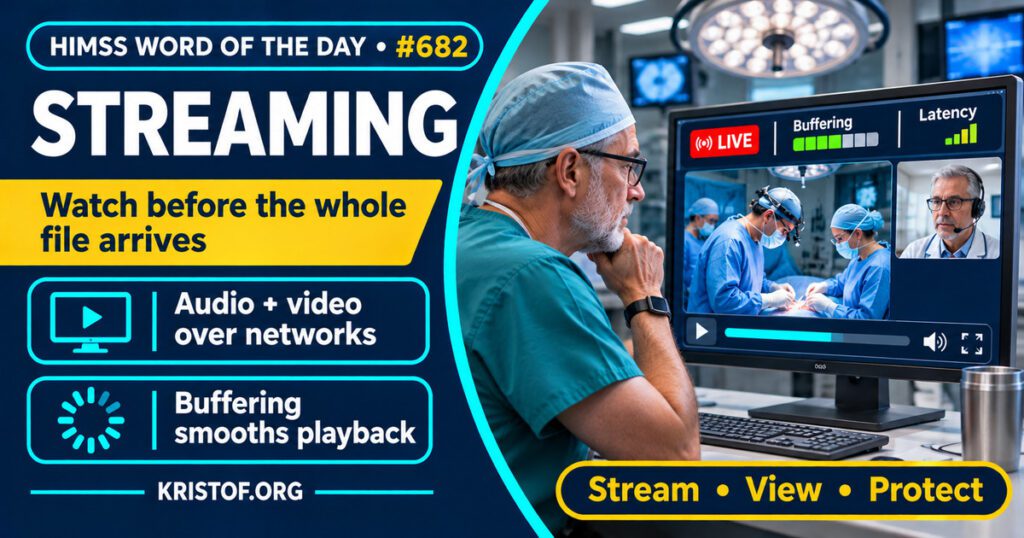
The HIMSS Dictionary describes streaming as a way of delivering audio and video data so the receiver can begin hearing or seeing a file before all of it has arrived. The receiving computer also needs a way to keep playback smooth even though the data comes in unevenly.
In the studies below, streaming carries live video and audio from an operating room, a microscope, or a hospital system to a remote viewer, and in one case a system that also records and archives the stream.
| Setting in the studies | What was streamed | Who watched |
|---|---|---|
| Surgical teleconsultation | Operating room video and audio over a wireless network | Surgeon consultants on a handheld device |
| Surgical education | Live surgery video | Trainees and other viewers |
| Pathology | Microscope video from a smartphone adapter | A remote pathologist |
| Hybrid operating room | Surgery performance data and imaging | A conference room and remote viewers |
⚠️ Exam Alert: Streaming is not the same as downloading, where the whole file arrives first. Streaming also is not automatically two-way, since some systems add interaction and others only broadcast. Do not assume a streamed session is recorded or secure, because those depend on how a system is built.
🌐 Why It Matters: Real-World Healthcare IT Context
Where it shows up. In my searches, the streaming studies I found were concentrated in surgery and a few other video-heavy specialties. The five studies below are small, mostly single-site, or retrospective, and I read abstracts only.
A review of live surgical streaming. Abu-Rmaileh et al. (2022) reviewed literature on live streaming of surgery, starting from 32 articles found in PubMed and Ovid. They report enhanced surgeon interaction with viewers and improved anatomy scores, and that surgeons reported positive feedback. The largest barriers they identify are video quality over the internet and patient information protection. They say live streaming of surgery for education has not been widely accepted in training programs and that little has been done to stream to trainees in a manner compliant with HIPAA. It is a narrative review based on a two-term search.
An early test of video quality. Schneider et al. (2007) tested a video streaming server in an operating room sending video and audio over a wireless network to a handheld computer, with two groups of 20 surgeons. Correct understanding of numbers by voice was 100% (n = 1,000) and of medical terms 98% (n = 400). Only 62% of structures were identified clearly on the handheld device, versus 78% on a 50 cm screen (p < 0.001), and accuracy was better when audio conversation was possible. The consultants judged the display sufficient for clinical use. The handheld computer is a 2007 device, so the findings on picture size are dated.
Remote pathology review. Agarwal et al. (2016) used FaceTime with smartphone adapters on microscopes for remote adequacy assessment of fine-needle aspiration samples. In a retrospective phase, 22 of 25 samples (88%) agreed between onsite and remote assessments, and two samples read as adequate onsite were indeterminate by FaceTime. In later phases, 14 samples agreed on adequacy and preliminary diagnosis. Reported problems included software version standardization, camera alignment, and rarely audio comprehension. The sample is small.
Is live-streamed surgery safe? Fassari et al. (2026) compared 42 robotic live-streamed liver resections with 42 matched resections that were not streamed, among 311 liver resections at three European centers between October 2024 and December 2025. Severe complications (Clavien-Dindo grade III or higher) were 4.8% versus 7.1%. The streamed group had a higher frequency and longer duration of the Pringle maneuver, a shorter hospital stay, and a lower rate of any-grade 30-day complications, and the authors read the Pringle finding as a teaching strategy and not as added risk. The streamed group also had larger tumours and more technically advanced resections. It is a retrospective study in highly selected patients, and the authors call for prospective studies of educational efficacy.
A hospital system build. Lin et al. (2020) describe an intelligent operating room system that streams surgery performance and imaging data from a hybrid operating room to a conference room, with a streaming server for recording, archiving, and playback. The authors report near-zero latency on the wired stream and say readily available hardware and open-access programming reduced cost. It is a development and usability study at one site, and the abstract gives no measured latency.
What I could not confirm. I did not find evidence that streaming improves patient outcomes or education outcomes, beyond the associations the review reports. I did not review any legal or privacy guidance on streaming patient video, and I did not review studies of streaming in other settings such as home telehealth or remote monitoring. I did not look at the technical details of buffering or streaming protocols beyond the dictionary’s description.
Common streaming problems:
- Video quality over the internet, which the review names as a barrier
- Protecting patient information in streamed content
- Small screens that make structures harder to identify
- Software version differences and camera alignment, as in the pathology study
- Streaming that has not been widely accepted in training programs
What supports streaming:
- Audio conversation alongside the video, which improved accuracy in the handheld study
- Low-cost, readily available hardware, as the hybrid operating room team reports
- Interaction between the presenting surgeon and viewers
- Recording and archiving through a streaming server
- Standardized software versions and camera setup
🏥 The Nurse’s Perspective: Clinical, Bedside, & Workflow
Operating room nurses are typically part of the team during a streamed procedure, though the abstracts do not describe their role.
At the Bedside
Patient information protection is the barrier the review names alongside video quality. How nurses handle consent and camera placement for streamed procedures is a local matter that none of these studies describes.
In Clinical Workflow
In the pathology study, the person driving the slide could be a resident or a cytotechnologist while a remote pathologist watched, which illustrates how streaming can add a remote participant to a workflow. For nurses in other settings, the closest parallel is a remote consult that depends on a camera view, which is an analogy and not a finding.
In EHR Implementation (Go-Live Perspective)
During an Epic Go-Live, analysts and at-the-elbow support staff depend on network capacity and devices working, as would any streamed or video-based service. That is general workflow context, and none of the studies reviewed examines go-lives.
🎓 CAHIMS / CPHIMS & HIMSS Perspective
CAHIMS Exam Domain Mapping
Streaming appears in questions about networks, telehealth, and information protection:
| CAHIMS Domain | How Streaming Appears |
|---|---|
| Healthcare & Technology Environments | Network delivery of audio and video |
| Clinical Informatics | Remote consultation, education, and telementoring |
| Healthcare Information & Systems Management | Bandwidth, latency, servers, and protecting patient video |
| Management & Leadership | Cost, privacy policy, and adoption in training |
Key Terms to Know Alongside Streaming
- Latency — the delay between when data is sent and when it is seen or heard
- Bandwidth — the amount of data a network connection can carry over time
- Telementoring — guidance of a clinician by a remote expert, which the hybrid operating room study names as a benefit
- Teleconsultation — a remote consultation, as in the surgical video study
- Protected health information — individually identifiable health information that privacy rules protect, a general definition
- Streaming server — a server that delivers, and in one study records, a stream
HIMSS Organizational Position
HIMSS offers education and research on health information and technology topics through its Resource Center. Members can find related information on the HIMSS Resource Center page.
🧭 More HIMSS Word of The Day Terms
Related terms in the IT Infrastructure series:
Browse all IT Infrastructure terms or the A–Z glossary.
🔗 Explore Further: External References
- Abu-Rmaileh et al. (2022), Annals of Plastic Surgery — The Use of Live Streaming Technologies in Surgery: A Review of the Literature. https://pubmed.ncbi.nlm.nih.gov/34270473/
- Schneider et al. (2007), Journal of Telemedicine and Telecare — Wireless live streaming video of surgical operations: an evaluation of communication quality. https://pubmed.ncbi.nlm.nih.gov/18078549/
- Agarwal et al. (2016), Cancer Cytopathology — FaceTime validation study: Low-cost streaming video for cytology adequacy assessment. https://pubmed.ncbi.nlm.nih.gov/26491941/
- Fassari et al. (2026), Journal of Robotic Surgery — Live-streaming robotic liver resection for surgical education: is it safe? a multicenter matched cohort analysis. https://pubmed.ncbi.nlm.nih.gov/42487051/
- Lin et al. (2020), JMIR Medical Informatics — Real-Time Streaming of Surgery Performance and Intraoperative Imaging Data in the Hybrid Operating Room: Development and Usability Study. https://pubmed.ncbi.nlm.nih.gov/32209528/
- HIMSS — Resource Center https://www.himss.org/resource-center
Term source: HIMSS Dictionary of Health Information and Technology Terms, Acronyms, and Organizations, 6th Edition (2025). All definitions in this series are paraphrased for editorial purposes. Readers are encouraged to consult the primary source for exact language.
Eric Andrew Kristof, RN, CAHIMS is a Healthcare IT professional and HIMSS Arkansas Chapter member based in Hot Springs Village, AR, with hands-on Epic Go-Live experience and a diverse healthcare and IT background. He writes at kristof.org at the intersection of clinical care and healthcare technology.
Leave a Reply