By Eric Andrew Kristof, RN, CAHIMS | Healthcare IT Professional | HIMSS Arkansas Chapter Member
About This Series: The HIMSS Word of The Day is a running blog series drawing from the HIMSS Dictionary of Health Information and Technology Terms, Acronyms, and Organizations, 6th Edition (2025) — the authoritative reference for healthcare IT professionals and the primary study resource for CAHIMS and CPHIMS certification. Each post paraphrases the term in plain language, grounds it in real-world healthcare IT context, and adds a bedside nursing perspective you won’t find in a textbook.
📖 The Term: Hackathon
Source: HIMSS Dictionary of Health Information and Technology Terms, Acronyms, and Organizations, 6th Edition (2025)
🔍 Plain-Language Definition
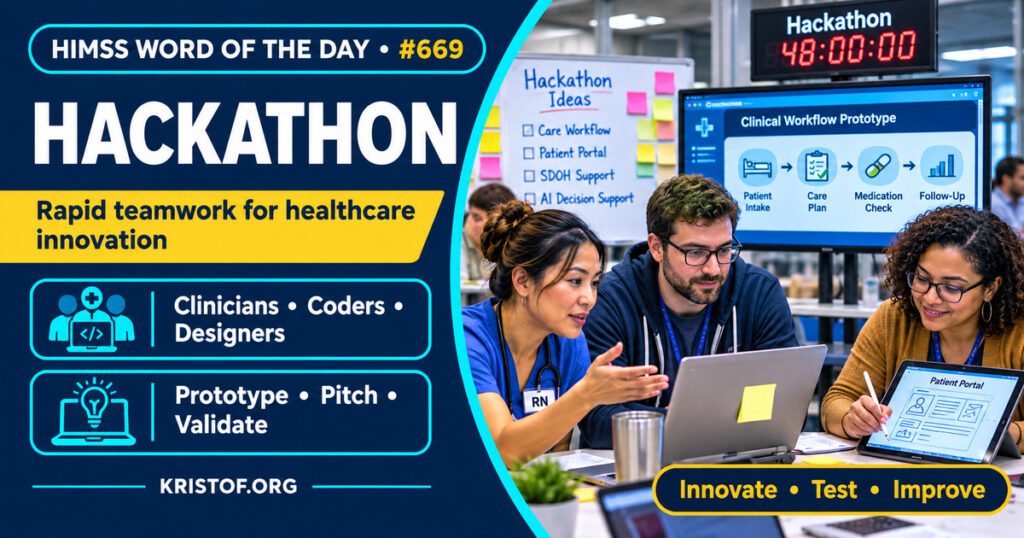
The HIMSS Dictionary describes a hackathon as a gathering at which programmers collaborate on code in an intense way over a short period. Events last at least a few days, often a weekend, and usually no longer than a week. Within a project, each developer is meant to have latitude to pursue the ideas that interest them.
The health literature uses the word more broadly than that definition suggests. Pathanasethpong and colleagues (2020) describe a health hackathon as an opportunity for healthcare professionals to collaborate with information technology developers and designers to solve health issues. Bigott and colleagues (2023) describe a hackathon run by nurse educators in which nurse teams brainstormed, drafted, and refined a solution and then pitched it to an expert panel. So, in healthcare, a hackathon may include clinicians, students, and designers, and the output may be a prototype or a proposal, not only code.
| Element | Dictionary description | Health care examples in the sources below |
|---|---|---|
| Time frame | A few days to about a week | A limited time frame, in the nurse educator event |
| Participants | Programmers | Clinicians, developers, designers, nurses, pharmacy students |
| Output | Code worked on collaboratively | AI prototypes, or ranked pitches for programs |
| Setting | Not specified | Hospital, health system, and school settings |
⚠️ Exam Alert: A hackathon is a time-limited collaborative event, not a software development methodology such as agile development, and it is not a standing project team. A prototype built at a hackathon is not the same as a validated system in production.
🌐 Why It Matters: Real-World Healthcare IT Context
A hospital generative AI event. Frid and colleagues (2025) describe a multidisciplinary hackathon at Hospital Clínic de Barcelona that was designed to develop and evaluate generative AI solutions for real clinical challenges. Thirteen challenges were selected through an internal call based on clinical impact, feasibility, and data availability. Participants used anonymized real-world data in a secure cloud environment, and teams used large language models and retrieval-augmented generation to build prototypes for tasks such as clinical text structuring, decision support, and workflow automation. The authors emphasize human-in-the-loop validation, explainability, and regulatory safeguards. They report entity recognition at 90.5 percent accuracy, summarization with more than 90 percent clinician concordance, and nutritional models with F1 scores of 0.75 to 0.93, but lower scores, with F1 under 0.52 and Jaccard index under 0.4, in complex reasoning and multilingual tasks. Bias was explored in 10 projects. The authors conclude that generative AI can be applied safely and effectively with strong governance. That is their conclusion from prototypes, and the abstract does not give sample sizes or evidence of clinical deployment.
Nurse education. Bigott and colleagues (2023) describe how a nursing education and professional development department at a large midwestern health care system used a hackathon to look for solutions to an organizational problem. Topics focused on community service opportunities related to social determinants of health. Teams brainstormed, drafted, and refined solutions, then pitched them to an expert panel that scored each pitch on feasibility, connection to social determinants, creativity, sustainability, and potential nurse engagement. Three program options emerged, and the winning pitch was a peer-to-peer social media strategy to engage adolescents in health and wellness topics. This is a description of one event, and it reports no outcomes after the event.
Interprofessional learning. Pathanasethpong and colleagues (2020) interviewed three faculty members and three students who took part in a 2017 mobile health hackathon. Participants reported learning to collaborate in interprofessional teams, appreciating other professions’ work, focusing on practical problem solving, and enjoying a collegial atmosphere. They also described potential downsides that a better event design might address. With six interviewees, this is a small qualitative study.
Pharmacy students. Cox and Barchet (2023) assessed a pharmacy school hackathon pilot planned over four months. They report that average excitement before the event increased, that student confidence in performing steps of the innovation process improved, and that students would recommend the event. The abstract gives no numbers, and the outcomes are self-reported perceptions.
A process model. Yarmohammadian and colleagues (2021) clarify the role of hackathons as an innovative educational approach in health care education and propose a process model for organizing hackathon events. It is a proposed model, not a tested one.
What I could not confirm. I did not find a controlled study showing that hackathons produce tools that reach clinical use or improve patient outcomes, and the reports above describe single events with mostly self-reported outcomes. I did not review hackathons in other countries beyond those cited, and I read abstracts only.
Common hackathon problems:
- No plan for what happens to prototypes after the event
- Participants who do not include the clinicians who live with the problem
- Real data used without clear privacy and governance rules
- Judging by enthusiasm instead of feasibility and evidence
- Treating a prototype’s results as proof it is ready for use
What supports a good hackathon:
- A real clinical or organizational problem chosen in advance
- A mix of clinicians, developers, and designers
- Clear scoring criteria such as feasibility, creativity, and sustainability
- Secure, anonymized data and governance for any AI work
- A path for promising ideas after the event
🏥 The Nurse’s Perspective: Clinical, Bedside, & Workflow
Nurses are the people who know where the workflow hurts, which makes them natural hackathon participants.
At the Bedside
Bigott and colleagues (2023) describe nurse teams who rapidly refined an idea and pitched it, which shows that nurses can lead the problem selection and design. A nurse who brings a real bedside frustration to such an event gives the team something concrete to solve.
In Clinical Workflow
In the Barcelona event, teams worked on tasks such as clinical text structuring and workflow automation, with human-in-the-loop validation emphasized. A nurse reviewer in a similar event checks whether the output would be usable and safe in real work, though the abstract does not say which professions served as validators.
In EHR Implementation (Go-Live Perspective)
After an Epic Go-Live, analysts and at-the-elbow support staff collect many small improvement ideas. A short, structured event could be one way to turn them into prototypes. This is a suggestion, and none of the reports above describes a post-go-live hackathon.
🎓 CAHIMS / CPHIMS & HIMSS Perspective
CAHIMS Exam Domain Mapping
Hackathons appear as an innovation and collaboration method:
| CAHIMS Domain | How Hackathons Appear |
|---|---|
| Healthcare & Technology Environments | Prototyping, cloud environments, and technology innovation |
| Clinical Informatics | Clinician-developer collaboration and clinical use cases |
| Healthcare Information & Systems Management | Data access, governance, and moving prototypes into production |
| Management & Leadership | Innovation programs, interprofessional teamwork, and scoring criteria |
Key Terms to Know Alongside Hackathon
- Prototype — an early working model built to test an idea
- Interprofessional education — learning in which members of different professions learn with and from each other
- Large language model (LLM) — an AI model trained on large amounts of text to generate language
- Retrieval-augmented generation (RAG) — a method that supplies retrieved documents to a language model to ground its answers
- Human-in-the-loop — a design in which a person reviews or approves automated output
- Social determinants of health — the conditions in which people live, learn, and work that affect health
HIMSS Organizational Position
HIMSS offers education and research on health information and technology topics through its Resource Center. Members can find related information on the HIMSS Resource Center page.
🧭 More HIMSS Word of The Day Terms
Related terms in the Project and Change Management series:
Browse all Project and Change Management terms or the A–Z glossary.
🔗 Explore Further: External References
- Frid et al. (2025), BMJ Health & Care Informatics — Bridging generative AI and healthcare practice: insights from the GenAI Health Hackathon at Hospital Clínic de Barcelona https://pubmed.ncbi.nlm.nih.gov/41093629/
- Bigott et al. (2023), American Journal of Nursing — Hackathons: Practical Problem-Solving for Nurse Educators https://pubmed.ncbi.nlm.nih.gov/37345782/
- Pathanasethpong et al. (2020), Journal of Interprofessional Care — Health hackathon as a venue for interprofessional education: a qualitative interview study https://pubmed.ncbi.nlm.nih.gov/31865825/
- Cox and Barchet (2023), Currents in Pharmacy Teaching and Learning — Evaluating the implementation of a pharmacy hackathon pilot https://pubmed.ncbi.nlm.nih.gov/37714756/
- Yarmohammadian et al. (2021), Journal of Education and Health Promotion — The role of hackathon in education: Can hackathon improve health and medical education? https://pubmed.ncbi.nlm.nih.gov/34761020/
- HIMSS — Resource Center https://www.himss.org/resource-center
Term source: HIMSS Dictionary of Health Information and Technology Terms, Acronyms, and Organizations, 6th Edition (2025). All definitions in this series are paraphrased for editorial purposes. Readers are encouraged to consult the primary source for exact language.
Eric Andrew Kristof, RN, CAHIMS is a Healthcare IT professional and HIMSS Arkansas Chapter member based in Hot Springs Village, AR, with hands-on Epic Go-Live experience and a diverse healthcare and IT background. He writes at kristof.org at the intersection of clinical care and healthcare technology.
Leave a Reply