By Eric Andrew Kristof, RN, CAHIMS | Healthcare IT Professional | HIMSS Arkansas Chapter Member
About This Series: The HIMSS Word of the Day is a running blog series drawing from the HIMSS Dictionary of Health Information and Technology Terms, Acronyms, and Organizations, 6th Edition (2025) — the authoritative reference for healthcare IT professionals and the primary study resource for CAHIMS and CPHIMS certification. Each post paraphrases the term in plain language, grounds it in real-world healthcare IT context, and adds a bedside nursing perspective you won’t find in a textbook.
📖 The Term: Anonymization
Source: HIMSS Dictionary of Health Information and Technology Terms, Acronyms, and Organizations, 6th Edition (2025)
🔍 Plain-Language Definition
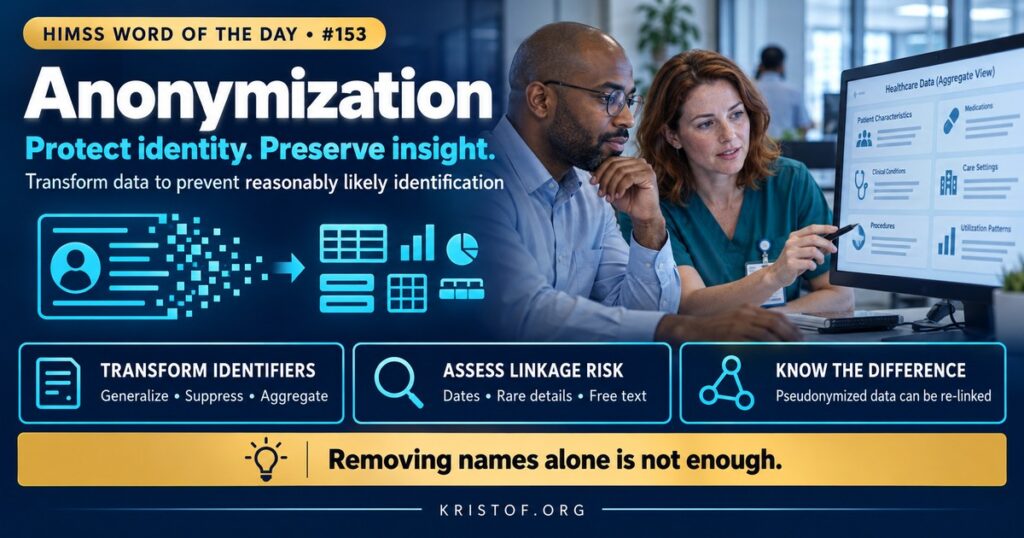
Anonymization is the process of removing or transforming identifying information in data so that the individuals described can no longer be identified, directly or indirectly, by any reasonably likely means.
The HIMSS Dictionary describes anonymization as removing or replacing identity information in a communication or record. It notes that data may instead be made pseudonymous, in which case the same person always receives the same substitute identity, but that substitute cannot be used to identify the person.
| Technique | What It Does | Can Data Be Linked Back? |
|---|---|---|
| Anonymization | Irreversibly removes the ability to identify individuals | Should not be possible by reasonably likely means |
| Pseudonymization | Replaces identifiers with consistent codes or tokens | Yes, with access to the key or mapping |
| HIPAA De-Identification | Meets Safe Harbor or Expert Determination standards | Very small risk remains; re-identification codes allowed under conditions |
| Limited Data Set | Removes direct identifiers but keeps dates and some geography | Still PHI; requires a data use agreement |
| Masking or Redaction | Hides specific fields in a view or document | Underlying data may still be identifiable |
⚠️ Exam Alert: Pseudonymized data can be linked back with a key and is generally still personal data under GDPR. Truly anonymized data falls outside GDPR. HIPAA uses the term de-identification, with two methods: Safe Harbor and Expert Determination. A limited data set is still PHI.
🌐 Why It Matters: Real-World Healthcare IT Context
Health data has enormous value for research, quality improvement, public health, and artificial intelligence. Using it while protecting privacy requires reducing or removing the ability to identify individuals. Anonymization, pseudonymization, and de-identification are the main techniques for doing so.
In the United States, HIPAA defines de-identification rather than anonymization. Under the Safe Harbor method, 18 types of identifiers are removed and the organization has no actual knowledge that the remaining information could identify someone. Under Expert Determination, a qualified expert applies statistical and scientific methods to conclude that the risk of re-identification is very small. De-identified data is no longer PHI under HIPAA.
European law draws the line differently. Under the General Data Protection Regulation, data that is truly anonymous falls outside the regulation, but pseudonymized data remains personal data because it can be re-linked with additional information. That distinction matters for multinational research and vendors.
Re-identification is a real risk. Research has repeatedly shown that combinations of seemingly harmless details, such as ZIP code, birth date, and sex, can uniquely identify many people, and that linking datasets or using public information can reveal identities. Rare conditions, small populations, unusual dates, and free-text notes increase the risk. Genomic data is especially difficult to anonymize because it is inherently unique.
Techniques continue to evolve. Generalization (for example, using age ranges instead of birth dates), suppression of rare values, adding noise, and aggregation reduce risk. Privacy-enhancing technologies, such as differential privacy, synthetic data, federated analysis, and secure enclaves, allow analysis while limiting exposure. NIST has published guidance on de-identification, including SP 800-188 for government datasets.
Utility and privacy trade off. Removing more detail lowers re-identification risk but can make data less useful. Researchers may need dates to study timing or geography to study disparities, which is why limited data sets and data use agreements exist.
Governance is essential. Even de-identified or anonymized data should be shared under agreements that prohibit re-identification attempts, restrict linkage, and define permitted uses. Organizations should assess risk for each release rather than assuming one method fits all purposes.
AI raises new questions. Training models on de-identified records is common, but models can sometimes memorize and reveal details from training data, so privacy protections must extend to how models are built and tested.
Common anonymization pitfalls:
- Removing names while leaving dates, ZIP codes, or rare details
- Free-text notes and images with hidden identifiers
- Assuming pseudonymized data is anonymous
- Linking de-identified data with other datasets
- Small cell sizes that reveal individuals in reports
- No agreements prohibiting re-identification
Practices for responsible anonymization:
- Choosing the right technique for each use and risk level
- Expert review for complex or high-risk releases
- Data use agreements prohibiting re-identification
- Minimum cell size rules for published results
- Scrubbing free text and image metadata
- Periodic reassessment as new data sources emerge
🏥 The Nurse’s Perspective: Clinical, Bedside, & Workflow
Nurses contribute to and benefit from anonymized and de-identified data, especially in quality improvement and research.
At the Bedside
Patients sometimes ask whether their information will be used for research or shared outside the organization. Nurses can explain that organizations use protections such as de-identification and approvals before data is used for research, and can direct detailed questions to privacy or research offices.
Photos, case details, and stories shared in education or on social media can identify patients even without names. Unique details, such as a rare condition, a date, or a distinctive tattoo, may reveal identity, so nurses should follow organizational rules before sharing any patient-related content.
In Clinical Workflow
Nurses leading quality projects or evidence-based practice work often request data. Understanding whether a project needs identified data, a limited data set, or de-identified data helps nurses request the right level and follow the correct approval process.
When presenting results, small numbers can identify individuals. Combining categories or suppressing very small counts protects privacy in unit dashboards and posters.
Nurse researchers working with institutional review boards learn how de-identification, consent, and data use agreements interact, and can help colleagues navigate these requirements.
Free-text nursing notes can contain identifiers such as family names or addresses, which is why free text is especially hard to de-identify.
In EHR Implementation (Go-Live Perspective)
During an Epic Go-Live, training environments often use test patients or de-identified data. Using real patient information in training, screenshots, or tip sheets is generally prohibited unless properly authorized.
At-the-elbow support analysts creating job aids should use fictitious patients. Reporting real patient information found in training materials helps prevent accidental disclosures.
🎓 CAHIMS / CPHIMS & HIMSS Perspective
CAHIMS Exam Domain Mapping
Anonymization appears in privacy, data governance, and research questions:
| CAHIMS Domain | How Anonymization Appears |
|---|---|
| Healthcare & Technology Environments | HIPAA de-identification; GDPR; research regulations |
| Clinical Informatics | Quality improvement data requests, sharing patient stories, training materials |
| Healthcare Information & Systems Management | De-identification techniques, privacy-enhancing technologies, data release processes |
| Management & Leadership | Data governance, data use agreements, risk assessment |
Key Terms to Know Alongside Anonymization
- De-Identification — HIPAA’s process for removing identifiers so data is no longer PHI
- Pseudonymization — replacing identifiers with codes that can be linked back with a key
- Re-Identification — determining the identity of individuals in supposedly de-identified data
- Safe Harbor — the HIPAA method that removes 18 specified identifiers
- Expert Determination — the HIPAA method relying on a qualified expert’s risk analysis
- Differential Privacy — a technique that adds controlled noise to protect individuals in data analysis
HIMSS Organizational Position
HIMSS supports responsible secondary use of health data through its data governance, privacy, and AI education, emphasizing protections that maintain public trust. Members can find related education and research through the HIMSS Resource Center.
🔗 Explore Further: External References
- HHS — Guidance Regarding Methods for De-identification of PHI https://www.hhs.gov/hipaa/for-professionals/special-topics/de-identification/index.html
- NIST — SP 800-188, De-Identifying Government Datasets: Techniques and Governance https://csrc.nist.gov/pubs/sp/800/188/final
- NIST — IR 8053, De-Identification of Personal Information https://csrc.nist.gov/pubs/ir/8053/final
- European Commission — Data Protection https://commission.europa.eu/law/law-topic/data-protection_en
- HHS — HIPAA and Research https://www.hhs.gov/hipaa/for-professionals/special-topics/research/index.html
- HIMSS — Public Policy & Advocacy https://www.himss.org/public-policy-advocacy-overview
Term source: HIMSS Dictionary of Health Information and Technology Terms, Acronyms, and Organizations, 6th Edition (2025). All definitions in this series are paraphrased for editorial purposes. Readers are encouraged to consult the primary source for exact language.
Eric Andrew Kristof, RN, CAHIMS is a Healthcare IT professional and HIMSS Arkansas Chapter member based in Hot Springs Village, AR, with hands-on Epic Go-Live experience and a diverse healthcare and IT background. He writes at kristof.org at the intersection of clinical care and healthcare technology.
Leave a Reply