By Eric Andrew Kristof, RN, CAHIMS | Healthcare IT Professional | HIMSS Arkansas Chapter Member
About This Series: The HIMSS Word of The Day is a running blog series drawing from the HIMSS Dictionary of Health Information and Technology Terms, Acronyms, and Organizations, 6th Edition (2025) — the authoritative reference for healthcare IT professionals and the primary study resource for CAHIMS and CPHIMS certification. Each post paraphrases the term in plain language, grounds it in real-world healthcare IT context, and adds a bedside nursing perspective you won’t find in a textbook.
📖 The Term: Measure
Source: HIMSS Dictionary of Health Information and Technology Terms, Acronyms, and Organizations, 6th Edition (2025)
🔍 Plain-Language Definition
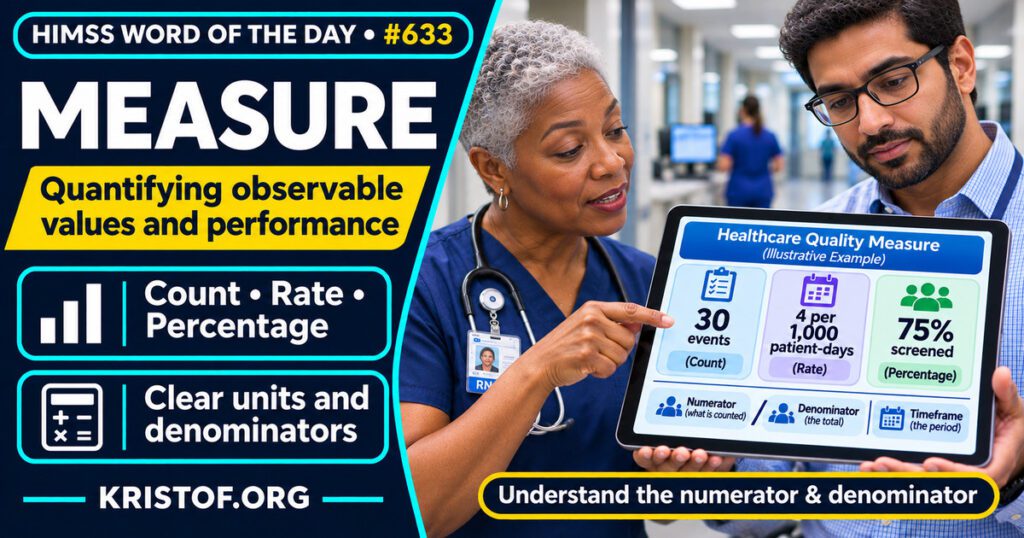
The HIMSS Dictionary treats a measure as a quantity that captures something directly observable, such as a value or a level of performance. Every measure carries a unit, and it may take the form of a count, a rate, a proportion, a percentage, or a ratio.
The form matters because each answers a different question. A count says how many. A rate says how often something happens relative to a population or a span of time. A proportion says what share of a group has a characteristic. A ratio compares two quantities. In CDC’s epidemiology course text, a proportion is a part-to-whole comparison and a type of ratio in which the numerator is included in the denominator. That course is written for epidemiology, so health IT teams should check how their own program defines each term.
| Form | What it tells you | Hypothetical example |
|---|---|---|
| Count | How many events or people | 30 fall events in a month |
| Rate | Events per unit of population or time | 4 falls per 1,000 patient-days |
| Proportion | A part of a whole, from 0 to 1 | 90 of 120 eligible patients screened, or 0.75 |
| Percentage | A proportion multiplied by 100 | 75% screened |
| Ratio | One quantity compared with another | 1 nurse to 5 patients |
The examples are made up to show the forms and are not real benchmarks.
⚠️ Exam Alert: A measure is the number itself. A quality indicator is a measure used to track a particular aspect of care, a metric is often used informally as a synonym, and a measurement is the act of collecting the data. Terminology varies between programs, so exam questions and real reports should be read for how the terms are defined.
🌐 Why It Matters: Real-World Healthcare IT Context
Measures drive dashboards, quality reports, staffing decisions, and payment programs, so a small definitional choice can change what a number means. Most measurement problems come from the denominator and the data behind it, not from the arithmetic.
What the definitions look like. CDC’s Principles of Epidemiology course text, an archived third edition, separates ratio, proportion, and incidence measures by what goes into the numerator and denominator. Its lesson on morbidity frequency measures gives incidence proportion as new cases during a period divided by the population at the start of that period. Because the numerator is part of the denominator, it is a proportion, even when it is also called an attack rate or risk. The page is archived and written for epidemiology, so health IT programs may define similar terms differently.
What studies show. The studies below come from cancer care, but the measurement questions are general.
- Mainz (2003) reviewed definitions and categories of clinical indicators for quality improvement. The review says indicators assess aspects of structure, process, and outcome, can be rate-based, mean-based, or sentinel, and can be generic or disease-specific. It concludes that reliable and valid indicators need to be designed and defined with scientific rigor. It is a 2003 review, not a trial.
- Anand and colleagues (2020) tested two automated ways to find patients with advanced solid tumors for a palliative care quality metric denominator, against expert review of 586 charts. Their best ICD-10 algorithm reached a specificity of 92% and a sensitivity of 68%, and excluding patients seen by oncologists who mostly treat blood cancers raised sensitivity to 76% with specificity at 91%. It was one academic practice, so results may not transfer. It shows that deciding who counts in the denominator can itself require testing.
- Johnston and colleagues (2024) used five nominal groups with 44 participants to decide which children with cancer should be included when measuring end-of-life care quality. Participants named five themes, and poor prognosis cancer and specific treatment scenarios received the most points, 49% and 23% of the total. Most participants were clinicians, and the group was not demographically diverse, so the framework is a starting point.
- Keating and colleagues (2021) linked cancer registry data to Medicare claims for patients with lung, colorectal, or breast cancer treated in oncology practices with 20 or more patients. Few practices had 20 or more eligible patients for most process measures. For the median-sized practice, none of the six lung cancer process measures and none of the six colorectal cancer process measures reached a practice-level reliability of 0.75, and only 3 of the 11 breast cancer process measures did. No utilization, end-of-life care, or survival measure reached it either. The study covers patients 65 and older diagnosed from 2011 to 2015, so it may not describe current practice.
What I could not find. I did not find one definition of measure, metric, and indicator that every healthcare program uses, and the studies above are limited to specific settings. The safest assumption is that each program defines its own measures, so the written specification should be read first.
Common measure problems:
- Comparing rates with different denominators or time periods
- Reporting a percentage without the numerator and denominator behind it
- Treating small counts as stable rates
- Unclear rules for who belongs in the denominator
- Using different definitions of the same measure in different reports
- Treating a measure as proof of quality without checking the data behind it
What supports good measure practice:
- A written specification stating the numerator, denominator, exclusions, unit, and time period
- Showing counts alongside rates and percentages
- Testing denominator logic against chart review
- Checking sample size and reliability before ranking units
- Version control when a definition changes
- A named owner for each measure
🏥 The Nurse’s Perspective: Clinical, Bedside, & Workflow
Nurses meet measures every shift, from fall rates on a unit dashboard to screening percentages in a quality report.
At the Bedside
Whether a measure is accurate depends on what is recorded at the bedside. A fall that is not documented, an assessment charted late, or a screening entered in a free-text note can leave a patient out of a numerator or push the wrong patient into a denominator.
In Clinical Workflow
Unit leaders use measures to spot trends, set staffing, and plan improvement work. A rate that moves after a definition change, or a percentage based on a handful of patients, can look like a real shift. Nurse informaticists help by asking what the numerator and denominator are and how many patients stand behind the number.
In EHR Implementation (Go-Live Perspective)
During an Epic Go-Live, the first reports often appear within days, and numbers can look different from the previous system because definitions, data capture, or documentation habits changed. At-the-elbow analysts hear nurses ask whether the numbers are wrong or just defined differently. This post does not claim that any specific go-live had such differences. It shows why measure specifications and a baseline comparison belong in readiness work.
🎓 CAHIMS / CPHIMS & HIMSS Perspective
CAHIMS Exam Domain Mapping
Measures connect data capture, analysis, and management decisions:
| CAHIMS Domain | How Measures Appear |
|---|---|
| Healthcare & Technology Environments | Quality and payment programs that define required measures |
| Clinical Informatics | Clinical data elements that feed numerators and denominators |
| Healthcare Information & Systems Management | Report build, data validation, and version control of definitions |
| Management & Leadership | Using measures for improvement, accountability, and resource decisions |
Key Terms to Know Alongside Measure
- Quality measures — standardized ways of assessing the quality of care
- Outcome measure — a measure that reflects the result of care for patients
- Quality indicator — a measure used to monitor a particular aspect of care
- eCQM — a quality measure built to run on electronic health record data
- Data quality — how accurate, complete, and consistent data are
- Quality improvement — structured work to improve care using data and feedback
HIMSS Organizational Position
HIMSS offers education and research on health information and technology topics through its Resource Center. Members can find related information on the HIMSS Resource Center page.
🧭 More HIMSS Word of The Day Terms
Related terms in the Data and Analytics series:
Browse all Data and Analytics terms or the A–Z glossary.
🔗 Explore Further: External References
- CDC — Principles of Epidemiology in Public Health Practice, Lesson 3: Measures of Risk, Section 1: Frequency Measures (archived) https://archive.cdc.gov/www_cdc_gov/csels/dsepd/ss1978/lesson3/section1.html
- CDC — Principles of Epidemiology in Public Health Practice, Lesson 3, Section 2: Morbidity Frequency Measures (archived) https://archive.cdc.gov/www_cdc_gov/csels/dsepd/ss1978/lesson3/section2.html
- Mainz (2003), International Journal for Quality in Health Care — Defining and classifying clinical indicators for quality improvement https://pubmed.ncbi.nlm.nih.gov/14660535/
- Anand et al. (2020), Journal of Palliative Medicine — Establishing a Denominator for Palliative Care Quality Metrics for Patients with Advanced Cancer https://pubmed.ncbi.nlm.nih.gov/31928372/
- Johnston et al. (2024), The Journal of Pediatrics — Defining the Denominator for Measuring Quality of End-of-Life Care in Children with Cancer: Results of a Nominal Group Technique https://pubmed.ncbi.nlm.nih.gov/38554745/
- Keating et al. (2021), JAMA Network Open — Evaluation of Reliability and Correlations of Quality Measures in Cancer Care https://pubmed.ncbi.nlm.nih.gov/33749769/
- HIMSS — Resource Center https://www.himss.org/resource-center
Term source: HIMSS Dictionary of Health Information and Technology Terms, Acronyms, and Organizations, 6th Edition (2025). All definitions in this series are paraphrased for editorial purposes. Readers are encouraged to consult the primary source for exact language.
Eric Andrew Kristof, RN, CAHIMS is a Healthcare IT professional and HIMSS Arkansas Chapter member based in Hot Springs Village, AR, with hands-on Epic Go-Live experience and a diverse healthcare and IT background. He writes at kristof.org at the intersection of clinical care and healthcare technology.
Leave a Reply