By Eric Andrew Kristof, RN, CAHIMS | Healthcare IT Professional | HIMSS Arkansas Chapter Member
About This Series: The HIMSS Word of The Day is a running blog series drawing from the HIMSS Dictionary of Health Information and Technology Terms, Acronyms, and Organizations, 6th Edition (2025) — the authoritative reference for healthcare IT professionals and the primary study resource for CAHIMS and CPHIMS certification. Each post paraphrases the term in plain language, grounds it in real-world healthcare IT context, and adds a bedside nursing perspective you won’t find in a textbook.
📖 The Term: PCDS (Patient Care Data Set)
Source: HIMSS Dictionary of Health Information and Technology Terms, Acronyms, and Organizations, 6th Edition (2025)
🔍 Plain-Language Definition
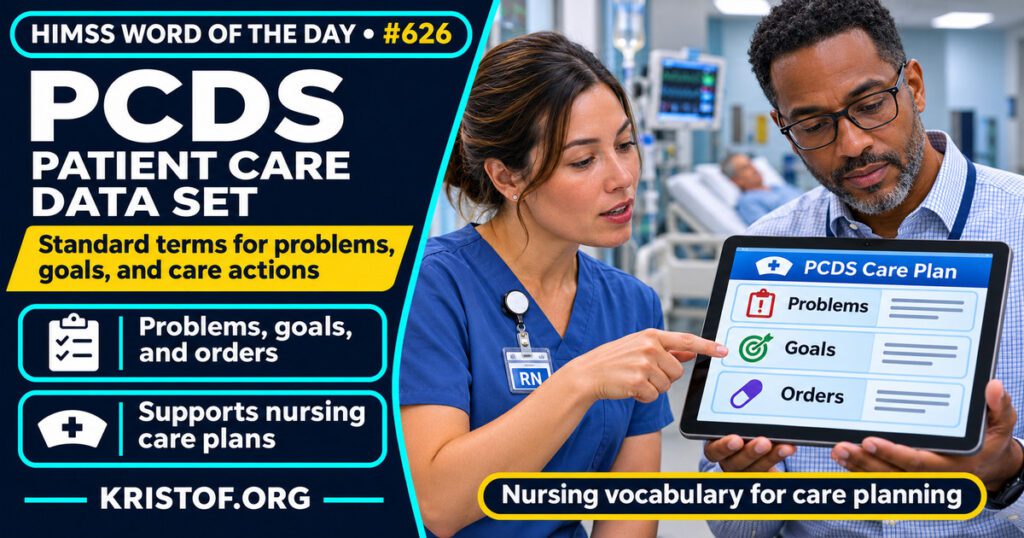
The HIMSS Dictionary describes the Patient Care Data Set (PCDS) as a collection of pre-coordinated terms that patient records draw on to capture a patient’s problems, therapeutic goals, and the actions taken in response. It is one of several standardized vocabularies built to represent nursing and interdisciplinary care in a form a computer can store and compare.
The National Library of Medicine‘s UMLS documentation gives more detail. It says the PCDS was developed by Judy Ozbolt at the University of Virginia along with member institutions of the University HealthSystem Consortium, and that Vanderbilt University Medical Center maintained it at the time of writing. According to that page, the set is organized into 22 components adapted from those in the Home Health Care Classification, and each component has three axes: Problems, Goals, and Orders. The same page describes the elements as atomic-level, while the dictionary says pre-coordinated, which probably reflects different versions or levels of description. I could not confirm which description applies to the current form of the set.
| Item | Detail |
|---|---|
| What it is | A set of standard terms for patient problems, goals, goal achievement, and care actions |
| Developed by | Judy Ozbolt, with University HealthSystem Consortium member institutions, per NLM |
| Structure | 22 components, each with Problems, Goals, and Orders axes, per NLM |
| Intended users | Nurses and others who plan care and document clinical events |
| Status note | NLM lists its last Metathesaurus update as 1999, so confirm current use before relying on it |
⚠️ Exam Alert: The PCDS is one of several nursing vocabularies, and the others have different structures. Do not mix it up with the Nursing Minimum Data Set, which lists the minimum categories of nursing data to collect, or the Perioperative Nursing Data Set, which serves operating room nursing. A pre-coordinated term combines concepts into one phrase, while a post-coordinated approach builds meaning by combining separate codes.
🌐 Why It Matters: Real-World Healthcare IT Context
Nursing care generates enormous amounts of documentation, and free-text phrases are hard to count, compare, or analyze. Standard terms let a plan of care be searched, aggregated, and reused, which is the idea behind the PCDS and its relatives.
Why a nursing-built vocabulary mattered. Medical diagnosis and procedure codes describe what physicians and billers need, but they say little about the problems nurses identify, the goals they set with patients, or the actions they take each shift. Vocabularies such as the PCDS tried to fill that gap by giving those activities their own terms. The bet was that if nursing care could be coded consistently, hospitals could compare patterns of care, study outcomes, and show what nursing contributes, all things that free-text notes make difficult.
The development story. NLM’s description says the PCDS serves as a set of standard terms to represent and capture clinical data in patient care information systems and that it represents patient problems, patient care goals, goal achievement status, and patient care orders. A 1999 profile written by Ozbolt for the National Committee on Vital and Health Statistics describes the set as not ANSI accredited and as undergoing revision at Vanderbilt University Medical Center. Those are dated statements, so they show where the set stood in that period and not where it stands now.
What studies show. Two older papers give historical context. Both are decades old, so they show how the idea was tested and debated and not current evidence.
- Ozbolt and colleagues (1995) derived a set of standard terms and codes from care planning and documentation materials submitted by nine hospitals. The abstract reports 329 terms for Patient Problems, 308 for Patient Outcomes, and 1,261 for Patient Care Actions, with six hospitals taking part in a validity and reliability test. Auditors identified 18,995 items in patient records as statements of problems, outcomes, or actions, and the standard terms and codes matched 99.1% of them. This was a development and validation study in a limited number of hospitals in the mid-1990s.
- Ozbolt (2000) reports on the 1999 Nursing Vocabulary Summit Conference, which aimed to reach consensus on a common approach to nursing terminology standards. According to the abstract, participants agreed that most recognized nursing terminologies were colloquial terminologies and that a reference terminology was needed. That discussion shaped later work on nursing terminology models.
What I could not find. A PubMed search for recent studies on the Patient Care Data Set returned older papers on its development and many unrelated results for the abbreviation PCDS. I did not find a recent evaluation of its use in current EHRs. A reader who wants to cite or implement it should verify its current status with Vanderbilt University Medical Center and the UMLS documentation.
Common nursing vocabulary problems:
- Assuming that every nursing vocabulary has the same structure
- Using pre-coordinated and post-coordinated terms interchangeably
- Building a plan of care from free text that cannot be counted or compared
- Relying on a vocabulary that is no longer maintained
- Mapping between nursing vocabularies as though terms matched one to one
- Leaving nurses out of vocabulary selection and review
What supports good nursing terminology practice:
- Nurse involvement in choosing and testing terms
- A clear structure for problems, goals, and interventions
- Mapping to reference terminologies such as SNOMED CT where appropriate
- Governance for updates and retirements
- Checks that terms match how care is actually documented
🏥 The Nurse’s Perspective: Clinical, Bedside, & Workflow
Nurses were the intended authors and users of this data set, which makes it a good example of terminology built from practice.
At the Bedside
A nursing plan of care states a problem, a goal, and actions. The PCDS structure of problems, goals, and orders mirrors that thinking, which is part of why nursing vocabularies of this kind were attractive to informatics teams.
In Clinical Workflow
Nurse informaticists decide whether a vocabulary fits the way nurses document and whether its terms can be searched and reported. They also decide how locally built care plan content maps to a standard. The 1995 validation study shows one way to test that fit, by auditing records against the term set.
In EHR Implementation (Go-Live Perspective)
During an Epic Go-Live, analysts at the elbow field questions about care plan content, such as why a problem is worded one way or why a goal cannot be edited. Vocabulary decisions made during the build are part of the answer. This post does not claim that any current product uses the PCDS.
🎓 CAHIMS / CPHIMS & HIMSS Perspective
CAHIMS Exam Domain Mapping
The PCDS supports terminology and nursing documentation knowledge:
| CAHIMS Domain | How PCDS Appears |
|---|---|
| Healthcare & Technology Environments | Standardized vocabularies and the UMLS |
| Clinical Informatics | Nursing care planning and documentation terminology |
| Healthcare Information & Systems Management | Terminology maintenance and mapping |
| Management & Leadership | Nurse engagement in selecting and governing terminology |
Key Terms to Know Alongside PCDS
- NMDS (Nursing Minimum Data Set) — a standardized set of essential nursing data elements
- PNDS (Perioperative Nursing Data Set) — a standardized terminology for perioperative nursing
- Terminology — a structured set of terms used to describe concepts in a field
- Reference terminology — a terminology designed to represent concepts precisely so other terminologies can map to it
- Nursing informatics — the specialty that integrates nursing science with information management and technology
- UMLS (Unified Medical Language System) — a collection of vocabularies and tools maintained by the National Library of Medicine
HIMSS Organizational Position
HIMSS offers education and research on health information and technology topics through its Resource Center. Members can find related information on the HIMSS Resource Center page.
🧭 More HIMSS Word of The Day Terms
Related terms in the Clinical Informatics series:
- Point-of-Care System
- NOC (Nursing Outcome Classification)
- NIC (Nursing Interventions Classification)
- CCC (Clinical Care Classification)
Browse all Clinical Informatics terms or the A–Z glossary.
🔗 Explore Further: External References
- National Library of Medicine — UMLS Source Vocabulary Documentation: Patient Care Data Set (PCDS) https://nlm.nih.gov/research/umls/sourcereleasedocs/current/PCDS
- Ozbolt et al. (1995), Proceedings. Symposium on Computer Applications in Medical Care — Validity and reliability of standard terms and codes for patient care data https://pubmed.ncbi.nlm.nih.gov/8563304/
- Ozbolt (2000), Journal of the American Medical Informatics Association : JAMIA — Terminology standards for nursing: collaboration at the summit https://pubmed.ncbi.nlm.nih.gov/11062224/
- Ozbolt — The Patient Care Data Set: Profile (1999), National Committee on Vital and Health Statistics https://ncvhs.hhs.gov/wp-content/uploads/2014/05/990518t3.pdf
- HIMSS — Resource Center https://www.himss.org/resource-center
Term source: HIMSS Dictionary of Health Information and Technology Terms, Acronyms, and Organizations, 6th Edition (2025). All definitions in this series are paraphrased for editorial purposes. Readers are encouraged to consult the primary source for exact language.
Eric Andrew Kristof, RN, CAHIMS is a Healthcare IT professional and HIMSS Arkansas Chapter member based in Hot Springs Village, AR, with hands-on Epic Go-Live experience and a diverse healthcare and IT background. He writes at kristof.org at the intersection of clinical care and healthcare technology.
Leave a Reply