By Eric Andrew Kristof, RN, CAHIMS | Healthcare IT Professional | HIMSS Arkansas Chapter Member
About This Series: The HIMSS Word of the Day is a running blog series drawing from the HIMSS Dictionary of Health Information and Technology Terms, Acronyms, and Organizations, 6th Edition (2025) — the authoritative reference for healthcare IT professionals and the primary study resource for CAHIMS and CPHIMS certification. Each post paraphrases the term in plain language, grounds it in real-world healthcare IT context, and adds a bedside nursing perspective you won’t find in a textbook.
📖 The Term: OASIS (Outcome and Assessment Information Set)
Source: HIMSS Dictionary of Health Information and Technology Terms, Acronyms, and Organizations, 6th Edition (2025)
🔍 Plain-Language Definition
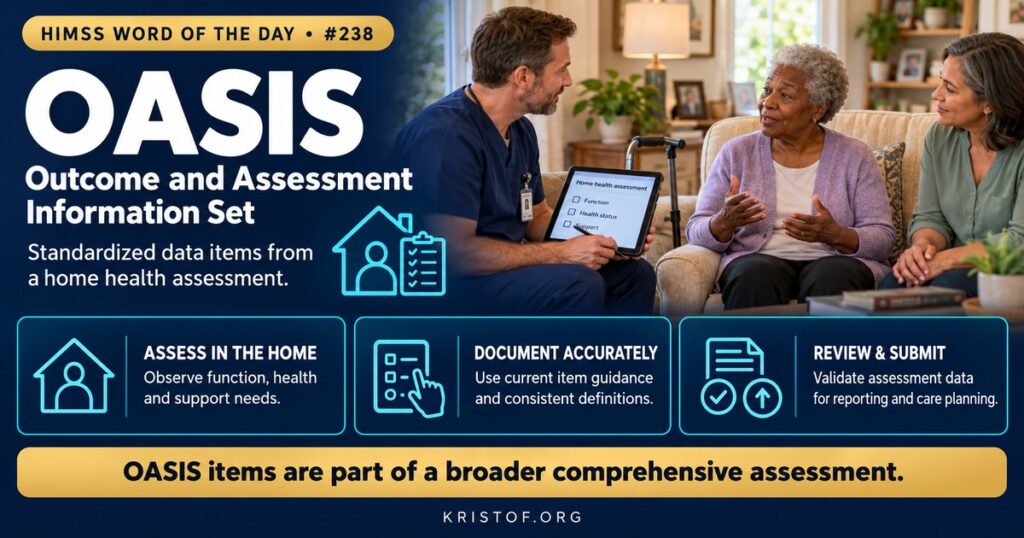
OASIS is the Outcome and Assessment Information Set, a group of standardized data items drawn from a comprehensive assessment of an adult home health patient. The HIMSS Dictionary explains that these items are the basis for measuring patient outcomes for outcome-based quality improvement, and that the assessment is performed for every patient served by home health agencies approved for Medicare or Medicaid. Items cover clinical status, functional ability, cognition, mood, medications, skin and wound status, living arrangements, and more, collected at defined time points such as start of care, resumption of care, recertification, transfer, discharge, and death at home.
Two federal rules frame the process. Under 42 CFR 484.55, each patient must receive a patient-specific comprehensive assessment. A registered nurse conducts the initial assessment visit, which must occur within 48 hours of referral, within 48 hours of the patient’s return home, or on the ordered start-of-care date. The comprehensive assessment must be completed in a timely manner and no later than five calendar days after the start of care. A registered nurse completes it, except when therapy is the only service ordered, in which case a qualified therapist may do so. Under 42 CFR 484.45, agencies must encode and electronically transmit each completed OASIS assessment to the CMS system within 30 days of completing it, and the encoded data must accurately reflect the patient’s status at the time of assessment.
| Element | What It Is | Key Point |
|---|---|---|
| OASIS items | Standard assessment questions | Same wording across agencies |
| Comprehensive assessment | Broader patient-specific evaluation | Includes more than the OASIS items |
| Time points | Start of care, recertification, discharge, and others | Different item sets by time point |
| Submission | Electronic transmission to CMS | Within 30 days of completion |
| Uses | Quality measures, star ratings, payment, research | Accuracy affects all of them |
⚠️ Exam Alert: OASIS is collected for home health, MDS for nursing homes, IRF-PAI for inpatient rehabilitation, and LTCH CARE Data Set for long-term care hospitals. The comprehensive assessment is broader than the OASIS items. OASIS data support quality reporting and payment and must reflect the patient’s status at the time of the visit.
🌐 Why It Matters: Real-World Healthcare IT Context
OASIS puts the same questions to every home health patient, so outcomes can be compared across agencies and over time. CMS uses the data for the Home Health Quality Reporting Program, public reporting, star ratings, and payment-related functions, and researchers use it to study function, hospitalization, and care patterns. Because so much depends on the answers, small differences in how clinicians interpret items can alter an agency’s reported results.
The instrument itself changes. CMS announced that the final OASIS-E1 time-point instruments took effect January 1, 2025, and that the final OASIS-E2 instruments take effect April 1, 2026. CMS publishes change tables that list differences between versions, along with user manuals and data specifications. Agencies must update software, retrain staff, and revise documentation templates each time. Because OASIS items are embedded in the clinical record, a version change affects the nursing workflow as well as billing and compliance.
Data quality is a shared concern. A 2026 cohort study in JAMA Network Open examined OASIS assessments from 2017 to 2023 linked to Medicare enrollment and fee-for-service home health claims. About 18 million OASIS assessments and 6 million assessed beneficiaries were recorded each year. The proportion of assessments that could be linked to a Medicare beneficiary fell from 89.8 percent in 2017 to 76.4 percent in 2023. Among unmatched assessments, the share with Medicare as the recorded payer increased, while the share with Medicaid decreased. The authors framed this as a problem for monitoring utilization and informing payment policy. For informaticists, it is a reminder that identifiers, demographics, and payer fields captured at the visit have consequences far downstream.
For agencies, the main risk is not the form itself but inconsistency. Two nurses may score the same patient’s mobility or wound status differently. Documentation in the narrative may not match OASIS responses. Items may be completed from the office after the visit without enough detail. Accurate responses require clear definitions, training, and review before submission. Many agencies assign clinical reviewers or quality staff to check completed assessments, and use EHR rules to catch missing or conflicting entries.
Technology can help but also hide problems. Point-of-care documentation on a tablet can reduce transcription, but poor connectivity in rural homes calls for offline capability and later synchronization. Prefilled responses from previous visits can save time and also copy outdated findings forward. Edits in the EHR should be tied to the CMS validation specifications so errors are caught before the file is rejected.
Common OASIS problems:
- Item interpretation that varies between clinicians
- Narrative notes that conflict with OASIS answers
- Assessments completed from memory after the visit
- Software not updated promptly for a new OASIS version
- Payer, identifier, or demographic errors that break linkage to claims
- Late submission or missing time points
What supports accurate OASIS data:
- Regular training with the current user manual
- Clinical review of assessments before submission
- EHR edits that match CMS validation rules
- Point-of-care documentation with offline support
- Feedback to clinicians based on audit results
- Version change plans covering software, training, and templates
🏥 The Nurse’s Perspective: Clinical, Bedside, & Workflow
Home health nurses are the people whose observations become OASIS data, so the quality of the data starts with the visit.
At the Bedside
In the home, the nurse observes how the patient moves, manages medications, handles stairs, and takes care of wounds, and asks about mood, memory, and who helps. The OASIS items are scored from what the nurse sees and learns, not from assumptions. Taking time to observe real function, such as asking a patient to demonstrate a transfer, produces more accurate answers than relying on the patient’s description alone.
Clear explanation helps patients understand why a long assessment is needed and that it shapes their plan of care.
In Clinical Workflow
Admission nurses balance a long assessment with immediate care needs, so planning the visit matters. Clinical managers and quality reviewers check completed assessments for consistency and coach staff on item definitions. Therapists and nurses coordinate so that functional scoring is consistent across disciplines. Agencies monitor the time from visit to completion and submission to meet deadlines.
Nurse informaticists configure assessment templates, edits, and reports, and they lead updates when a new OASIS version arrives. They also review audit findings for patterns, such as an item that is often left inconsistent with the narrative.
In EHR Implementation (Go-Live Perspective)
An Epic Go-Live for a home health service must support mobile documentation, offline use, and OASIS-specific edits before nurses are in homes. At-the-elbow support analysts ride along or work by phone with clinicians in the first visits, watching for missing items, slow screens, and synchronization problems. Findings go back to build teams so that the form matches CMS requirements and fits the visit flow.
🎓 CAHIMS / CPHIMS & HIMSS Perspective
CAHIMS Exam Domain Mapping
OASIS appears in post-acute care, quality reporting, and data standards questions:
| CAHIMS Domain | How OASIS Appears |
|---|---|
| Healthcare & Technology Environments | CMS requirements, post-acute care settings, quality reporting programs |
| Clinical Informatics | Standardized assessments, point-of-care documentation, nursing workflow |
| Healthcare Information & Systems Management | Data submission, validation edits, version updates, linkage to claims |
| Management & Leadership | Compliance, quality improvement, training, vendor management |
Key Terms to Know Alongside OASIS
- Home Health Quality Reporting Program — CMS program that collects and reports home health quality data
- Comprehensive Assessment — patient-specific evaluation required under the conditions of participation
- MDS (Minimum Data Set) — assessment data set for nursing home residents
- Star Ratings — public summary ratings of home health agency quality
- Time Point — specific assessment event such as start of care or discharge
- Conditions of Participation — federal requirements for Medicare-certified providers
HIMSS Organizational Position
HIMSS supports quality measurement and standards-based data exchange across care settings through its research, education, and community work. Members can find related resources through the HIMSS Resource Center.
🔗 Explore Further: External References
- CMS — OASIS Data Sets https://www.cms.gov/medicare/quality/home-health/oasis-data-sets
- CMS — Home Health Quality Reporting Program https://www.cms.gov/medicare/quality/home-health
- eCFR — 42 CFR 484.55, Comprehensive Assessment of Patients https://www.ecfr.gov/current/title-42/chapter-IV/subchapter-G/part-484/subpart-B/section-484.55
- eCFR — 42 CFR 484.45, Reporting OASIS Information https://www.ecfr.gov/current/title-42/chapter-IV/subchapter-G/part-484/subpart-B/section-484.45
- Rahman et al. (2026), JAMA Network Open — Match Rates Between Home Health Assessment and Medicare Claims Data https://pubmed.ncbi.nlm.nih.gov/41926120/
Term source: HIMSS Dictionary of Health Information and Technology Terms, Acronyms, and Organizations, 6th Edition (2025). All definitions in this series are paraphrased for editorial purposes. Readers are encouraged to consult the primary source for exact language.
Eric Andrew Kristof, RN, CAHIMS is a Healthcare IT professional and HIMSS Arkansas Chapter member based in Hot Springs Village, AR, with hands-on Epic Go-Live experience and a diverse healthcare and IT background. He writes at kristof.org at the intersection of clinical care and healthcare technology.
Leave a Reply