By Eric Andrew Kristof, RN, CAHIMS | Healthcare IT Professional | HIMSS Arkansas Chapter Member
About This Series: The HIMSS Word of The Day is a running blog series drawing from the HIMSS Dictionary of Health Information and Technology Terms, Acronyms, and Organizations, 6th Edition (2025) — the authoritative reference for healthcare IT professionals and the primary study resource for CAHIMS and CPHIMS certification. Each post paraphrases the term in plain language, grounds it in real-world healthcare IT context, and adds a bedside nursing perspective you won’t find in a textbook.
📖 The Term: Cookies
Source: HIMSS Dictionary of Health Information and Technology Terms, Acronyms, and Organizations, 6th Edition (2025)
🔍 Plain-Language Definition
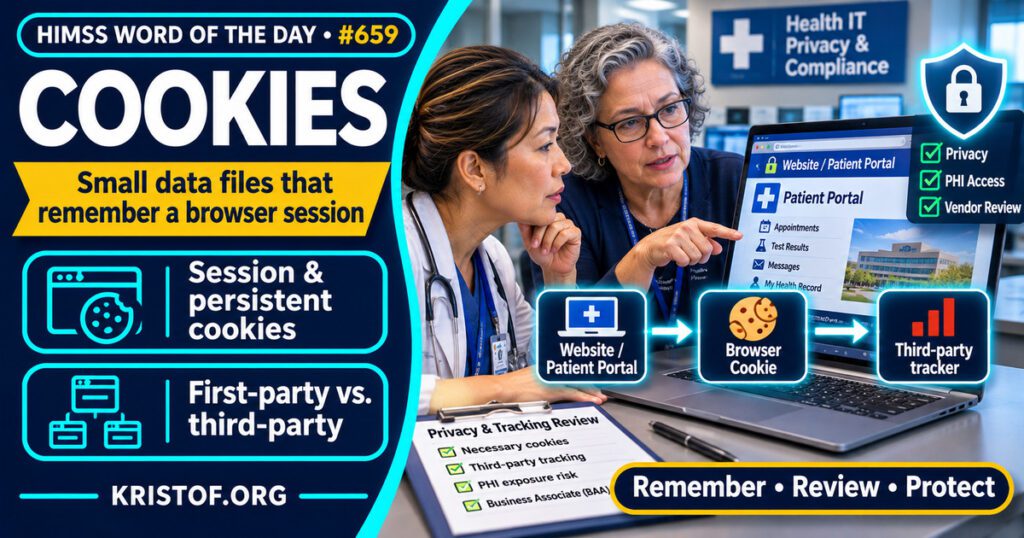
The HIMSS Dictionary describes a cookie as a small amount of data that a website generates and saves in the visitor’s browser or another location, so the site can remember details about the session, much as a software application keeps a preference file. The data may be temporary or persistent.
Cookies are not all the same. A site can set its own cookies, and other companies can set theirs through code embedded in the page. Whether a cookie is strictly necessary for the site to work or is used for tracking is a separate question.
| Cookie type | What it does | Privacy issue |
|---|---|---|
| Session (temporary) | Remembers a visit until the browser closes | Lower, but still tied to the visit |
| Persistent | Stays on the device for a set time | Can recognize a returning visitor |
| First-party | Set by the site being visited | Depends on what the site does with it |
| Third-party | Set by another company through embedded code | Data can flow to outside companies |
⚠️ Exam Alert: Do not treat “cookies” as a synonym for all web tracking. Tracking pixels and other embedded code can send data to third parties without storing a cookie. HIPAA questions turn on whether the information involved is protected health information, not on the cookie label.
🌐 Why It Matters: Real-World Healthcare IT Context
Cookies matter in health IT because hospital and patient portal websites sit between the public and protected health information (PHI). The sources below are cross-sectional and observational studies plus one regulatory page. Several of them measure tracking in general, not cookies alone.
How common tracking is. Friedman and colleagues (2023) examined a census of US nonfederal acute care hospital websites and found third-party tracking on 98.6 percent of them. The transfers included large technology companies, social media companies, advertising firms, and data brokers. Hospitals in health systems, hospitals affiliated with a medical school, and hospitals serving more urban populations exposed visitors to more tracking in adjusted analyses. The authors say the practice may lead to dignitary harms, targeted health advertising, and legal liability. The study counts third-party tracking, which includes more than cookies, and does not show what data was sent in each case.
Policies and disclosure. McCoy and colleagues (2024) analyzed 100 hospital websites. Ninety-six transferred user information to third parties, and 71 had a privacy policy. Policies averaged 2,527 words and a 13.7 grade reading level. Of 71 policies, 66 addressed categories of third-party recipients, but only 40 named specific companies or services. The authors conclude that many sites did not give users enough information about privacy implications. The sample is small, and it was measured from November 2023 to January 2024.
Pixels and breach risk. Atasoy and colleagues (2025) used historical website data from the Wayback Machine for 2012 to 2023 and reported that 66 percent of their sample used pixel tracking. They report that third-party pixel use significantly increases data breach risk and that tracking pixels operate outside the traditional scope of HIPAA protections. This is an observational analysis, so the link to breaches is an association, and I did not review the statistical methods.
Outside the United States. Siegle and colleagues (2025) studied more than 231,000 German-language health websites from Germany, Austria, and Switzerland. Of the sites visited successfully, 56.04 percent stored at least one cookie, and up to 18.93 percent contained cookies that were not technically necessary and were set without explicit consent. The setting differs from US hospitals, and the abstract measures websites rather than patients.
Where HHS guidance stands. The HHS Office for Civil Rights page on online tracking technologies says tracking on pages behind a login, such as patient portals, can reach PHI, and that the regulated entity must use and disclose it only as the Privacy Rule allows and protect it under the Security Rule. It says tracking vendors that handle PHI are business associates and need a business associate agreement. It says tracking on general public pages, such as visiting hours or locations, generally does not involve PHI, but that the HIPAA Rules apply when tracking captures health-related information such as appointment scheduling or portal login details. The page reports that on June 20, 2024, a federal court in the Northern District of Texas declared part of the guidance unlawful and vacated it. That part concerned IP addresses linked to visits to public pages about health conditions or providers. The page states it was last reviewed on June 26, 2024, and says HHS was evaluating next steps. Press reports say HHS filed an appeal and then withdrew it in August 2024. I am not a lawyer, and legal status can change, so confirm with counsel and the current HHS page.
What I could not confirm. I did not verify whether the page’s remaining guidance has changed since its latest revision, and I did not review state privacy laws. I could not tell from the abstracts how many of the tracking cases involved cookies specifically, or whether any involved PHI. I read abstracts and one regulatory page, not full study texts.
Common cookie and tracking problems:
- Third-party code on pages where visitors enter health information
- Privacy policies that are missing, long, or vague about recipients
- Tracking set up on login or scheduling pages without review by privacy staff
- Assuming that removing cookies removes all tracking
- Marketing tools added by teams without a security or privacy check
What supports responsible website practices:
- An inventory of the tags, pixels, and cookies each page uses
- Privacy and security review before adding third-party code
- Business associate agreements where a vendor handles PHI
- Plain, specific privacy policies that name recipients
- Regular scans for new trackers
🏥 The Nurse’s Perspective: Clinical, Bedside, & Workflow
Nurses answer patient questions about portals, apps, and online health information, so the privacy side of websites reaches the bedside.
At the Bedside
A patient who asks whether a portal or hospital website is private is asking a real question. The studies above show that many hospital sites pass data to third parties, so a nurse is better served by pointing the patient to the organization’s privacy policy and privacy office than by a quick reassurance.
In Clinical Workflow
The HHS page gives examples of pages where health information may be captured, including appointment scheduling and portal login. Those are workflows nurses and clinic staff use every day, so nurse informaticists can ask whether privacy staff have reviewed the tracking on those pages. This is a workflow suggestion, not a finding from the studies.
In EHR Implementation (Go-Live Perspective)
During an Epic Go-Live, portal activation and patient enrollment are topics that support staff handle. Analysts can confirm with privacy and security teams which web analytics or advertising tools run on enrollment and login pages. The studies do not examine go-live, so this is a practical consideration only.
🎓 CAHIMS / CPHIMS & HIMSS Perspective
CAHIMS Exam Domain Mapping
Cookies sit within privacy and security topics:
| CAHIMS Domain | How Cookies Appear |
|---|---|
| Healthcare & Technology Environments | Web technologies, portals, and third-party services |
| Clinical Informatics | Patient-facing tools and how patient data may be exposed |
| Healthcare Information & Systems Management | Web governance, security review, and vendor agreements |
| Management & Leadership | Privacy policy, compliance, and risk decisions |
Key Terms to Know Alongside Cookies
- Protected health information (PHI) — individually identifiable health information that HIPAA protects
- Business associate agreement (BAA) — a contract required when a vendor handles PHI for a covered entity
- Tracking pixel — a small piece of embedded code that sends visitor data to a third party
- Patient portal — a secure website that lets patients view parts of their record and message their care team
- HIPAA Security Rule — the rule that sets safeguards for electronic PHI
- Privacy policy — a statement of how an organization collects and uses information
HIMSS Organizational Position
HIMSS offers education and research on health information and technology topics through its Resource Center. Members can find related information on the HIMSS Resource Center page.
🧭 More HIMSS Word of The Day Terms
Related terms in the Cybersecurity and Privacy series:
Browse all Cybersecurity and Privacy terms or the A–Z glossary.
🔗 Explore Further: External References
- U.S. Department of Health and Human Services, Office for Civil Rights — Use of Online Tracking Technologies by HIPAA Covered Entities and Business Associates https://www.hhs.gov/hipaa/for-professionals/privacy/guidance/hipaa-online-tracking/index.html
- Friedman et al. (2023), Health Affairs — Widespread Third-Party Tracking On Hospital Websites Poses Privacy Risks For Patients And Legal Liability For Hospitals https://pubmed.ncbi.nlm.nih.gov/37011312/
- McCoy et al. (2024), JAMA Network Open — User Information Sharing and Hospital Website Privacy Policies https://pubmed.ncbi.nlm.nih.gov/38602678/
- Atasoy et al. (2025), PNAS Nexus — Beyond the click: Pixel tracking technologies and patient data security in hospitals https://pubmed.ncbi.nlm.nih.gov/41376707/
- Siegle et al. (2025), PLOS One — Analysis of web tracking and geolocation of German-language health websites https://pubmed.ncbi.nlm.nih.gov/40372997/
- Healthcare IT News — HHS files, then drops, its data-tracking lawsuit appeal https://healthcareitnews.com/node/555137
- HIMSS — Resource Center https://www.himss.org/resource-center
Term source: HIMSS Dictionary of Health Information and Technology Terms, Acronyms, and Organizations, 6th Edition (2025). All definitions in this series are paraphrased for editorial purposes. Readers are encouraged to consult the primary source for exact language.
Eric Andrew Kristof, RN, CAHIMS is a Healthcare IT professional and HIMSS Arkansas Chapter member based in Hot Springs Village, AR, with hands-on Epic Go-Live experience and a diverse healthcare and IT background. He writes at kristof.org at the intersection of clinical care and healthcare technology.
Leave a Reply