By Eric Andrew Kristof, RN, CAHIMS | Healthcare IT Professional | HIMSS Arkansas Chapter Member
About This Series: The HIMSS Word of The Day is a running blog series drawing from the HIMSS Dictionary of Health Information and Technology Terms, Acronyms, and Organizations, 6th Edition (2025) — the authoritative reference for healthcare IT professionals and the primary study resource for CAHIMS and CPHIMS certification. Each post paraphrases the term in plain language, grounds it in real-world healthcare IT context, and adds a bedside nursing perspective you won’t find in a textbook.
📖 The Term: Preferred Term
Source: HIMSS Dictionary of Health Information and Technology Terms, Acronyms, and Organizations, 6th Edition (2025)
🔍 Plain-Language Definition
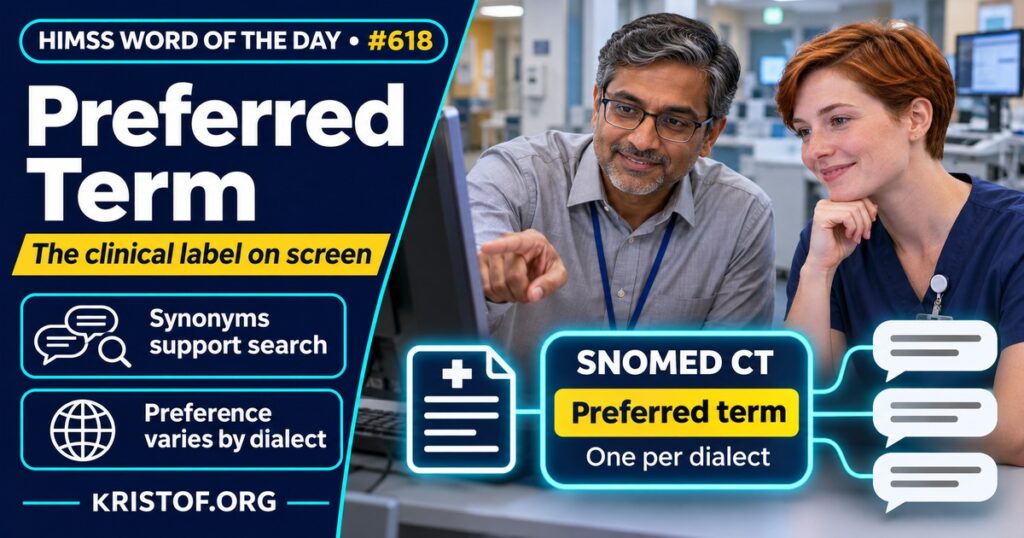
The HIMSS Dictionary describes the preferred term as the wording judged most clinically appropriate for expressing a concept in a clinical record. It adds that the preferred term is one of three kinds of term a description type field can indicate.
SNOMED International‘s documentation frames this a little differently. Its Editorial Guide says each concept has several descriptions, each with a type, and that the two main description types are the fully specified name and the synonym. A preferred term is a synonym that has been marked as preferred in a particular dialect, and a concept can have only one preferred term per dialect. A SNOMED International education page, based on the January 2026 Editorial Guide, describes the preferred term as the common word or phrase clinicians use for a concept in practice or in the literature, and says Language Reference Sets specify which descriptions are preferred or acceptable in each language or dialect. The dictionary’s “three types” wording does not match these two pages, and this post did not trace the reason.
| Item | Detail |
|---|---|
| What it is | The wording chosen as the display term for a concept, in SNOMED CT a synonym marked preferred for a dialect |
| How preference is set | By a Language Reference Set for each language or dialect, per SNOMED International |
| How many | One per dialect, so US and GB English can each have their own |
| Related terms | Fully specified name, synonym, description, and concept |
| Other uses of the phrase | In MedDRA, a Preferred Term is a hierarchy level that stands for a single medical concept |
⚠️ Exam Alert: In SNOMED CT, the concept is the meaning, the fully specified name is the unique and unambiguous description, a synonym is an alternative label, and the preferred term is the synonym preferred for display in a dialect. In MedDRA, a Preferred Term is a level of the hierarchy. Check which terminology a question is asking about.
🌐 Why It Matters: Real-World Healthcare IT Context
Clinical software shows people words, but stores meaning as identifiers. The preferred term is one of the bridges between the two, and it can vary by language, dialect, and context.
How SNOMED CT handles it. SNOMED International’s education page says a concept can have a preferred term for each language, and that a term can be preferred in one dialect, merely acceptable in another, and unused in a third. Its example is esophageal structure, which has a US English preferred term and a GB English one. The same page notes that a term can be the preferred term for one concept and a synonym for another, using “cold” as the example. The education page is labeled for education purposes only, so treat it as explanatory material rather than the specification. The Editorial Guide page shows no date or version.
How MedDRA uses the phrase. MedDRA’s hierarchy page describes five levels. At the most specific level, Lowest Level Terms, it says there are more than 80,000 terms that parallel how information is communicated, and it calls each Preferred Term a distinct descriptor for a single medical concept, covering symptoms, signs, diagnoses, therapeutic indications, investigations, procedures, and medical, social, or family history characteristics. The page excerpt read for this post is not dated, so the term count may have changed.
How FHIR approaches display. The FHIR CodeSystem page (the version read covers R5) presents concept.display as the recommended default text for showing a concept to users and concept.designation as a repeatable element for additional representations, such as other-language displays. It does not use the phrase “preferred term” and does not map designation uses to SNOMED CT description types. Teams therefore decide how a SNOMED CT preferred term is carried into FHIR displays and designations.
What studies show. Two papers illustrate why terminology details matter, and neither is about EHR display wording directly.
- Zhang and colleagues (2024) evaluated mappings between MedDRA and ICD through the UMLS and the OMOP common data model. They report that the mapped pairs cover 27.23% of MedDRA preferred terms and that only 51.44% of the UMLS-provided mapped pairs were exact matches, citing differences in granularity and focus. These figures come from the abstract, so verify them in the paper.
- Lucano and colleagues (2026) describe the Orphanet Nomenclature of rare diseases, whose entities each carry a unique code, a preferred term, synonyms, a classification level, and a textual definition. They emphasize mappings to other resources as a route to interoperability. This is a descriptive paper about one nomenclature.
Common preferred term problems:
- Confusing the SNOMED CT preferred term with the MedDRA Preferred Term
- Treating the preferred term as the concept’s identity instead of its identifier
- Assuming one preferred term applies in every language or dialect
- Mapping between terminologies as though terms matched exactly
- Hiding useful synonyms so clinicians cannot find a concept by the words they use
- Using the fully specified name as the display text when a clinical term is more familiar
What supports good preferred term practice:
- Knowing which terminology and edition a system uses
- Language Reference Sets or equivalent settings that match the user community
- Synonyms available for search
- Mapping reviews that check exactness, not only presence
- Clinician input on how terms are displayed
🏥 The Nurse’s Perspective: Clinical, Bedside, & Workflow
Nurses see preferred terms as the words in pick lists, problem lists, and search results.
At the Bedside
The wording on screen can differ from the words a nurse uses, so a search may return a different phrase than the one typed. That gap is why synonyms matter. SNOMED International’s guidance says a concept can carry several descriptions and that only one is the preferred term for a dialect.
In Clinical Workflow
Nurse informaticists help terminology teams judge which wording suits clinical practice and which synonyms to expose. The Zhang mapping study is a reminder that crosswalks between terminologies are rarely exact, so mapped data deserves a review before it drives reports or decision support.
In EHR Implementation (Go-Live Perspective)
During an Epic Go-Live, analysts at the elbow often hear that a user cannot find a diagnosis, procedure, or problem entry. Checking whether the concept exists under a different wording is a common first step. This post does not claim that any specific go-live had a terminology display problem.
🎓 CAHIMS / CPHIMS & HIMSS Perspective
CAHIMS Exam Domain Mapping
The preferred term supports terminology and standards knowledge:
| CAHIMS Domain | How Preferred Term Appears |
|---|---|
| Healthcare & Technology Environments | Clinical terminologies and how systems display them |
| Clinical Informatics | Clinical wording, documentation, and search |
| Healthcare Information & Systems Management | Terminology mapping and data quality |
| Management & Leadership | Terminology governance and change control |
Key Terms to Know Alongside Preferred Term
- SNOMED CT — a clinical terminology whose concepts have descriptions in one or more languages
- Fully specified name — a unique description intended to name a concept unambiguously
- Synonym — an alternative description for the same concept
- Language Reference Set — a list specifying which descriptions are preferred or acceptable for a language or dialect
- MedDRA — a medical terminology used in drug safety work, with a five-level hierarchy
- Terminology mapping — linking terms in one terminology to terms in another
HIMSS Organizational Position
HIMSS offers education and research on health information and technology topics through its Resource Center. Members can find related information on the HIMSS Resource Center page.
🔗 Explore Further: External References
- SNOMED International — SNOMED CT Editorial Guide: Descriptions https://docs.snomed.org/snomed-ct-specifications/snomed-ct-editorial-guide/readme/authoring/general-naming-conventions/descriptions
- SNOMED International — SNOMED CT Education Editorial Guide: Preferred Term https://docs.snomed.org/education/snomed-ct-education-editorial-guide/readme/authoring/general-naming-conventions/descriptions/preferred-term
- MedDRA — MedDRA Hierarchy https://www.meddra.org/how-to-use/basics/hierarchy
- Zhang et al. (2024), BMC medical informatics and decision making — Evaluating MedDRA-to-ICD terminology mappings https://pubmed.ncbi.nlm.nih.gov/38326827/
- Lucano et al. (2026), JMIR medical informatics — The Orphanet Nomenclature and Classification of Rare Diseases for Improved Patient Recognition and Data Interoperability: Qualitative and Quantitative Analysis https://pubmed.ncbi.nlm.nih.gov/42417450/
- HL7 — FHIR CodeSystem Resource https://hl7.org/fhir/codesystem.html
- HIMSS — Resource Center https://www.himss.org/resource-center
Term source: HIMSS Dictionary of Health Information and Technology Terms, Acronyms, and Organizations, 6th Edition (2025). All definitions in this series are paraphrased for editorial purposes. Readers are encouraged to consult the primary source for exact language.
Eric Andrew Kristof, RN, CAHIMS is a Healthcare IT professional and HIMSS Arkansas Chapter member based in Hot Springs Village, AR, with hands-on Epic Go-Live experience and a diverse healthcare and IT background. He writes at kristof.org at the intersection of clinical care and healthcare technology.
Leave a Reply