By Eric Andrew Kristof, RN, CAHIMS | Healthcare IT Professional | HIMSS Arkansas Chapter Member
About This Series: The HIMSS Word of the Day is a running blog series drawing from the HIMSS Dictionary of Health Information and Technology Terms, Acronyms, and Organizations, 6th Edition (2025) — the authoritative reference for healthcare IT professionals and the primary study resource for CAHIMS and CPHIMS certification. Each post paraphrases the term in plain language, grounds it in real-world healthcare IT context, and adds a bedside nursing perspective you won’t find in a textbook.
📖 The Term: Transitions of Care (TOC)
Source: HIMSS Dictionary of Health Information and Technology Terms, Acronyms, and Organizations, 6th Edition (2025)
🔍 Plain-Language Definition
A transition of care (TOC) is a patient’s movement from one care setting to another. The HIMSS Dictionary lists examples of settings: a hospital, a primary care practice, a specialty practice, long-term care, home health, and a rehabilitation facility. Common transitions include hospital to home, emergency department to inpatient unit, hospital to skilled nursing facility, and primary care to a specialist. The related term transitional care refers to the services and programs that support patients through these moves.
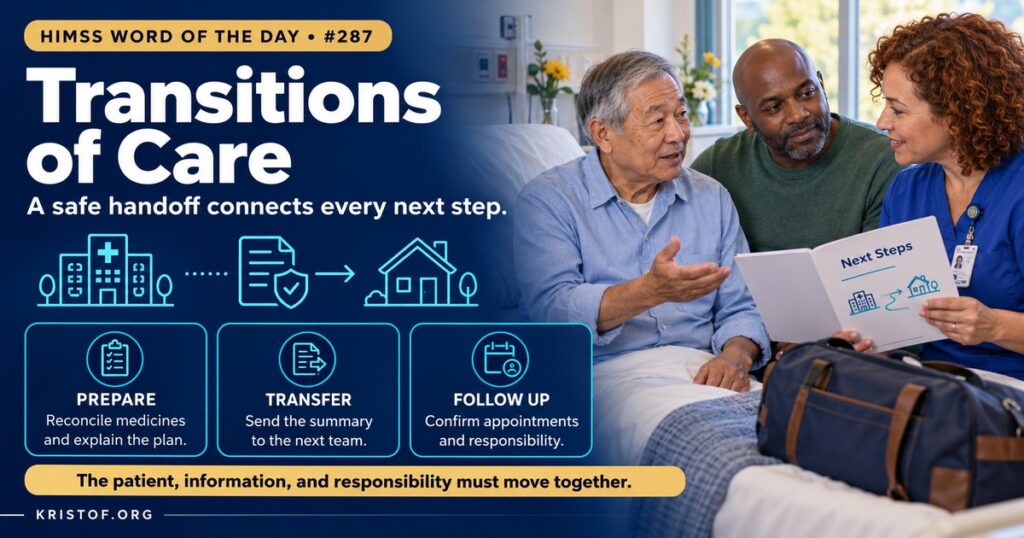
Each transition is a handoff, and handoffs are where information, medications, and responsibility can be lost. A safe transition needs four things: the sending team prepares the patient and records, the receiving team gets the right information in time, the patient and caregivers understand the plan, and someone follows up to confirm that the plan is working.
| Element | What Should Happen | Informatics Support |
|---|---|---|
| Discharge planning | Needs identified early | Risk scores, care plans, checklists |
| Medication reconciliation | Lists compared and differences resolved | Medication list tools, pharmacy data |
| Information transfer | Summary reaches the next clinician | Discharge summary, CCD, HIE or direct exchange |
| Patient education | Teach-back with caregiver involvement | Education modules, portal materials |
| Follow-up | Appointment and call arranged | Scheduling, outreach lists, notifications |
| Monitoring | Problems found early | Telephone support, remote monitoring |
⚠️ Exam Alert: A transition of care is a change of setting; care coordination is the broader organization of activities across providers; medication reconciliation is one task within a transition. The discharge summary and the continuity of care document (CCD) are common vehicles for transferring information.
🌐 Why It Matters: Real-World Healthcare IT Context
The weeks after leaving a hospital are a vulnerable period. Length of stay has been shortening, so patients go home sooner with more to manage, and the quality of the handoff can affect whether they return. Programs to improve transitions vary widely, which is one reason the evidence is mixed.
A 2025 systematic review and meta-analysis in BMC Nursing examined nurse-led transitional care for adults discharged from acute care hospitals. It included 16 randomized controlled trials. Readmission rates were significantly lower in the intervention group when data were collected beyond 12 weeks (relative risk 0.67; 95 percent confidence interval 0.49 to 0.92), with moderate certainty of evidence. Emergency room visits were also lower (relative risk 0.63; confidence interval 0.49 to 0.81), with high certainty, and quality of life measured with the SF-36 was higher at five and six weeks, although with low certainty. The authors cautioned that the number of studies and participants in some analyses was small, and that populations, institutions, and interventions differed.
Condition-specific reviews show how much the program design matters. A 2026 network meta-analysis in BMC Cardiovascular Disorders compared transitional care approaches for heart failure, updating an earlier review. It included 19 trials with 11,452 patients and grouped interventions into home visiting, multidisciplinary clinics, telemonitoring, structured telephone support, pharmacy-led care, physical rehabilitation, education, and usual care. Home visiting was the only approach significantly better than usual care for all-cause readmission (relative risk 0.67; confidence interval 0.52 to 0.86) and ranked highest for readmission and mortality. Multidisciplinary clinics ranked first for heart failure-specific readmission, rehabilitation and multidisciplinary clinics ranked best for quality of life, and telemonitoring showed moderate benefit for mortality but ranked poorly for preventing readmission. The authors suggested a bundled approach combining these elements. A network meta-analysis ranks interventions statistically and depends on the trials available, so the ranking is a guide and not a prescription.
Stroke shows a more cautious picture. A 2026 review in the Journal of Neuroscience Nursing pooled 16 trials with 7,487 participants. Nurse-led transitional care was associated with lower readmission risk (relative risk 0.43), but that result rested on only four trials with 455 participants, and the review also found better functional outcomes and quality of life but no difference in caregiver burden. The authors rated the evidence certainty as low or very low and noted substantial heterogeneity. A 2025 review in Nursing Open that included 18 studies found better one-year quality of life with nurse-led transition care for stroke survivors, but no significant differences in mortality or readmission. Taken together, nurse-led transitional care appears to help with some outcomes in some groups, and a single headline claim would overstate the evidence.
Information flow underlies all of these programs. Discharge summaries must arrive quickly and contain what the receiving clinician needs. A 2024 literature review in the Journal of Medical Internet Research identified only 12 records on the usability of electronic discharge summaries, and found that heuristic evaluation and think-aloud testing were most often used, which suggests that an important handoff document is rarely tested with its users. Organizations aiming to improve transitions generally combine several elements: notifications when patients are admitted and discharged, structured medication lists, summaries that travel by health information exchange or direct messaging, follow-up appointments booked before discharge, outreach calls, and metrics that follow patients after they leave.
Common transition problems:
- Discharge summaries that arrive late, or never, at the next clinician
- Medication lists that differ between settings
- Patients and caregivers unsure of the plan
- Follow-up appointments not scheduled before discharge
- No owner for the days after discharge
- Programs without data on whether they work
What supports safe transitions:
- Early identification of patients at risk
- Teach-back with caregivers and written plans
- Reconciled medication lists that travel with the patient
- Timely electronic transfer of summaries
- Post-discharge calls or visits by a defined team member
- Metrics that include readmissions, emergency visits, and patient-reported outcomes
🏥 The Nurse’s Perspective: Clinical, Bedside, & Workflow
Nurses carry much of the work of transitions: they prepare patients to leave, receive patients from other settings, and follow up afterward.
At the Bedside
Discharge teaching is a nursing task that begins well before the day of discharge. Nurses review medications, warning signs, equipment, and follow-up with the patient and caregivers, and use teach-back to check understanding. On the receiving side, admitting nurses compare what the patient reports with what the sending facility documented and chase differences.
In Clinical Workflow
Transition nurses, case managers, and clinic care managers call patients after discharge, arrange visits, and coordinate community services. In heart failure and stroke programs, nurses lead much of the home visiting, telephone support, and education studied in the reviews. Nurse managers decide how discharge tasks are divided and what is documented where.
Nurse informaticists build discharge navigators, medication reconciliation workflows, patient instruction templates, and the reports that identify patients needing outreach. They also check that the summary a nurse documents is the one the next setting actually receives.
In EHR Implementation (Go-Live Perspective)
An Epic Go-Live changes discharge workflow on every inpatient unit. At-the-elbow support analysts watch discharges closely, because missed steps in the new navigator are discovered when a patient is already waiting to leave. Early feedback on where nurses cannot find reconciliation or instruction tasks guides quick fixes.
🎓 CAHIMS / CPHIMS & HIMSS Perspective
CAHIMS Exam Domain Mapping
Transitions of care appear in workflow, interoperability, and quality questions:
| CAHIMS Domain | How Transitions of Care Appear |
|---|---|
| Healthcare & Technology Environments | Readmission programs, value-based payment, care settings |
| Clinical Informatics | Medication reconciliation, discharge workflows, care plans |
| Healthcare Information & Systems Management | Health information exchange, CCD, notifications, interfaces |
| Management & Leadership | Program design, metrics, accountability across organizations |
Key Terms to Know Alongside Transitions of Care
- Care Coordination — deliberate organization of care across providers and settings
- Discharge Summary — document summarizing a hospital stay for later clinicians
- Medication Reconciliation — comparing medication lists across settings and resolving differences
- Continuity of Care Document (CCD) — standard document for exchanging a patient summary
- Readmission — return to a hospital within a defined period after discharge
- Teach-Back — method of confirming understanding by asking the patient to explain the plan
HIMSS Organizational Position
HIMSS supports safe, coordinated care and the exchange of health information through its interoperability work, research, and education. Members can find related resources through the HIMSS Nursing Informatics Community page.
🔗 Explore Further: External References
- Sakashita et al. (2025), BMC Nursing — Effectiveness of Nurse-Led Transitional Care Interventions for Adult Patients Discharged From Acute Care Hospitals: A Systematic Review and Meta-Analysis https://pubmed.ncbi.nlm.nih.gov/40197243/
- Dai et al. (2026), BMC Cardiovascular Disorders — Comparative Effectiveness of Transitional Care Interventions for Hospital-to-Home Transition in Heart Failure: An Updated Systematic Review and Network Meta-Analysis https://pubmed.ncbi.nlm.nih.gov/42141394/
- Ma et al. (2026), Journal of Neuroscience Nursing — Nurse-Led Transitional Care and Postdischarge Outcomes in Stroke Survivors: A Systematic Review and Meta-Analysis https://pubmed.ncbi.nlm.nih.gov/42879661/
- Michael et al. (2025), Nursing Open — The Effectiveness of Nurse-Led Transition Care on Post-Discharge Outcomes of Adult Stroke Survivors: A Systematic Review and Meta-Analysis https://pubmed.ncbi.nlm.nih.gov/40022522/
- Tesfaye et al. (2024), Journal of Medical Internet Research — Usability Evaluation Methods Used in Electronic Discharge Summaries: Literature Review https://pubmed.ncbi.nlm.nih.gov/39264712/
Term source: HIMSS Dictionary of Health Information and Technology Terms, Acronyms, and Organizations, 6th Edition (2025). All definitions in this series are paraphrased for editorial purposes. Readers are encouraged to consult the primary source for exact language.
Eric Andrew Kristof, RN, CAHIMS is a Healthcare IT professional and HIMSS Arkansas Chapter member based in Hot Springs Village, AR, with hands-on Epic Go-Live experience and a diverse healthcare and IT background. He writes at kristof.org at the intersection of clinical care and healthcare technology.
Leave a Reply