By Eric Andrew Kristof, RN, CAHIMS | Healthcare IT Professional | HIMSS Arkansas Chapter Member
About This Series: The HIMSS Word of The Day is a running blog series drawing from the HIMSS Dictionary of Health Information and Technology Terms, Acronyms, and Organizations, 6th Edition (2025) — the authoritative reference for healthcare IT professionals and the primary study resource for CAHIMS and CPHIMS certification. Each post paraphrases the term in plain language, grounds it in real-world healthcare IT context, and adds a bedside nursing perspective you won’t find in a textbook.
📖 The Term: Abstract Message
Source: HIMSS Dictionary of Health Information and Technology Terms, Acronyms, and Organizations, 6th Edition (2025)
🔍 Plain-Language Definition
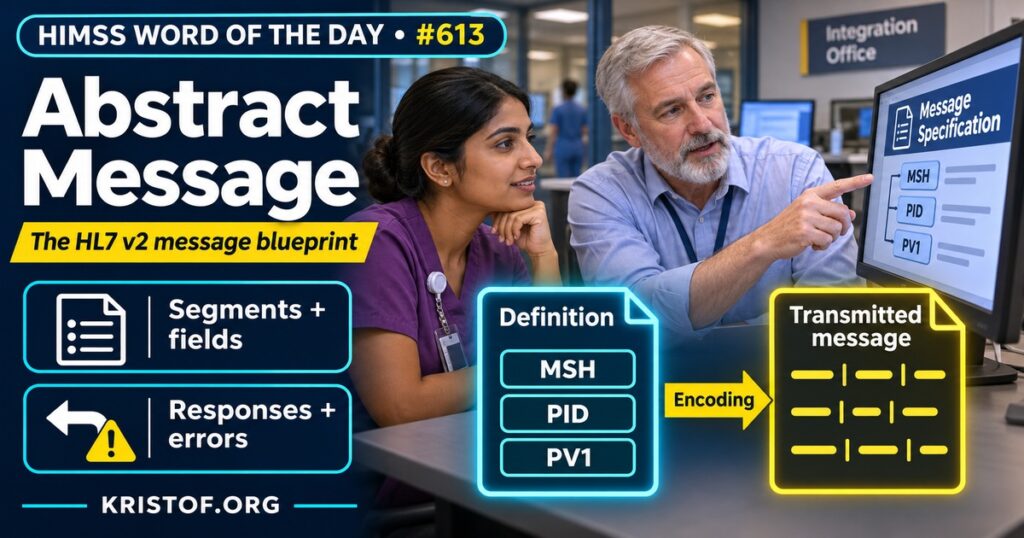
The HIMSS Dictionary treats the abstract message as the foundation of HL7 definition. It is the specification written for one trigger event, and it lists the data fields a message carries, which response messages are valid, and how application-level errors or a failure in the underlying communication link are handled. The dictionary adds that an abstract message is expressed in HL7 segments and fields.
HL7’s Version 2 Control chapter explains why the word “abstract” fits. This post read ANSI/HL7 V2.9-2019 at hl7.eu, an independent mirror of the HL7 v2 chapters, so check the wording against HL7’s official copy. The chapter describes a form for stating each message’s purpose, its contents, and how its parts relate, and calls it abstract because it is purely an application-level (Level 7) definition. It does not say how the message is written as characters. Separate encoding rules do that, turning an abstract message into the delimited character string that is actually sent, with the delimiters set in the MSH segment and a carriage return ending each segment.
| Item | Detail |
|---|---|
| Defined for | One trigger event, per the HIMSS Dictionary |
| Built from | Segments and fields, marked required, optional, or repeating |
| Turned into characters by | HL7’s separate encoding rules |
| Includes | Data fields to send, valid responses, and error and failure handling, per the HIMSS Dictionary |
| Related terms | Trigger event, HL7 v2, interface engine, and acknowledgment |
⚠️ Exam Alert: The abstract message is the definition. The encoded message is the character string that travels between systems. A trigger event is the real-world occurrence that creates the need to send data, and the message type is a three-character code. Keep these four separate, and do not confuse an HL7 v2 abstract message with a FHIR resource.
🌐 Why It Matters: Real-World Healthcare IT Context
Two systems that exchange admissions, orders, or results need a shared picture of what each message contains. The abstract message supplies that picture, and a site’s own interface specification usually narrows it further.
How HL7 v2 describes structure. According to the Control chapter, segments can be required or optional and can occur once or repeat, and segments can be grouped, with the first segment in a group acting as a required anchor. Rules also stop a repeating segment from appearing where it would make a message ambiguous to parse. Fields can be populated, left unpopulated, or carry a delete indicator, and the chapter notes that HL7 v2 has no explicit null concept. Optionality codes include required, required but may be empty, optional, conditional, not used for the trigger event, backward compatibility, and withdrawn, and repetition is shown as no repeat, unlimited repeat, or a stated maximum.
Trigger events and message types. The chapter says each message has a three-character message type. As the chapter describes it, one message type can have several trigger event codes, but a trigger event code belongs to only one message type. Codes beginning with Z are reserved for local use and are not defined by the standard.
Responses and acknowledgments. The chapter separates two kinds of acknowledgment in enhanced mode, which replaced the original mode in version 2.2. A positive accept acknowledgment means the receiver has committed the message to safe storage, so the sender need not resend it. The application acknowledgment reports the processing result. The chapter also notes that a sender cannot assume a message arrived unless an acknowledgment says so. Acknowledgment and error handling use the ACK message and the MSA and ERR segments. The part of the chapter on error-handling rules was beyond what this post read, so it makes no claim about those details.
Message maps and FHIR. The HL7 Version 2 to FHIR Implementation Guide indexes its message maps by v2 message structure, such as ADT_A01, ORU_R01, and MDM_T02. Each mapping row identifies a segment by its path through the message structure and group and gives minimum and maximum cardinality. The guide is version 1.0.0, labeled STU 1 and based on FHIR R4, with an informative status. The page shows no publication date, and it describes mapping rows rather than replacing the v2 chapters.
What research shows. Studies in this area describe specific interfaces and tools, not the concept itself, so they support only modest points.
- Luu and colleagues (2024) present a case report of nine laboratory tests moving between two institutions through a health information exchange platform. They compared HL7 v2 messages across the instrument, laboratory information system, and sending EHR, and reported information loss: consistently missing specimen source, missing analytical technique or instrument platform, inconsistent units and reference ranges, discordant LOINC code use, and added complexity from multiple HL7 versions. This is one case pair, not a survey. The paper does not frame its findings in terms of abstract messages. Reading them that way, a definition that allows a field does not ensure the sending system populates it.
- López and Blobel (2010) analyze integration architectures and conclude that the point-to-point and message-server models are fully supported by traditional HL7 v2 and v3 messaging, while the mediator model relies on HL7 v3 with service-oriented approaches. Their demonstration is a proof of concept for public health surveillance.
- Kim and colleagues (2011) describe a graphical tool that helps non-programmers build exchange rules for an HL7 v2.x interface engine. It was tested through information exchange tests only, and the authors note it handles only HL7 v2.x messages and a database.
Common abstract message problems:
- Treating the abstract definition as the encoded message string
- Assuming an optional field will be populated by the sending system
- Confusing the trigger event with the message type
- Overlooking locally defined Z codes that a site adds
- Assuming a message arrived without checking acknowledgments
- Mixing HL7 versions across interfaces without checking which definition each uses
What supports clear abstract message use:
- Reading the definition for the HL7 version actually in use
- A written interface specification for each trigger event
- Test messages that exercise optional, repeating, and conditional parts
- Agreed acknowledgment behavior between sender and receiver
- Review of the fields clinicians rely on, such as specimen source, units, and reference ranges
🏥 The Nurse’s Perspective: Clinical, Bedside, & Workflow
Nurses rarely read abstract messages, but they work with what those definitions deliver.
At the Bedside
An admission, transfer, discharge, or posted lab result sets a message in motion between systems. When a result appears without its specimen source or with unclear units, nurses are seeing the downstream effect of what a message did or did not carry. The Luu case report lists gaps like these among its findings, though it does not describe any particular system a nurse might use.
In Clinical Workflow
Nurse informaticists often stand between clinicians and interface analysts. A practical contribution is naming which data elements a workflow depends on, so analysts can check them in the interface specification and in sample messages. Because a sender cannot assume receipt without an acknowledgment, watching interface queues and error reports is also part of ongoing support.
In EHR Implementation (Go-Live Perspective)
During an Epic Go-Live, interface problems reach analysts as clinician-level questions, such as a patient missing from a department list or a result that has not appeared. At-the-elbow support and analysts trace such reports back to whether the event message was sent, accepted, and processed. This post does not claim that any specific go-live had an interface message problem.
🎓 CAHIMS / CPHIMS & HIMSS Perspective
CAHIMS Exam Domain Mapping
The abstract message supports interoperability and standards knowledge:
| CAHIMS Domain | How Abstract Message Appears |
|---|---|
| Healthcare & Technology Environments | Interfaces, message structure, and exchange standards |
| Clinical Informatics | Which clinical events trigger messages and what data clinicians need |
| Healthcare Information & Systems Management | Interface specifications, testing, and monitoring |
| Management & Leadership | Vendor interface governance and change control |
Key Terms to Know Alongside Abstract Message
- HL7 v2 — the HL7 messaging standard whose messages are built from segments and fields
- Trigger event — the real-world occurrence that creates the need to send a message
- Interface engine — software that translates and routes messages between systems
- Interface — the connection that lets two systems exchange data
- FHIR — HL7’s resource-based standard, separate from the v2 message format
- Acknowledgment — a response message reporting receipt or processing of a message
HIMSS Organizational Position
HIMSS offers education and research on health information and technology topics through its Resource Center. Members can find related information on the HIMSS Resource Center page.
🔗 Explore Further: External References
- HL7 — Version 2.9 Chapter 2, Control (mirror at hl7.eu) https://www.hl7.eu/HL7v2x/v29/std29/ch02.html
- HL7 — HL7 Version 2 to FHIR Implementation Guide, Message Maps https://hl7.org/fhir/uv/v2mappings/message_maps.html
- Luu et al. (2024), JAMIA open — Analysis of laboratory data transmission between two healthcare institutions using a widely used point-to-point health information exchange platform: a case report https://pubmed.ncbi.nlm.nih.gov/38660616/
- López and Blobel (2010), Methods of information in medicine — Architectural approaches for HL7-based health information systems implementation https://pubmed.ncbi.nlm.nih.gov/20213040/
- Kim et al. (2011), Healthcare informatics research — The Development of a Graphical User Interface Engine for the Convenient Use of the HL7 Version 2.x Interface Engine https://pubmed.ncbi.nlm.nih.gov/22259723/
- HIMSS — Resource Center https://www.himss.org/resource-center
Term source: HIMSS Dictionary of Health Information and Technology Terms, Acronyms, and Organizations, 6th Edition (2025). All definitions in this series are paraphrased for editorial purposes. Readers are encouraged to consult the primary source for exact language.
Eric Andrew Kristof, RN, CAHIMS is a Healthcare IT professional and HIMSS Arkansas Chapter member based in Hot Springs Village, AR, with hands-on Epic Go-Live experience and a diverse healthcare and IT background. He writes at kristof.org at the intersection of clinical care and healthcare technology.
Leave a Reply