By Eric Andrew Kristof, RN, CAHIMS | Healthcare IT Professional | HIMSS Arkansas Chapter Member
About This Series: The HIMSS Word of The Day is a running blog series drawing from the HIMSS Dictionary of Health Information and Technology Terms, Acronyms, and Organizations, 6th Edition (2025) — the authoritative reference for healthcare IT professionals and the primary study resource for CAHIMS and CPHIMS certification. Each post paraphrases the term in plain language, grounds it in real-world healthcare IT context, and adds a bedside nursing perspective you won’t find in a textbook.
📖 The Term: Safeguard
Source: HIMSS Dictionary of Health Information and Technology Terms, Acronyms, and Organizations, 6th Edition (2025)
🔍 Plain-Language Definition
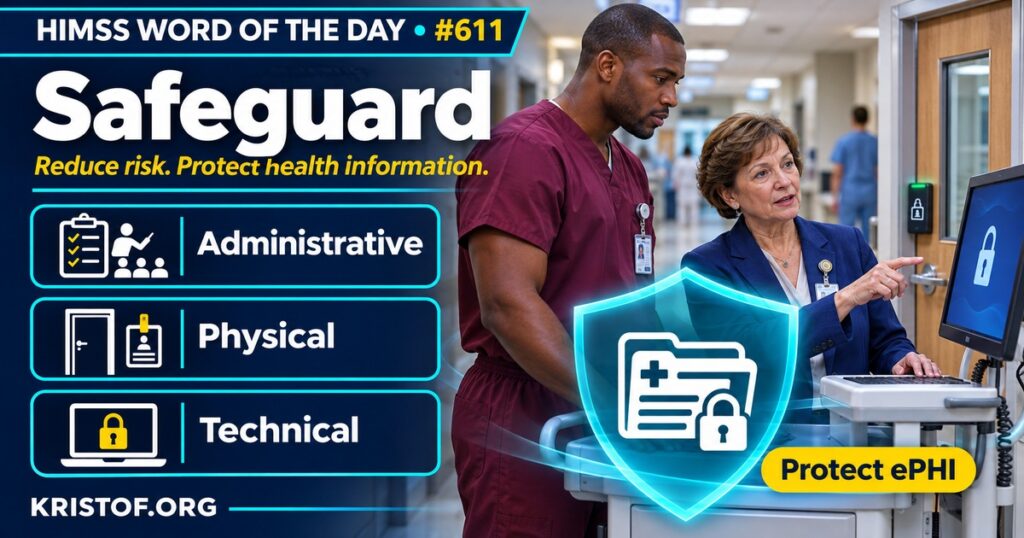
The HIMSS Dictionary describes a safeguard as a sanctioned security measure that protects computing resources by removing or lowering risk. It says a safeguard can be technical, procedural, or physical.
NIST‘s cybersecurity glossary shows several related definitions. One entry, attributed to NIST SP 800-28 Version 2, is close in meaning to the dictionary’s. Other entries, attributed to FIPS 200 and SP 800-137, describe safeguards as protective measures for meeting a system’s confidentiality, integrity, and availability requirements, which may include security features, management constraints, personnel security, and physical security. Several entries state that the term is synonymous with security controls and countermeasures.
The HIPAA Security Rule uses the word differently. Section 164.304 of Title 45 of the Code of Federal Regulations defines three types, and Section 164.306 sets the general rules for how covered entities and business associates apply the rule’s standards.
| Type | HIPAA definition (45 CFR 164.304), summarized |
|---|---|
| Administrative safeguards | Actions, policies, and procedures that manage security measures for ePHI and the conduct of the workforce regarding it |
| Physical safeguards | Physical measures, policies, and procedures that protect information systems, buildings, and equipment from natural and environmental hazards and unauthorized intrusion |
| Technical safeguards | The technology and the policies and procedures for its use that protect ePHI and control access to it |
⚠️ Exam Alert: In HIPAA, an addressable implementation specification is not the same as an optional one. Section 164.306 says an entity must assess whether the specification is reasonable and appropriate. If it is, the entity must implement it. If it is not, the entity must document why and, where reasonable and appropriate, implement an equivalent alternative. Also, 164.306 itself does not define the three safeguard categories. That is done in 164.304.
🌐 Why It Matters: Real-World Healthcare IT Context
“Safeguard” is a general term, so its meaning depends on whose framework is in use. For health IT work, the two that matter most are HIPAA and NIST.
HIPAA’s general rules. According to 45 CFR 164.306, covered entities and business associates must ensure the confidentiality, integrity, and availability of the ePHI they create, receive, maintain, or transmit, and must protect against reasonably anticipated threats and impermissible uses or disclosures. The same section lets entities choose any security measures that let them reasonably and appropriately implement the standards, and lists factors to consider: their size, complexity, and capabilities; their technical infrastructure and security capabilities; the cost of measures; and the probability and criticality of risks to ePHI. The rule also says entities must review and modify their security measures as needed and update their documentation. So a safeguard is not a one-time purchase; it is something that is kept under review.
Required and addressable. The rule marks each implementation specification as either Required or Addressable. Required ones must be implemented. For addressable ones, the assessment and documentation steps in the exam alert apply. This distinction is often misunderstood because the word suggests choice, while the regulation text describes a decision that has to be made, justified, and recorded.
NIST usage. NIST’s glossary page for safeguards shows that the term appears across NIST publications, often as a synonym for security controls and countermeasures. NIST SP 800-53 Revision 5, which its CSRC page describes as a catalog of security and privacy controls for information systems and organizations, is where many organizations find specific controls. The page says the document is dated September 2020, with updates as of December 10, 2020, and notes a minor release, 5.2.0, issued on August 27, 2025.
Bridging the two. NIST SP 800-66 Revision 2, issued in February 2024, is described on its CSRC page as a cybersecurity resource guide for implementing the HIPAA Security Rule. A planning note on that page says NIST’s Cybersecurity and Privacy Reference Tool includes mappings from the Security Rule’s standards and implementation specifications to Cybersecurity Framework subcategories and SP 800-53 Revision 5 controls. The page does not say a mapping makes an organization compliant, and compliance decisions rest with the entity and its regulators.
What is not covered. This post does not list the individual HIPAA standards or controls. Administrative safeguards and physical safeguards already have their own Word of The Day posts, and the HIPAA Security Rule post covers the rule as a whole.
Common safeguard problems:
- Treating safeguards as only technology when HIPAA and NIST both include policies, procedures, and physical measures
- Reading “addressable” as “optional”
- Applying the same measures everywhere without considering size, risk, and cost as 164.306 describes
- Implementing a safeguard once and not reviewing it as systems and threats change
- Assuming a mapping between HIPAA and NIST controls proves compliance
What supports effective safeguards:
- A risk analysis that explains why each safeguard was chosen
- Documentation of decisions, especially for addressable specifications
- Periodic review and updating of measures
- A shared vocabulary across HIPAA, NIST, and local policy
🏥 The Nurse’s Perspective: Clinical, Bedside, & Workflow
Nurses live with safeguards daily, even when nobody calls them that.
At the Bedside
Examples that fit the three HIPAA categories include a policy on not sharing logins (administrative), a badge-controlled medication room (physical), and unique sign-in with automatic screen lock (technical). These are illustrations, not a statement of what any particular organization requires. Nurses who understand the purpose of a measure are better positioned to follow it correctly and to report a gap.
In Clinical Workflow
Safeguards can feel like friction, such as a timeout during a busy shift or a badge tap at a door. Nurse informaticists help weigh this, because 164.306 asks entities to balance risk, capability, and cost, and a measure that staff routinely work around may protect less than it appears to. Raising a specific workflow problem lets the security team adjust the measure or the training.
In EHR Implementation (Go-Live Perspective)
During an Epic Go-Live, analysts at the elbow hear complaints about sign-in, locked screens, and access limits. Explaining that these are safeguards, and routing real workflow barriers to the right team, is part of the support role. This post does not claim that any specific go-live had a safeguard problem.
🎓 CAHIMS / CPHIMS & HIMSS Perspective
CAHIMS Exam Domain Mapping
Safeguards support security and compliance knowledge:
| CAHIMS Domain | How Safeguards Appear |
|---|---|
| Healthcare & Technology Environments | HIPAA Security Rule categories and NIST controls |
| Clinical Informatics | Access, sign-in, and the protection of clinical data |
| Healthcare Information & Systems Management | Risk analysis, controls, documentation, and review |
| Management & Leadership | Governance, accountability, and keeping measures current |
Key Terms to Know Alongside Safeguard
- Administrative safeguards — policies, procedures, and actions that manage security measures and workforce conduct
- Physical safeguards — measures that protect systems, buildings, and equipment
- HIPAA Security Rule — the rule that sets standards for protecting ePHI
- Risk analysis — the process of identifying threats and vulnerabilities to ePHI
- Access control — limiting who or what can use a system or data
- Risk management — choosing and applying measures to reduce identified risks
HIMSS Organizational Position
HIMSS offers education and research on health information and technology topics through its Resource Center. Members can find related information on the HIMSS Resource Center page.
🧭 More HIMSS Word of The Day Terms
Related terms in the Cybersecurity and Privacy series:
- Access Control
- TKIP (Temporal Key Integrity Protocol)
- Data Origin Authentication
- AUP (Acceptable Use Policy)
Browse all Cybersecurity and Privacy terms or the A–Z glossary.
🔗 Explore Further: External References
- eCFR — 45 CFR 164.304, Definitions (Security Standards) https://www.ecfr.gov/current/title-45/subtitle-A/subchapter-C/part-164/subpart-C/section-164.304
- eCFR — 45 CFR 164.306, Security Standards: General Rules https://www.ecfr.gov/current/title-45/subtitle-A/subchapter-C/part-164/subpart-C/section-164.306
- NIST CSRC — Glossary: safeguards https://csrc.nist.gov/glossary/term/safeguards
- NIST — SP 800-66 Revision 2, a cybersecurity resource guide for implementing the HIPAA Security Rule (February 2024) https://csrc.nist.gov/pubs/sp/800/66/r2/final
- NIST — SP 800-53 Revision 5, Security and Privacy Controls for Information Systems and Organizations https://csrc.nist.gov/pubs/sp/800/53/r5/upd1/final
- HIMSS — Resource Center https://www.himss.org/resource-center
Term source: HIMSS Dictionary of Health Information and Technology Terms, Acronyms, and Organizations, 6th Edition (2025). All definitions in this series are paraphrased for editorial purposes. Readers are encouraged to consult the primary source for exact language.
Eric Andrew Kristof, RN, CAHIMS is a Healthcare IT professional and HIMSS Arkansas Chapter member based in Hot Springs Village, AR, with hands-on Epic Go-Live experience and a diverse healthcare and IT background. He writes at kristof.org at the intersection of clinical care and healthcare technology.
Leave a Reply