By Eric Andrew Kristof, RN, CAHIMS | Healthcare IT Professional | HIMSS Arkansas Chapter Member
About This Series: The HIMSS Word of the Day is a running blog series drawing from the HIMSS Dictionary of Health Information and Technology Terms, Acronyms, and Organizations, 6th Edition (2025) — the authoritative reference for healthcare IT professionals and the primary study resource for CAHIMS and CPHIMS certification. Each post paraphrases the term in plain language, grounds it in real-world healthcare IT context, and adds a bedside nursing perspective you won’t find in a textbook.
📖 The Term: Risk Analysis
Source: HIMSS Dictionary of Health Information and Technology Terms, Acronyms, and Organizations, 6th Edition (2025)
🔍 Plain-Language Definition
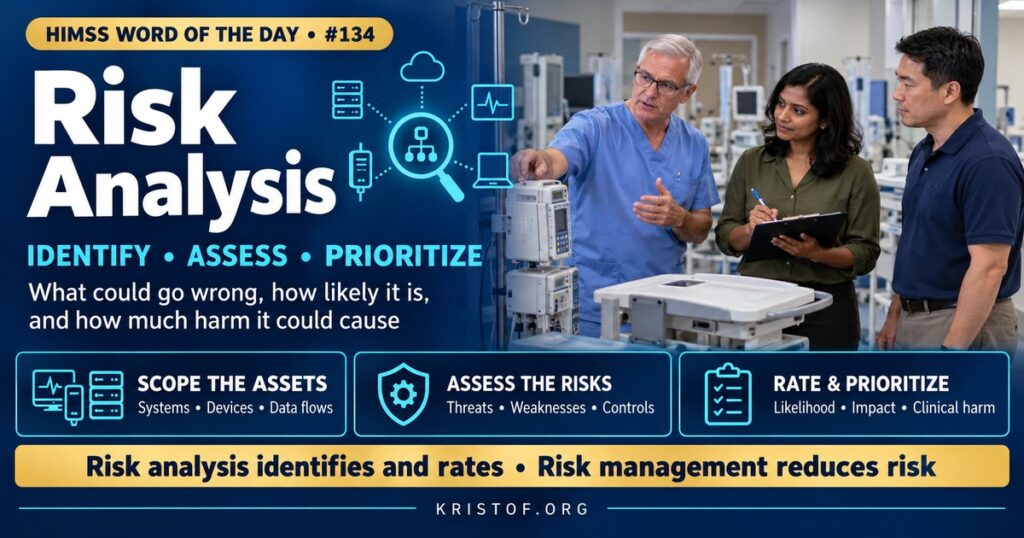
A risk analysis is a structured process for identifying what could go wrong, how likely it is, and how much harm it could cause. In healthcare information security, it means assessing risks and vulnerabilities to the confidentiality, integrity, and availability of electronic protected health information (ePHI).
The HIMSS Dictionary describes risk analysis briefly as the process of understanding the nature of risk and determining its level.
| Risk Analysis Element | What It Means | Healthcare Example |
|---|---|---|
| Scope and Assets | Identify where ePHI is created, stored, and transmitted | EHR servers, medical devices, laptops, cloud services |
| Threats | Potential events or actors that could cause harm | Ransomware, insider snooping, power outages, theft |
| Vulnerabilities | Weaknesses that threats could exploit | Unpatched software, unencrypted devices, weak passwords |
| Current Controls | Safeguards already in place | Backups, multifactor authentication, badge access |
| Likelihood and Impact | How probable an event is and how severe the harm | High likelihood and high impact for phishing leading to ransomware |
| Risk Level | The combined rating that guides priorities | A heat map ranking risks for action |
⚠️ Exam Alert: Risk analysis identifies and rates risks. Risk management implements measures to reduce them to a reasonable level. A vulnerability scan finds technical weaknesses but is not a complete risk analysis. A gap analysis compares controls to a standard, which is also narrower than an enterprise-wide risk analysis.
🌐 Why It Matters: Real-World Healthcare IT Context
The HIPAA Security Rule requires covered entities and business associates to conduct an accurate and thorough assessment of the potential risks and vulnerabilities to the ePHI they hold. It is the first implementation specification in the administrative safeguards, and much of the rest of the rule depends on it, because organizations use the results to decide which safeguards are reasonable and appropriate.
HHS guidance on risk analysis explains that the analysis should cover all ePHI, regardless of the media on which it is stored, and should include identifying where ePHI is, potential threats and vulnerabilities, current security measures, likelihood and impact, and the resulting level of risk, with documentation and periodic review. NIST’s Guide for Conducting Risk Assessments, SP 800-30, provides a widely used methodology.
Enforcement history shows why this matters. OCR has repeatedly found that organizations involved in breaches had not performed a thorough risk analysis, and in 2024 it launched a Risk Analysis Initiative focused on enforcing this requirement. Settlements under the initiative have commonly included corrective action plans requiring a current risk analysis and a risk management plan.
Smaller organizations have help. ONC and OCR developed the Security Risk Assessment (SRA) Tool, a free resource designed to help small and medium-sized practices conduct and document their analyses. Larger organizations often use frameworks such as NIST guidance and specialized software.
A risk analysis is not a one-time project. Systems, threats, vendors, and workflows change constantly. Organizations should update their analysis regularly and whenever significant changes occur, such as adopting a new EHR, adding cloud services, acquiring practices, or experiencing a security incident.
Scope is a common weakness. Analyses that cover only the main EHR may miss medical devices, departmental systems, research databases, shadow IT spreadsheets, backup media, or business associates that handle ePHI. An accurate asset inventory is often the hardest and most important first step.
Clinical risk belongs in the picture. Availability of systems and integrity of data directly affect patient safety, so impacts such as delayed medication administration or incorrect results deserve weight alongside privacy and financial harm.
Third parties extend the scope further. Business associates, cloud providers, billing companies, and device vendors may store or access ePHI, and a breach at a vendor can affect many organizations at once. Strong analyses consider vendor risk, review security assurances, and track which vendors have access to which data, so that contracts and monitoring match the level of risk each relationship presents.
Common risk analysis shortcomings:
- Limited scope that misses systems or locations with ePHI
- Checklists or vulnerability scans presented as a full analysis
- No rating of likelihood and impact
- Results not linked to a risk management plan
- Outdated analyses that ignore new systems
- Little input from clinical and operational staff
Characteristics of a strong risk analysis:
- Complete inventory of systems, devices, and data flows
- Consistent methodology, such as NIST SP 800-30
- Documented threats, vulnerabilities, and controls
- Risk ratings that drive prioritized actions
- Regular updates and updates after major changes
- Leadership review and accountability for remediation
🏥 The Nurse’s Perspective: Clinical, Bedside, & Workflow
Risk analyses are led by security and compliance teams, but nurses see risks that technical reviews can miss.
At the Bedside
Frontline workflows reveal real vulnerabilities: shared workstations left logged in, devices stored where visitors can reach them, workarounds such as photographing whiteboards, or paper census lists left in public areas. Reporting these patterns helps risk assessments reflect how care actually happens.
Nurses also understand clinical impact. Knowing that a smart pump network outage would delay infusions, or that loss of the medication administration record would slow every dose, helps analysts rate the impact of risks accurately.
In Clinical Workflow
Workarounds deserve honest discussion. When security controls make work difficult, staff may create unofficial solutions that introduce new risks. Sharing these openly, without fear of blame, allows organizations to fix the underlying problem.
New tools and devices introduced on a unit, such as an app for wound photography or a new monitoring system, should go through organizational review so they can be included in the risk analysis and secured appropriately.
Nurse informaticists often participate in risk assessments for clinical systems, bringing knowledge of data flows, downtime impacts, and user behavior.
Nurses in leadership roles can help prioritize remediation by explaining which risks would most disrupt care, ensuring that limited security resources go first to the problems that matter most for patients.
In EHR Implementation (Go-Live Perspective)
During an Epic Go-Live, organizations update their risk analysis to reflect the new system, its interfaces, devices, hosting arrangements, and remote access. Downtime procedures and backups are evaluated as part of availability risk.
At-the-elbow support analysts often notice risky behaviors, such as shared logins or unlocked workstations, during the early days of a new system. Reporting patterns to security and informatics leaders helps address them through better workflows rather than discipline alone.
🎓 CAHIMS / CPHIMS & HIMSS Perspective
CAHIMS Exam Domain Mapping
Risk analysis appears in security, compliance, and management questions:
| CAHIMS Domain | How Risk Analysis Appears |
|---|---|
| Healthcare & Technology Environments | HIPAA Security Rule requirements; OCR enforcement |
| Clinical Informatics | Clinical impact of system failures; workflow-related risks |
| Healthcare Information & Systems Management | Asset inventory, threats, vulnerabilities, controls, NIST methods |
| Management & Leadership | Risk management plans, governance, accountability, resource allocation |
Key Terms to Know Alongside Risk Analysis
- Risk Management — implementing measures to reduce risks to a reasonable and appropriate level
- Threat — a potential cause of an unwanted incident
- Vulnerability — a weakness that could be exploited by a threat
- Likelihood — the probability that a threat will exploit a vulnerability
- Impact — the magnitude of harm if a risk occurs
- Asset Inventory — a catalog of systems, devices, and data that must be protected
HIMSS Organizational Position
HIMSS emphasizes risk-based cybersecurity programs through its Healthcare Cybersecurity Community, research, and education, and engages with HHS on HIPAA security policy. Members can find related education and research through the HIMSS Resource Center.
🔗 Explore Further: External References
- HHS — Guidance on Risk Analysis https://www.hhs.gov/hipaa/for-professionals/security/guidance/guidance-risk-analysis/index.html
- NIST — SP 800-30 Rev. 1, Guide for Conducting Risk Assessments https://csrc.nist.gov/pubs/sp/800/30/r1/final
- ONC — Security Risk Assessment Tool https://healthit.gov/privacy-security/security-risk-assessment-tool/
- HHS — The Security Rule https://www.hhs.gov/hipaa/for-professionals/security/index.html
- HHS — HIPAA Compliance and Enforcement https://www.hhs.gov/hipaa/for-professionals/compliance-enforcement/index.html
- HHS 405(d) Program — Health Industry Cybersecurity Practices https://405d.hhs.gov/
Term source: HIMSS Dictionary of Health Information and Technology Terms, Acronyms, and Organizations, 6th Edition (2025). All definitions in this series are paraphrased for editorial purposes. Readers are encouraged to consult the primary source for exact language.
Eric Andrew Kristof, RN, CAHIMS is a Healthcare IT professional and HIMSS Arkansas Chapter member based in Hot Springs Village, AR, with hands-on Epic Go-Live experience and a diverse healthcare and IT background. He writes at kristof.org at the intersection of clinical care and healthcare technology.
Leave a Reply