By Eric Andrew Kristof, RN, CAHIMS | Healthcare IT Professional | HIMSS Arkansas Chapter Member
About This Series: The HIMSS Word of The Day is a running blog series drawing from the HIMSS Dictionary of Health Information and Technology Terms, Acronyms, and Organizations, 6th Edition (2025) — the authoritative reference for healthcare IT professionals and the primary study resource for CAHIMS and CPHIMS certification. Each post paraphrases the term in plain language, grounds it in real-world healthcare IT context, and adds a bedside nursing perspective you won’t find in a textbook.
📖 The Term: CHIP (Children’s Health Insurance Program)
Source: HIMSS Dictionary of Health Information and Technology Terms, Acronyms, and Organizations, 6th Edition (2025)
🔍 Plain-Language Definition
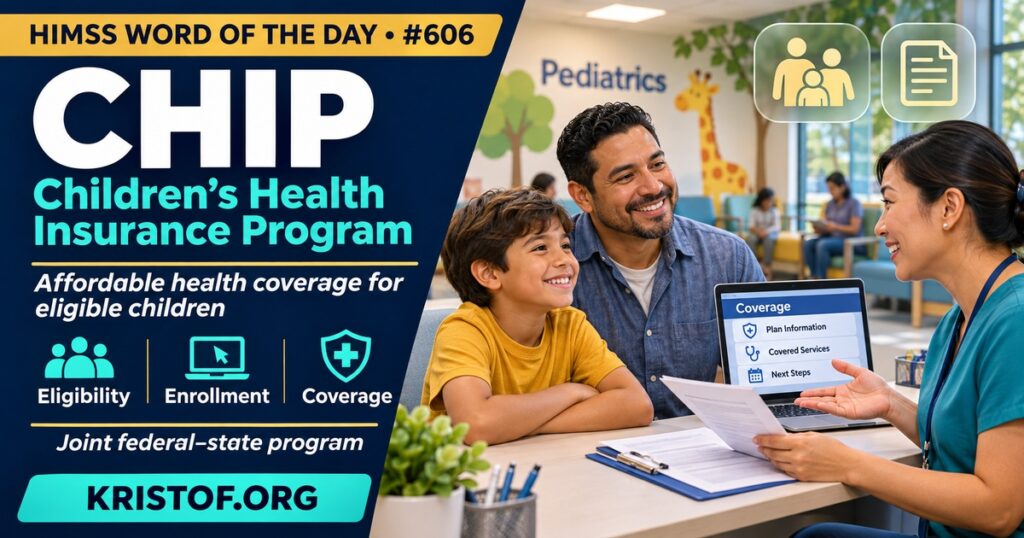
The HIMSS Dictionary describes CHIP (Children’s Health Insurance Program) as a coverage program tied to the Centers for Medicare & Medicaid Services (CMS) that helps children in households above the Medicaid income limit get affordable health coverage. It adds that some states also cover pregnant women under CHIP, and that each state offers CHIP and works closely with its Medicaid program.
Medicaid.gov, a CMS website, gives a fuller picture. It describes CHIP as a joint federal and state program that provides coverage to uninsured children in families whose income is too high for Medicaid but too low to afford private or group plans. Medicaid.gov also says states manage CHIP under federal requirements and that both states and the federal government fund it. The same site describes three ways a state can structure CHIP: a Medicaid expansion, a separate CHIP, or a combination of the two. It does not give a count of states under each design, and it shows no date for that information, so the state map on the site is the place to check a specific state.
| Item | Detail |
|---|---|
| Type | Joint federal and state coverage program for children, managed by states |
| Who it covers | Uninsured children in families above Medicaid income limits; some states also cover pregnant women under a separate CHIP |
| State design options | Medicaid expansion, separate CHIP, or a combination, per Medicaid.gov |
| Shared eligibility method | Modified Adjusted Gross Income (MAGI) for Medicaid, CHIP, and marketplace subsidies |
| Health IT touchpoints | Eligibility and enrollment data, T-MSIS reporting, and the Children’s EHR Format |
⚠️ Exam Alert: CHIP is a coverage program, not a care delivery model. Do not confuse it with Medicaid, which covers a broader group and runs alongside it, with Medicare, which is the federal program for older adults and some people with disabilities, or with MACRA, whose full name, the Medicare Access and CHIP Reauthorization Act, simply contains the acronym. In hematology, the same four letters also stand for a different concept altogether.
🌐 Why It Matters: Real-World Healthcare IT Context
CHIP is mostly discussed as policy, but the coverage it provides generates data that health IT systems have to handle: who is eligible, what coverage a child has at a visit, what claims were paid, and how care quality is measured.
Eligibility rules and shared data. Medicaid.gov says MAGI sets financial eligibility for Medicaid, CHIP, and the premium tax credits and cost-sharing reductions available through the health insurance marketplace. It says using one set of income rules and a single application across these programs helps make enrollment easier. The same page names express lane, continuous, and presumptive eligibility as enrollment strategies, although it does not explain how each one works. States also decide eligibility details within federal rules, so what applies in one state may not apply in another.
Who is covered. According to the Medicaid.gov eligibility page, CHIP covers targeted low-income children who are under 19, uninsured, residents of the state, within the state’s income range, and either U.S. citizens or meeting immigration requirements. The page also describes coverage for targeted low-income pregnant women under a separate CHIP, and for children from conception to the end of pregnancy, with states able to cover prenatal, delivery, and postpartum care. The page lists exclusions, such as people in certain institutions, with exceptions. Because the page describes these as options and conditions, a state’s own program page governs the details for a given patient.
T-MSIS. CMS describes the Transformed Medicaid Statistical Information System, or T-MSIS, as a national resource of Medicaid and CHIP data for policy, implementation, and oversight, and says it evolved from the older Medicaid Statistical Information System. The T-MSIS page names an eligibility file with beneficiary demographics and program participation, four claims files (inpatient, long-term care, other, and prescription) with a financial transactions file, a provider file, and a managed care file. States, territories, and the District of Columbia submit the data, and the page says two territories do not yet do so, without naming them. It points to a separate data guide for the full list of data elements, which is not summarized here.
Children’s EHR Format. The 2009 Children’s Health Insurance Program Reauthorization Act (CHIPRA) authorized a model EHR format for children, and the Agency for Healthcare Research and Quality (AHRQ) developed it in close collaboration with CMS. AHRQ’s Digital Healthcare Research site describes the Format as a minimum set of child-specific data elements and standards that developers can use as a checklist, with topic areas such as immunizations, growth data, and children with special health care needs. It says AHRQ, working with CMS, contracted RTI International in 2014 to enhance the Format, producing a 2015 priority list and recommended-uses document. The page gives no last-updated date and does not say whether the Format is current, whether it is required for certification or any program, or how widely EHR products implement it. This post therefore makes no claim about adoption.
Common CHIP problems:
- Treating CHIP and Medicaid as one program when states may operate them in different structures
- Assuming eligibility rules, income limits, or covered groups are the same in every state
- Using an old state map or enrollment figure as if it were current
- Mixing up CHIP with MACRA, or with the hematology use of the same four letters
- Assuming the Children’s EHR Format is a mandate rather than a published set of requirements and guidance
What supports understanding CHIP in health IT:
- Medicaid.gov’s CHIP pages for definitions, eligibility, and state program information
- The MAGI rules and single application that link CHIP, Medicaid, and marketplace coverage
- T-MSIS documentation for how Medicaid and CHIP data are described nationally
- AHRQ’s Children’s EHR Format pages for pediatric data requirements
The acronym overlap with hematology is real. A 2026 review by Patel and Mangaonkar in Blood Cancer Journal uses CHIP for clonal hematopoiesis of indeterminate potential, a pre-malignant condition managed in specialty clinics. It is cited here only to show that the abbreviation is used in more than one field, and it says nothing about the insurance program.
🏥 The Nurse’s Perspective: Clinical, Bedside, & Workflow
Nurses and registration staff meet CHIP mostly through coverage, and a child’s coverage can affect how a visit, a referral, or a prescription is handled.
At the Bedside
A parent may say a child has “state insurance” without naming Medicaid or CHIP, and the program name may not be visible to the clinician at all. Nurses often help families understand what their coverage may require, such as referrals or prior approvals, and the right answer can differ by state and by plan. Pediatric nurses also rely on accurate immunization and growth data in the record, which are topics the Children’s EHR Format names.
In Clinical Workflow
Insurance verification and registration typically sit with registration, patient financial services, or case management, with nurses affected when a coverage problem blocks an order or a referral. Because eligibility depends on income and household circumstances that the Medicaid.gov pages describe as varying by state, coverage status can change, and a nurse informaticist may see this as a registration or billing alert that needs follow-up. This is a general workflow observation, and sites differ.
In EHR Implementation (Go-Live Perspective)
During an Epic Go-Live, analysts at the elbow hear coverage-related questions from registration and front-desk staff, such as why a child’s payer shows one way in the system and another on the card. Pediatric practices may also notice that adult-oriented screens do not always fit well-child visits, which is the gap the Children’s EHR Format was written to address. This post does not claim that any specific go-live used the Format or encountered a CHIP-specific problem.
🎓 CAHIMS / CPHIMS & HIMSS Perspective
CAHIMS Exam Domain Mapping
CHIP supports policy and data-source knowledge:
| CAHIMS Domain | How CHIP Appears |
|---|---|
| Healthcare & Technology Environments | Public coverage programs, CMS, and state-federal roles |
| Clinical Informatics | Pediatric data needs, immunizations, and the Children’s EHR Format |
| Healthcare Information & Systems Management | Eligibility data, T-MSIS reporting, and payer information in registration |
| Management & Leadership | Policy awareness and checking state-specific rules |
Key Terms to Know Alongside CHIP
- Medicaid Management Information System — the claims and administration system associated with state Medicaid programs
- MACRA — the Medicare Access and CHIP Reauthorization Act, whose name includes the acronym
- CMS — the federal agency that oversees Medicaid and CHIP at the national level
- Electronic health record — the clinical record the Children’s EHR Format describes requirements for
- AHRQ — the agency that developed the Children’s EHR Format with CMS
- Health Insurance Portability and Accountability Act — the federal law that governs protected health information
HIMSS Organizational Position
HIMSS offers education and research on health information and technology topics through its Resource Center. Members can find related information on the HIMSS Resource Center page.
🧭 More HIMSS Word of The Day Terms
Related terms in the Healthcare Policy series:
- Covered Entity (HIPAA)
- FFP (Federal Financial Participation)
- Prescription Drug Monitoring Program (PDMP)
- J-Codes
Browse all Healthcare Policy terms or the A–Z glossary.
🔗 Explore Further: External References
- Medicaid.gov — Children’s Health Insurance Program (CHIP) https://www.medicaid.gov/chip/index.html
- Medicaid.gov — CHIP Eligibility and Enrollment https://www.medicaid.gov/chip/eligibility/index.html
- Medicaid.gov — CHIP State Program Information https://www.medicaid.gov/chip/state-program-information/index.html
- Medicaid.gov — Transformed Medicaid Statistical Information System (T-MSIS) https://www.medicaid.gov/medicaid/data-systems/macbis/transformed-medicaid-statistical-information-system-t-msis/index.html
- AHRQ Digital Healthcare Research — Children’s Electronic Health Record (EHR) Format https://digital.ahrq.gov/health-it-tools-and-resources/pediatric-resources/childrens-electronic-health-record-ehr-format
- Patel and Mangaonkar (2026), Blood cancer journal — CHIP clinics: a practical overview of structure and function https://pubmed.ncbi.nlm.nih.gov/42135277/
- HIMSS — Resource Center https://www.himss.org/resource-center
Term source: HIMSS Dictionary of Health Information and Technology Terms, Acronyms, and Organizations, 6th Edition (2025). All definitions in this series are paraphrased for editorial purposes. Readers are encouraged to consult the primary source for exact language.
Eric Andrew Kristof, RN, CAHIMS is a Healthcare IT professional and HIMSS Arkansas Chapter member based in Hot Springs Village, AR, with hands-on Epic Go-Live experience and a diverse healthcare and IT background. He writes at kristof.org at the intersection of clinical care and healthcare technology.
Leave a Reply