By Eric Andrew Kristof, RN, CAHIMS | Healthcare IT Professional | HIMSS Arkansas Chapter Member
About This Series: The HIMSS Word of The Day is a running blog series drawing from the HIMSS Dictionary of Health Information and Technology Terms, Acronyms, and Organizations, 6th Edition (2025) — the authoritative reference for healthcare IT professionals and the primary study resource for CAHIMS and CPHIMS certification. Each post paraphrases the term in plain language, grounds it in real-world healthcare IT context, and adds a bedside nursing perspective you won’t find in a textbook.
📖 The Term: Hijacking
Source: HIMSS Dictionary of Health Information and Technology Terms, Acronyms, and Organizations, 6th Edition (2025)
🔍 Plain-Language Definition
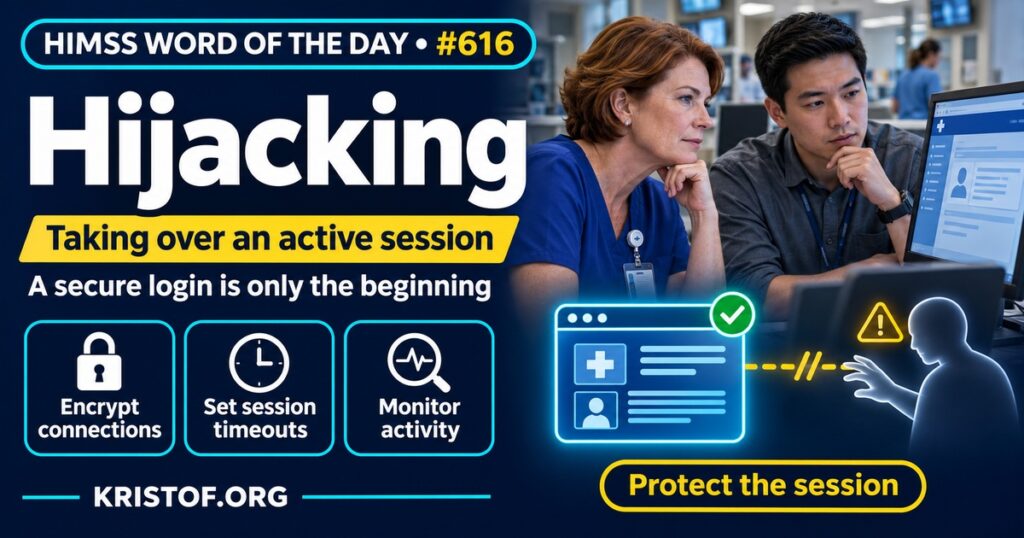
The HIMSS Dictionary gives two senses of hijacking. The broad sense is an attack on network security where the attacker seizes control of a communication. The narrower sense describes an attacker who steps between two parties after they have completed a successful authentication exchange. From that position, the attacker can pose as the user to the verifying system, or as the system to the user, and so control what is exchanged during the session. The dictionary adds that sessions between the user and a relying party can be compromised the same way.
NIST‘s Digital Identity Guidelines glossary describes a session hijack attack in the same terms, and the dictionary’s second sense closely follows that framing. This post read the glossary in SP 800-63-3, a page that states it was superseded by SP 800-63-4 as of August 1, 2025, and did not check whether the newer edition keeps the same entry. The practical point is that the attack happens after authentication, so a strong login alone does not prevent it.
| Item | Detail |
|---|---|
| What it targets | An established communication or session, not only the login step |
| Typical position | Between two parties, such as a user and a verifying system |
| Related terms | Man-in-the-middle attack, session fixation, replay attack, and session timeout |
| Common defenses | Encrypted connections, session timeouts, new session IDs, reauthentication, and monitoring |
| HIPAA touchpoints | Automatic logoff, transmission security, and person or entity authentication in 45 CFR 164.312 |
⚠️ Exam Alert: Hijacking takes over an existing session or communication. Credential theft obtains a login so an attacker can start a new session. A man-in-the-middle attack is a broader interception position, and session fixation tricks a user into using a session ID the attacker already knows. Keep them separate.
🌐 Why It Matters: Real-World Healthcare IT Context
Health care runs on long-lived sessions: clinicians stay signed in to EHRs, patient portals keep users logged in, and administrators use remote services to reach servers. Each session is something an attacker might try to take over.
How OWASP describes session exposure. The OWASP Session Management Cheat Sheet says session IDs can be exposed through disclosure, capture, prediction, brute force, or fixation, which enables hijacking, and that attackers may target one user or any valid account. Its controls include using encrypted connections for the entire session, setting cookie flags such as Secure and HttpOnly, renewing the session ID at login and after privilege changes, avoiding session IDs in web storage or URLs, requiring reauthentication after risk events, and enforcing timeouts on the server. It lists detection ideas such as watching for unexpected or reused IDs, and notes that binding sessions to IP address or User-Agent is a weak signal because attackers can share addresses or copy headers. The page shows no publication date.
What NIST says about sessions. NIST SP 800-63B (the page is dated August 26, 2025) covers session management in its Section 5, including session secrets and reauthentication. The page describes a session secret as something the verifier issues at authentication to keep the session continuous, and says browser cookies are not authentication but may serve as short-term secrets. Reauthentication limits tighten as assurance rises. At the second assurance level, the page gives an overall timeout of no more than 24 hours and an inactivity timeout of no more than 1 hour, and at the third level 12 hours and 15 minutes. This post read the front portion of the page and not Section 5 itself, so check the publication for exact wording. The page also stresses phishing-resistant and replay-resistant authentication, which address stolen or replayed credentials and not session takeover by themselves.
Hijacking inside networks. MITRE ATT&CK lists Remote Service Session Hijacking (T1563) as a lateral movement technique in which adversaries take over an existing session with a remote service such as SSH, Telnet, or RDP, with SSH and RDP hijacking as sub-techniques. Its listed mitigations include disabling unneeded remote services, network segmentation, limiting remote users’ permissions, and avoiding privileged remote access unless necessary. The page shows version 1.1, last modified October 24, 2025.
What HHS OCR said. A 2017 HHS OCR cyber awareness newsletter warns that man-in-the-middle attacks can capture or alter communications, including protected health information. It says HTTPS inspection products can weaken security if they fail to validate certificate chains, and it links continued use of older TLS and SSL versions to more man-in-the-middle attacks and session hijacks. It asks covered entities and business associates to consider these risks in their risk analysis. The newsletter is dated April 2017, and its advice on which TLS versions to use is outdated, so check current NIST TLS guidance instead of relying on it.
HIPAA’s technical safeguards. On the eCFR page, 45 CFR 164.312 lists automatic logoff as an addressable implementation specification, calling for procedures that end an electronic session after a period of inactivity. Its transmission security standard calls for measures that guard against unauthorized access to ePHI sent over a network, with integrity controls and encryption as addressable specifications, and its person or entity authentication standard calls for procedures to verify identity. The page shows Title 45 as current as of July 9, 2026. This post does not claim the rule addresses hijacking by name.
Evidence note. Peer-reviewed health care studies on session hijacking specifically were thin in the searches run for this post, so the evidence here is standards and agency guidance.
Common hijacking problems:
- Sessions that stay open for a long time on shared workstations
- Connections that are not encrypted for the whole session
- Session IDs exposed in URLs or web storage
- The same session ID kept after login or a privilege change
- Outdated TLS or SSL versions still enabled
- Inspection products that do not validate certificates
- Remote services left enabled when they are not needed
What supports defense against hijacking:
- Encrypted connections for the entire session
- Automatic logoff and server-side session timeouts
- New session IDs after login and privilege changes
- Reauthentication after risky events
- Limited and segmented remote services
- Monitoring for unusual session activity
🏥 The Nurse’s Perspective: Clinical, Bedside, & Workflow
Nurses rarely see a hijacked session, but they work with the controls meant to prevent one.
At the Bedside
The control nurses notice most is the session timeout or automatic logoff that ends an open EHR session after inactivity. HIPAA lists automatic logoff as an addressable specification, and OWASP and NIST both treat timeouts as a way to limit how long an open session stays usable. That purpose is easy to forget when a timeout interrupts a busy shift.
In Clinical Workflow
Nurse informaticists often help weigh timeout length against workflow. OWASP says appropriate timeouts depend on how valuable the application is, and NIST ties limits to assurance level, so settings are a judgment call that involves clinicians, security staff, and policy owners. Reporting a suspicious screen, an unexpected logout, or a session that appears to have changed user is part of the shared defense.
In EHR Implementation (Go-Live Perspective)
During an Epic Go-Live, analysts at the elbow often hear complaints about being logged out, which can reflect timeout and security settings working as configured. Explaining why those settings exist helps users accept them. This post does not claim that any specific go-live involved a hijacked session.
🎓 CAHIMS / CPHIMS & HIMSS Perspective
CAHIMS Exam Domain Mapping
Hijacking supports security and privacy knowledge:
| CAHIMS Domain | How Hijacking Appears |
|---|---|
| Healthcare & Technology Environments | Networks, remote access, and web sessions |
| Clinical Informatics | Session timeouts and workflow tradeoffs |
| Healthcare Information & Systems Management | Security controls, risk analysis, and HIPAA technical safeguards |
| Management & Leadership | Security policy and incident response |
Key Terms to Know Alongside Hijacking
- Authentication — verifying that a user is who they claim to be
- Man-in-the-middle attack — secret interception of communications between two parties, with possible alteration
- Session timeout — a limit that ends a session after set time or inactivity
- Replay attack — resending captured valid data to trick a system
- Encryption — protecting data so only authorized parties can read it
- Automatic logoff — ending an electronic session after a period of inactivity
HIMSS Organizational Position
HIMSS offers education and research on health information and technology topics through its Resource Center. Members can find related information on the HIMSS Resource Center page.
🔗 Explore Further: External References
- NIST — SP 800-63-3, Digital Identity Guidelines (glossary entry for session hijack attack) https://pages.nist.gov/800-63-3/sp800-63-3.html
- NIST — SP 800-63B, Digital Identity Guidelines (authentication volume, page dated August 26, 2025) https://pages.nist.gov/800-63-4/sp800-63b.html
- OWASP — Session Management Cheat Sheet https://cheatsheetseries.owasp.org/cheatsheets/Session_Management_Cheat_Sheet.html
- MITRE ATT&CK — Remote Service Session Hijacking (T1563) https://attack.mitre.org/techniques/T1563/
- HHS OCR — Cyber Awareness Newsletter, April 2017: Man-in-the-Middle Attacks and HTTPS Inspection Products https://www.hhs.gov/sites/default/files/april-2017-ocr-cyber-awareness-newsletter.pdf
- eCFR — 45 CFR 164.312, Technical Safeguards https://www.ecfr.gov/current/title-45/subtitle-A/subchapter-C/part-164/subpart-C/section-164.312
- HIMSS — Resource Center https://www.himss.org/resource-center
Term source: HIMSS Dictionary of Health Information and Technology Terms, Acronyms, and Organizations, 6th Edition (2025). All definitions in this series are paraphrased for editorial purposes. Readers are encouraged to consult the primary source for exact language.
Eric Andrew Kristof, RN, CAHIMS is a Healthcare IT professional and HIMSS Arkansas Chapter member based in Hot Springs Village, AR, with hands-on Epic Go-Live experience and a diverse healthcare and IT background. He writes at kristof.org at the intersection of clinical care and healthcare technology.
Leave a Reply