By Eric Andrew Kristof, RN, CAHIMS | Healthcare IT Professional | HIMSS Arkansas Chapter Member
About This Series: The HIMSS Word of the Day is a running blog series drawing from the HIMSS Dictionary of Health Information and Technology Terms, Acronyms, and Organizations, 6th Edition (2025) — the authoritative reference for healthcare IT professionals and the primary study resource for CAHIMS and CPHIMS certification. Each post paraphrases the term in plain language, grounds it in real-world healthcare IT context, and adds a bedside nursing perspective you won’t find in a textbook.
📖 The Term: Healthcare Common Procedure Coding System (HCPCS)
Source: HIMSS Dictionary of Health Information and Technology Terms, Acronyms, and Organizations, 6th Edition (2025)
🔍 Plain-Language Definition
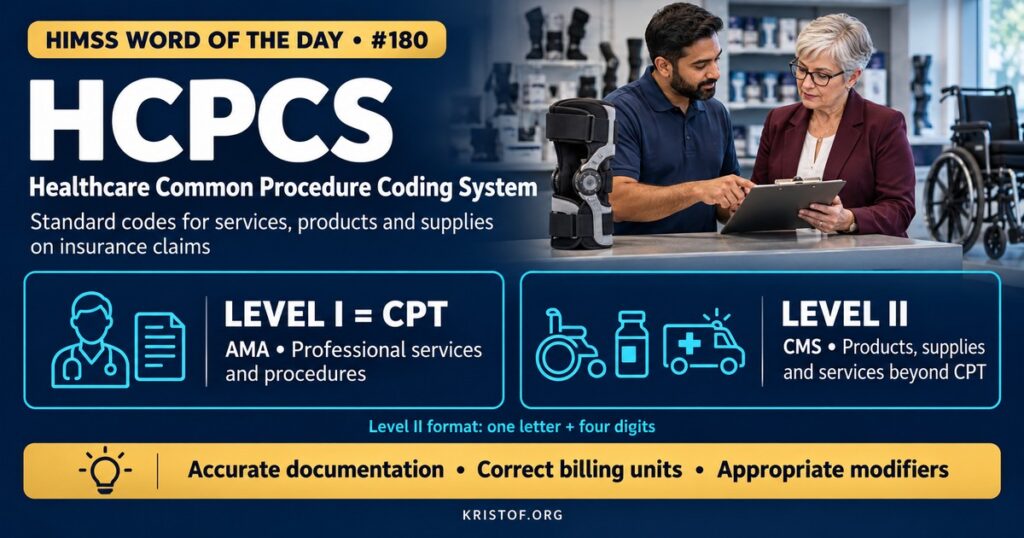
The Healthcare Common Procedure Coding System (HCPCS) is a standardized set of codes used to report medical procedures, services, products, and supplies on health insurance claims, especially to Medicare and Medicaid.
The HIMSS Dictionary explains that Medicare and other insurers depend on standardized coding to process claims in an orderly, consistent way, and that HCPCS Level II is among the code sets that serve this role. It notes that HCPCS has two main subsystems, Level I and Level II.
| HCPCS Level | Maintained By | What It Covers | Example |
|---|---|---|---|
| Level I | American Medical Association | CPT codes for professional services and procedures | Office visits, surgeries, lab tests |
| Level II | CMS | Products, supplies, and services not in CPT | Drugs, durable medical equipment, ambulance services, prosthetics |
| Modifiers | AMA and CMS | Two-character additions that add detail | Indicating the side of the body or a distinct service |
| Common Level II Code Groups | What They Cover |
|---|---|
| A Codes | Ambulance services and medical and surgical supplies |
| E Codes | Durable medical equipment |
| G Codes | Temporary procedures and professional services |
| J Codes | Drugs administered other than by oral method |
| L Codes | Orthotic and prosthetic procedures and devices |
⚠️ Exam Alert: HCPCS Level I is CPT, maintained by the AMA. HCPCS Level II is maintained by CMS and uses alphanumeric codes (a letter followed by four digits). ICD-10-CM codes diagnoses. Level II codes for drugs are reported in billing units defined by the code descriptor.
🌐 Why It Matters: Real-World Healthcare IT Context
Claims need to describe not only professional services but also the items and non-physician services delivered. HCPCS Level II fills that gap, covering drugs administered in clinics and hospital outpatient departments, durable medical equipment, prosthetics, orthotics and supplies, ambulance transport, and certain services not described in CPT.
HIPAA established HCPCS as a standard code set for electronic transactions, with Level I CPT used for professional services and Level II for items and supplies. Before HIPAA’s standards took effect, many payers used local codes, sometimes called Level III codes, which were eliminated to promote consistency.
CMS maintains and updates Level II codes. Updates occur quarterly, with a larger annual update, and CMS publishes coding decisions and applications through a public process. New codes are often created for new drugs, biologics, and devices.
Drug coding requires precision. Many injectable and infused drugs are reported with J codes, and billing units depend on the dose described in the code. If a code describes 10 milligrams and a patient receives 50 milligrams, five units are billed. Errors in dose documentation or unit conversion lead to underbilling, overbilling, and compliance risk. Some payers also require National Drug Codes on claims for drugs.
Durable medical equipment, prosthetics, orthotics, and supplies are often covered under specific rules, with documentation requirements such as face-to-face encounters and detailed written orders for certain items. Missing documentation can delay patients’ access to equipment.
Modifiers add essential detail. They indicate circumstances such as which side of the body was treated, whether a service was distinct, or whether a drug amount was wasted from a single-use vial, which some payers require to be reported.
HCPCS data supports analysis. Payers, researchers, and organizations use HCPCS codes to study utilization, costs, and trends in outpatient drugs and equipment.
Outpatient payment systems depend on these codes. Medicare’s hospital outpatient prospective payment system groups services, including many drugs and devices identified by HCPCS codes, into payment classifications, and pass-through payment status for new drugs and devices is tied to specific codes. Accurate coding therefore affects not only individual claims but how organizations are paid for new technologies.
Health IT keeps codes current. Charge masters, order catalogs, and pharmacy systems must be updated when codes change, and mapping between medications, supplies, and HCPCS codes requires ongoing maintenance.
Biosimilars and new therapies add complexity. Each biosimilar product may have its own HCPCS code and modifier requirements, so pharmacy formulary changes must be coordinated with billing updates.
Common HCPCS-related problems:
- Incorrect billing units for drugs
- Outdated codes after quarterly updates
- Missing documentation for equipment orders
- Missing or incorrect modifiers
- Drug waste not documented when required
- Mismatched NDC and HCPCS information
Practices for accurate HCPCS use:
- Automated mapping from medication administration to billing units
- Regular charge master updates aligned with CMS releases
- Clear documentation of doses, waste, and administration times
- Order templates meeting equipment documentation requirements
- Claim edits that check units and modifiers
- Collaboration among pharmacy, nursing, and revenue cycle teams
🏥 The Nurse’s Perspective: Clinical, Bedside, & Workflow
Nursing documentation often determines how drugs, supplies, and equipment are coded and billed.
At the Bedside
In infusion centers, emergency departments, and clinics, nurses document drugs administered, doses, routes, and times. These details flow into HCPCS codes and billing units, so accuracy matters for both safety and reimbursement.
Documenting wasted drug amounts from single-use vials, when required by policy, supports correct billing and compliance.
Accurate medication reconciliation at infusion visits, including the specific product given, supports both safety and correct coding when multiple manufacturers’ products are stocked.
In Clinical Workflow
Nurses involved in discharge planning help ensure that equipment orders, such as for wheelchairs, oxygen, or hospital beds, include the documentation suppliers and payers require. Incomplete orders can delay equipment delivery to patients’ homes.
Supply documentation, especially for high-cost items, supports charge capture. Many organizations integrate supply scanning with documentation to reduce manual entry.
Understanding why certain documentation fields are required helps nurses complete them accurately rather than viewing them as extra work.
Home infusion and specialty pharmacy services also rely on HCPCS codes, and nurses coordinating these services may see coding questions arise during authorization.
In EHR Implementation (Go-Live Perspective)
During an Epic Go-Live, pharmacy, supply chain, and revenue cycle teams map medications, supplies, and equipment to HCPCS codes and test that administration documentation generates correct charges.
At-the-elbow support analysts often field questions about documenting infusions, drug waste, and supplies. Escalating charge-related issues early prevents claim errors after Go-Live.
🎓 CAHIMS / CPHIMS & HIMSS Perspective
CAHIMS Exam Domain Mapping
HCPCS appears in coding, revenue cycle, and standards questions:
| CAHIMS Domain | How HCPCS Appears |
|---|---|
| Healthcare & Technology Environments | HIPAA code sets; CMS coding policy; Medicare billing |
| Clinical Informatics | Drug administration documentation, equipment orders, supply capture |
| Healthcare Information & Systems Management | Charge masters, code mapping, quarterly updates, claims |
| Management & Leadership | Revenue cycle compliance, denial management, audit readiness |
Key Terms to Know Alongside HCPCS
- CPT — the AMA code set for professional services, also HCPCS Level I
- J Codes — HCPCS Level II codes for drugs administered other than orally
- DMEPOS — durable medical equipment, prosthetics, orthotics, and supplies
- Modifier — a code addition providing more detail about a service
- Billing Units — the quantity reported based on a code’s descriptor
- Charge Master — the list of billable items and their codes and prices
HIMSS Organizational Position
HIMSS supports standardized code sets and accurate data as foundations for interoperability, analytics, and revenue cycle operations through education and policy engagement. Members can find related education and research through the HIMSS Resource Center.
🔗 Explore Further: External References
- CMS — Healthcare Common Procedure Coding System (HCPCS) https://www.cms.gov/medicare/coding-billing/healthcare-common-procedure-system
- CMS — HCPCS Quarterly Update https://www.cms.gov/medicare/coding-billing/healthcare-common-procedure-system/quarterly-update
- American Medical Association — CPT https://www.ama-assn.org/practice-management/cpt
- CMS — Administrative Simplification https://www.cms.gov/priorities/key-initiatives/burden-reduction/administrative-simplification
- FDA — National Drug Code Directory https://www.fda.gov/drugs/drug-approvals-and-databases/national-drug-code-directory
- HIMSS — Public Policy & Advocacy https://www.himss.org/public-policy-advocacy-overview
Term source: HIMSS Dictionary of Health Information and Technology Terms, Acronyms, and Organizations, 6th Edition (2025). All definitions in this series are paraphrased for editorial purposes. Readers are encouraged to consult the primary source for exact language.
Eric Andrew Kristof, RN, CAHIMS is a Healthcare IT professional and HIMSS Arkansas Chapter member based in Hot Springs Village, AR, with hands-on Epic Go-Live experience and a diverse healthcare and IT background. He writes at kristof.org at the intersection of clinical care and healthcare technology.
Leave a Reply