By Eric Andrew Kristof, RN, CAHIMS | Healthcare IT Professional | HIMSS Arkansas Chapter Member
About This Series: The HIMSS Word of the Day is a running blog series drawing from the HIMSS Dictionary of Health Information and Technology Terms, Acronyms, and Organizations, 6th Edition (2025) — the authoritative reference for healthcare IT professionals and the primary study resource for CAHIMS and CPHIMS certification. Each post paraphrases the term in plain language, grounds it in real-world healthcare IT context, and adds a bedside nursing perspective you won’t find in a textbook.
📖 The Term: Smart Contract
Source: HIMSS Dictionary of Health Information and Technology Terms, Acronyms, and Organizations, 6th Edition (2025)
🔍 Plain-Language Definition
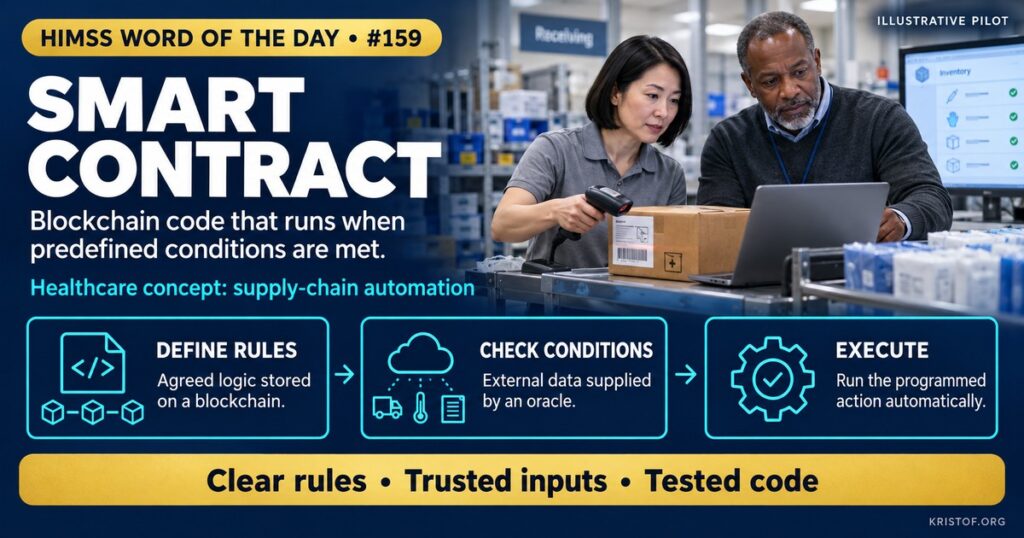
A smart contract is a program stored on a blockchain that runs automatically when predefined conditions are met, executing the terms of an agreement without requiring a central intermediary to carry them out.
The HIMSS Dictionary describes a smart contract as code that runs on a blockchain and contains rules that participating parties agree to follow. When the defined conditions are satisfied, the agreement is enforced automatically. It adds that smart contracts help negotiate, verify, and carry out agreements or transactions, and calls them the simplest form of decentralized automation.
| Smart Contract Concept | What It Means | Example |
|---|---|---|
| Code on a Blockchain | The rules are stored and executed on a shared ledger | Logic deployed to a permissioned blockchain network |
| Conditions and Triggers | Defined events cause the code to run | A shipment scan confirms delivery |
| Automatic Execution | The outcome happens without manual approval | Payment released to the supplier |
| Oracle | A source that feeds outside data into the blockchain | A logistics system reporting delivery status |
| Immutability | Deployed code and recorded transactions are hard to change | Errors cannot easily be reversed |
⚠️ Exam Alert: A smart contract is code, not necessarily a legally binding contract. Blockchain is the ledger where smart contracts run. Oracles bring external data onto the blockchain and can be points of failure. Smart contracts automate rules, but they cannot judge ambiguous or clinical situations.
🌐 Why It Matters: Real-World Healthcare IT Context
Smart contracts promise automation and trust between parties who may not fully trust one another. Instead of relying on a central intermediary to check conditions and process transactions, participants agree on rules written in code and let the shared blockchain enforce them.
Healthcare has explored several uses. In supply chains, smart contracts could release payments or trigger reorders when goods are received and verified. In claims processing, they could automatically apply contract terms between payers and providers. In consent management, they could record and enforce a patient’s choices about data sharing. In credentialing, they could share verified clinician credentials among organizations. Clinical trials have also been proposed as a use case for tracking protocol steps and consent.
Most healthcare applications remain pilots or concepts. The same practical barriers that limit blockchain adoption apply to smart contracts: integration with existing systems, governance among participants, scalability, regulatory uncertainty, and the question of whether a traditional database with good controls would work as well.
Software defects are a serious risk. Because smart contracts execute automatically and blockchain records are hard to reverse, a coding error can lead to irreversible outcomes. High-profile failures outside healthcare have shown that bugs in smart contract code can be exploited to drain funds. Rigorous code review, testing, and formal verification are essential.
External data creates dependency. Smart contracts can only act on data available to them. Real-world events, such as a delivery, a lab result, or a patient’s consent decision, must be fed in by oracles, which reintroduce trust in the data source and can be manipulated or fail.
Privacy and regulation complicate healthcare uses. Health data generally should not be stored directly on a blockchain, especially public ones, because records may be visible to participants and difficult to delete. HIPAA rights such as amendment, and laws in other jurisdictions that include deletion rights, conflict with immutable records. Designs typically keep PHI off the chain and store only references or proofs.
Legal enforceability varies. Some jurisdictions recognize electronic records and signatures generated through smart contracts, but disputes, errors, and changing circumstances still require human judgment and traditional legal processes.
Evaluating these claims requires discipline. Emerging technologies often follow a pattern of inflated expectations followed by disappointment before realistic uses emerge. Healthcare leaders can ask for evidence from working deployments, clear measures of benefit compared with existing approaches, and honest accounting of integration and maintenance costs before investing.
NIST’s blockchain technology overview, NISTIR 8202, describes smart contracts as part of blockchain systems and highlights both their potential and their limitations, encouraging organizations to evaluate carefully whether blockchain fits a given problem.
Common smart contract limitations:
- Code defects that cannot easily be undone
- Dependence on trustworthy external data sources
- Privacy risks if health data is placed on chain
- Unclear legal status in disputes
- Governance challenges among network participants
- Integration complexity with existing health IT
Questions to ask before using smart contracts:
- Does the problem require a shared ledger among parties?
- Can the rules be defined clearly enough to automate?
- How will errors be corrected?
- Where will PHI be stored, and who can see it?
- Who governs changes to the code?
- Would a conventional system be simpler and safer?
🏥 The Nurse’s Perspective: Clinical, Bedside, & Workflow
Smart contracts are far from bedside practice today, but nurses benefit from understanding the questions they raise.
At the Bedside
Most nurses will not interact with smart contracts directly. However, proposals involving automated consent management or supply chain tracking could eventually affect how patient choices are honored or how medications and supplies arrive on units.
Patients sometimes encounter blockchain-related marketing for health apps or data-sharing platforms. Nurses can encourage patients to read privacy policies and understand who can access their information.
In Clinical Workflow
Supply chain automation is one area where smart contract concepts could touch nursing work, for example by tracking the provenance of high-value products such as implants or specialty medications. Reliable supply information helps prevent shortages and supports recalls.
Consent is a nursing concern. Any system that automates consent decisions must accurately reflect what patients chose, allow changes, and make those choices visible to clinicians.
Nurse informaticists evaluating new technologies can apply the same questions used for any innovation: what problem does it solve, what evidence supports it, how does it fit workflow, and what are the risks?
Automation of any kind needs a human override. Nurses understand that rigid rules can fail in unusual clinical situations, a perspective worth contributing whenever automated systems are designed.
In EHR Implementation (Go-Live Perspective)
Smart contracts are not part of typical Epic Go-Lives today. Organizations considering blockchain-based tools would evaluate integration, governance, privacy, and support needs as part of any implementation project.
At-the-elbow support teams focus on proven tools, but the evaluation mindset, testing thoroughly and planning for errors, applies to emerging technologies as well.
🎓 CAHIMS / CPHIMS & HIMSS Perspective
CAHIMS Exam Domain Mapping
Smart contracts appear in emerging technology questions:
| CAHIMS Domain | How Smart Contracts Appear |
|---|---|
| Healthcare & Technology Environments | Emerging technology trends; blockchain use cases |
| Clinical Informatics | Consent management concepts; supply chain impacts |
| Healthcare Information & Systems Management | Blockchain architecture, oracles, integration, security |
| Management & Leadership | Technology evaluation, governance, risk assessment |
Key Terms to Know Alongside Smart Contract
- Blockchain — a shared, tamper-evident ledger of transactions
- Distributed Ledger — a database replicated across multiple participants
- Oracle — a source that supplies external data to a blockchain
- Immutability — the property that recorded data is very difficult to change
- Permissioned Blockchain — a blockchain limited to approved participants
- Hype Cycle — a model describing expectations and adoption of emerging technologies
HIMSS Organizational Position
HIMSS encourages careful evaluation of emerging technologies such as blockchain through education and research focused on real-world value, interoperability, and privacy. Members can find related education and research through the HIMSS Resource Center.
🔗 Explore Further: External References
- NIST — IR 8202, Blockchain Technology Overview https://csrc.nist.gov/pubs/ir/8202/final
- NIST — IR 8301, Blockchain Networks: Token Design and Management Overview https://csrc.nist.gov/pubs/ir/8301/final
- Ethereum.org — Introduction to Smart Contracts https://ethereum.org/smart-contracts/
- HHS — HIPAA and Research https://www.hhs.gov/hipaa/for-professionals/special-topics/research/index.html
- FDA — Drug Supply Chain Security Act (DSCSA) https://www.fda.gov/drugs/drug-supply-chain-integrity/drug-supply-chain-security-act-dscsa
- HIMSS — Public Policy & Advocacy https://www.himss.org/public-policy-advocacy-overview
Term source: HIMSS Dictionary of Health Information and Technology Terms, Acronyms, and Organizations, 6th Edition (2025). All definitions in this series are paraphrased for editorial purposes. Readers are encouraged to consult the primary source for exact language.
Eric Andrew Kristof, RN, CAHIMS is a Healthcare IT professional and HIMSS Arkansas Chapter member based in Hot Springs Village, AR, with hands-on Epic Go-Live experience and a diverse healthcare and IT background. He writes at kristof.org at the intersection of clinical care and healthcare technology.
Leave a Reply