By Eric Andrew Kristof, RN, CAHIMS | Healthcare IT Professional | HIMSS Arkansas Chapter Member
About This Series: The HIMSS Word of The Day is a running blog series drawing from the HIMSS Dictionary of Health Information and Technology Terms, Acronyms, and Organizations, 6th Edition (2025) — the authoritative reference for healthcare IT professionals and the primary study resource for CAHIMS and CPHIMS certification. Each post paraphrases the term in plain language, grounds it in real-world healthcare IT context, and adds a bedside nursing perspective you won’t find in a textbook.
📖 The Term: Transaction
Source: HIMSS Dictionary of Health Information and Technology Terms, Acronyms, and Organizations, 6th Edition (2025)
🔍 Plain-Language Definition
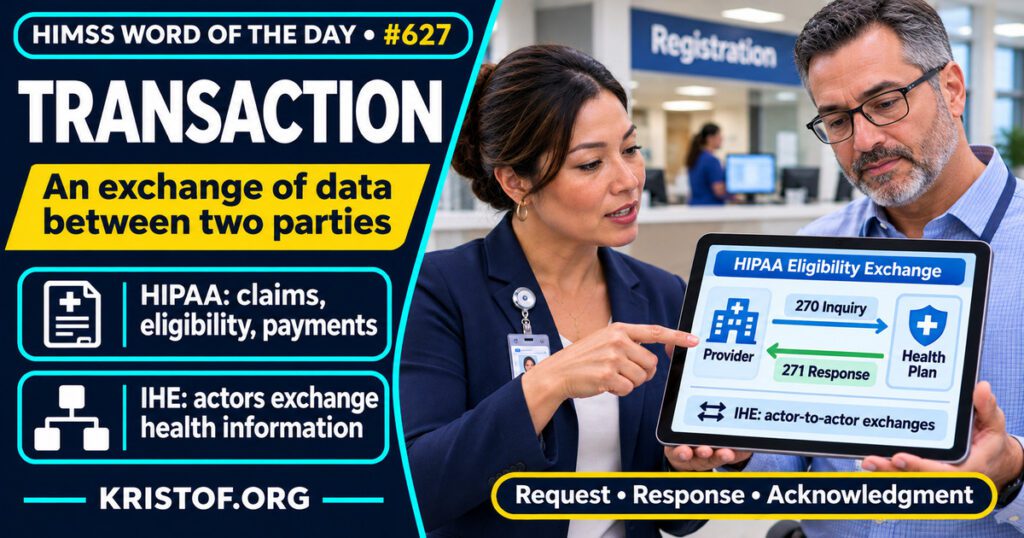
The HIMSS Dictionary gives the word transaction two related meanings, and a health IT professional needs both. The first is the HIPAA meaning: an exchange of data in which two parties complete a piece of clinical, financial, or administrative work connected to care. The second is the integration meaning: a defined interaction between two actors in a system design, where a technical framework states which established standard, such as HL7, DICOM, or one of the W3C web standards, governs the exchange.
In both senses, the transaction is the exchange itself, with a sender, a receiver, a purpose, and an expected response. The rules for the layout of the message belong to a neighboring term, the transaction standard, which has its own post in this series.
CMS describes the HIPAA version in similar terms. Its Administrative Simplification pages say a transaction is an electronic exchange between two parties for financial or administrative health care activities, and the example given is a provider sending a claim to a health plan for payment. The IHE General Introduction, in its chapter on terminology, describes a transaction as a way for actors to exchange health information using established standards, and it lists examples such as Query Modality Worklist, Retrieve Images, Register DocumentSet, and Communicate Infusion Order.
| Sense | Defined by | Parties | Example |
|---|---|---|---|
| HIPAA transaction | HHS, with X12N and NCPDP standards adopted | Providers, health plans, and clearinghouses | Eligibility inquiry and response |
| IHE transaction | IHE technical frameworks | Actors such as a Document Source and a Document Repository | Provide and Register Document Set-b (ITI-41) |
⚠️ Exam Alert: A transaction is the exchange. A transaction standard is the format of the message, a code set supplies the values inside it, and operating rules add business rules the standard does not define. In X12 terms, a transaction set is the definition of the data content for one business purpose, such as the 270 and 271 pair for eligibility. Not every message between health IT systems is a HIPAA standard transaction, because the adopted list is limited to eight financial and administrative exchanges.
🌐 Why It Matters: Real-World Healthcare IT Context
Nearly every day of operation in a hospital or clinic depends on transactions that most clinicians never see. A patient is registered, coverage is checked, a service is authorized, a claim is sent, and a payment is posted. Each step is an exchange between two organizations or two systems, and each one either works or produces a delay that someone has to resolve.
The HIPAA meaning. HIPAA’s administrative simplification provisions led HHS to adopt national standards for certain electronic exchanges. CMS’s Transactions Overview page lists eight, and its Adopted Standards and Operating Rules page names the formats. ASC X12 Version 5010 is the default format, except for retail pharmacy, where NCPDP Version D.0 applies, and NCPDP Version 3.0 is listed for Medicaid pharmacy subrogation. Covered entities (health plans, health care clearinghouses, and providers that conduct the adopted transactions electronically) must use the adopted standard. CMS notes that this applies to any provider that conducts the adopted transactions electronically, not only to those who accept Medicare or Medicaid.
| Transaction | X12 transaction set listed by CMS | Typical direction |
|---|---|---|
| Claims and encounter information | 837 | Provider to health plan |
| Eligibility and benefit inquiry and response | 270 and 271 | Provider to plan, then plan to provider |
| Claim status inquiry and response | 276 and 277 | Provider to plan, then plan to provider |
| Referral certification and authorization | 278 | Provider to plan, then plan to provider |
| Enrollment and disenrollment in a health plan | 834 | Plan sponsor to health plan |
| Premium payment | 820 | Premium payer to health plan |
| Payment and remittance advice | 835, with electronic funds transfer | Plan to provider |
| Coordination of benefits | 837 for non-pharmacy, NCPDP D.0 for pharmacy | Between plans, or provider to plan |
The numbers in this table come from CMS’s own pages, and the pairing of numbers with directions is a simplified summary, so check the current CMS pages before relying on it for an implementation. CMS also lists federally mandated operating rules for eligibility, claim status, electronic funds transfer, and electronic remittance advice, with compliance dates in 2013 and 2014. It does not list mandated operating rules for the referral and authorization transaction.
The IHE meaning. IHE profiles describe integration as a set of actors and the transactions between them. In the XDS.b chapter of the IT Infrastructure Technical Framework, each transaction is assigned to specific actors, and a table marks which transactions each actor must support and which are optional. A Document Source starts Provide and Register Document Set-b [ITI-41] to send documents and metadata to a Document Repository. A Document Consumer starts Registry Stored Query [ITI-18] to find documents and Retrieve Document Set [ITI-43] to fetch them. The practical lesson is that compliance is defined by the transactions an actor supports, which is why a claim of IHE support is more meaningful when it names the profile, the actor, and the transactions involved.
What studies show. The research base for the plain word “transaction” is thin, and this post leans on regulatory sources for that reason.
- Wu and colleagues (2005) proposed using HIPAA messages, described in the abstract as the standard transactions between hospitals and insurance companies, as a data source and transmission standard for public health data collection. The paper presents a prototype design. The abstract does not report an evaluation, and it is two decades old, so it shows an idea and not a proven result.
- Neprash and colleagues (2025) examined the CMS relief funding that followed the 2024 cyberattack on Change Healthcare. The abstract reports that CMS distributed $3.3 billion to providers with revenue disruptions, including $2.2 billion to hospitals, and that the opt-in, one-size-fits-all design led to overpayments to many participating hospitals and underparticipation by many hospitals that had likely been disrupted. The abstract does not say which transactions were affected, so it is best read as evidence of how costly a disruption in the payment chain can be.
What I could not find. PubMed searches on HIPAA standard transactions returned mostly policy commentary from the early 2000s, and searches on the bare word returned many unrelated studies on blockchain, economics, and other uses of the term. I did not find a recent evaluation that measures the effect of the adopted standard transactions. Statements about savings or error rates should be checked against a primary source.
Common transaction problems:
- Treating the transaction, the message format, and the code set as the same thing
- Assuming every interface message, such as an admission notice, is a HIPAA standard transaction
- Sending a request without handling the acknowledgment or response
- Letting version changes or payer-specific rules surprise the revenue cycle team
- Skipping end-to-end testing with clearinghouses and health plans
- Claiming IHE support without naming the profile, actor, and transactions
What supports good transaction practice:
- Written trading partner agreements and clear ownership of each exchange
- Monitoring of rejections, acknowledgments, and response times
- Testing with each clearinghouse and payer before go-live
- Documentation that names the standard, version, and operating rules in use
- A downtime plan for when a clearinghouse or payer connection fails
- Clinical and revenue cycle staff who understand which transactions touch their work
🏥 The Nurse’s Perspective: Clinical, Bedside, & Workflow
Nurses rarely see a transaction directly, but they see its consequences throughout a shift.
At the Bedside
An eligibility check that fails at registration can surface later as a question about coverage for a planned procedure. A pending authorization can delay a scheduled admission, a home health start, or a medication that requires approval. Nurses are often the first to hear the patient’s frustration when an exchange between a clinic and a health plan has not completed.
In Clinical Workflow
Utilization review and case management nurses work closest to these exchanges. They gather the clinical information that supports an authorization request, follow up on denials, and answer status questions. Clear, timely documentation helps those requests move, and unclear documentation can stall them. Charge capture also depends on documentation that reflects the services actually delivered, because the claim transaction that follows is built from it.
In EHR Implementation (Go-Live Perspective)
During an Epic Go-Live, analysts at the elbow hear the word transaction used in several ways. Registration staff mean an eligibility check, billing staff mean a claim, and interface analysts mean a message between systems. Sorting out which meaning applies is often the first step in resolving a ticket. This post does not claim that any specific go-live had a particular transaction problem. It describes why shared vocabulary helps, and why testing with payers and clearinghouses belongs on the readiness plan.
🎓 CAHIMS / CPHIMS & HIMSS Perspective
CAHIMS Exam Domain Mapping
Transactions appear across standards, operations, and management topics:
| CAHIMS Domain | How Transaction Appears |
|---|---|
| Healthcare & Technology Environments | HIPAA administrative simplification, covered entities, and payer-provider exchanges |
| Clinical Informatics | IHE actors and transactions, and the link between documentation and claims |
| Healthcare Information & Systems Management | Interfaces, clearinghouses, testing, and monitoring of exchanges |
| Management & Leadership | Trading partner agreements, compliance, and revenue cycle risk |
Key Terms to Know Alongside Transaction
- Transaction standard — the agreed format for a message that carries a transaction
- ASC X12 — the standards body whose transaction sets define many administrative exchanges
- EDI (Electronic Data Interchange) — computer-to-computer exchange of structured business data
- Healthcare clearinghouse — an entity that converts nonstandard data into standard transactions, or the reverse
- Trading partner agreement — an agreement that sets terms for exchanging transactions electronically
- IHE profile — a defined set of actors and transactions that solves a specific integration problem
HIMSS Organizational Position
HIMSS offers education and research on health information and technology topics through its Resource Center. Members can find related information on the HIMSS Resource Center page.
🧭 More HIMSS Word of The Day Terms
Related terms in the Interoperability and Standards series:
- Interoperability
- PIX (Patient Identifier Cross-referencing)
- Standards Development Organization (SDO)
- Consolidated Clinical Document Architecture (C-CDA)
Browse all Interoperability and Standards terms or the A–Z glossary.
🔗 Explore Further: External References
- CMS — Administrative Simplification: Transactions Overview https://www.cms.gov/priorities/key-initiatives/burden-reduction/administrative-simplification/transactions
- CMS — Adopted Standards and Operating Rules https://www.cms.gov/priorities/key-initiatives/burden-reduction/administrative-simplification/hipaa/adopted-standards-operating-rules
- IHE — General Introduction, Chapter 3: Important IHE Terminology https://profiles.ihe.net/GeneralIntro/ch-3.html
- IHE — IT Infrastructure Technical Framework Volume 1, Chapter 10: Cross-Enterprise Document Sharing (XDS.b) https://profiles.ihe.net/ITI/TF/Volume1/ch-10.html
- Wu et al. (2005), Journal of Medical Systems — Public health data collection and sharing using HIPAA messages https://pubmed.ncbi.nlm.nih.gov/16178329/
- Neprash et al. (2025), Health Affairs — Lessons From CMS Relief Funding After Cyberattack On Change Healthcare https://pubmed.ncbi.nlm.nih.gov/41329887/
- HIMSS — Resource Center https://www.himss.org/resource-center
Term source: HIMSS Dictionary of Health Information and Technology Terms, Acronyms, and Organizations, 6th Edition (2025). All definitions in this series are paraphrased for editorial purposes. Readers are encouraged to consult the primary source for exact language.
Eric Andrew Kristof, RN, CAHIMS is a Healthcare IT professional and HIMSS Arkansas Chapter member based in Hot Springs Village, AR, with hands-on Epic Go-Live experience and a diverse healthcare and IT background. He writes at kristof.org at the intersection of clinical care and healthcare technology.
Leave a Reply