By Eric Andrew Kristof, RN, CAHIMS | Healthcare IT Professional | HIMSS Arkansas Chapter Member
About This Series: The HIMSS Word of the Day is a running blog series drawing from the HIMSS Dictionary of Health Information and Technology Terms, Acronyms, and Organizations, 6th Edition (2025) — the authoritative reference for healthcare IT professionals and the primary study resource for CAHIMS and CPHIMS certification. Each post paraphrases the term in plain language, grounds it in real-world healthcare IT context, and adds a bedside nursing perspective you won’t find in a textbook.
📖 The Term: Blockchain
Source: HIMSS Dictionary of Health Information and Technology Terms, Acronyms, and Organizations, 6th Edition (2025)
🔍 Plain-Language Definition
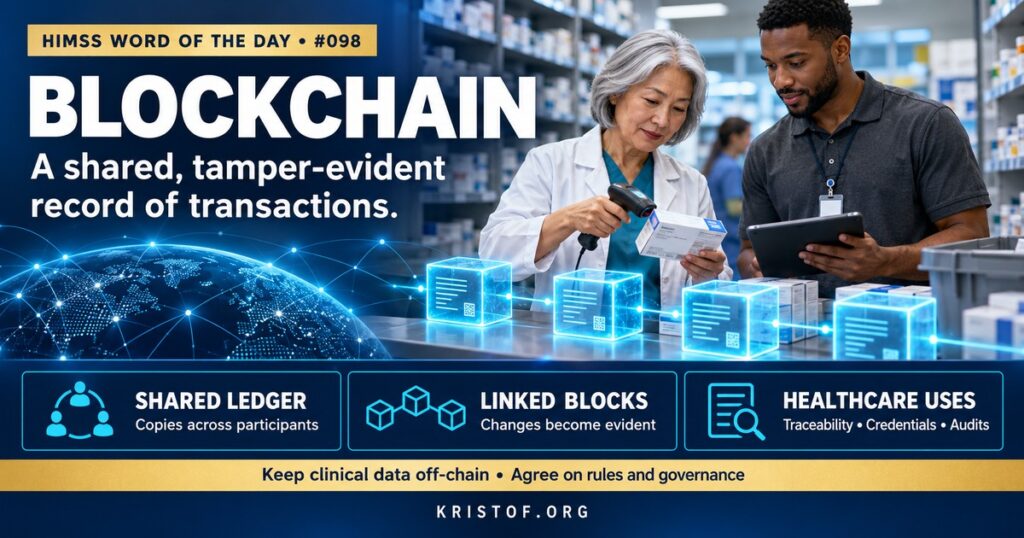
Blockchain is a technology for keeping a shared record of transactions, called a ledger, that is copied across many participants and is extremely difficult to alter once entries are added. Each new block of transactions is linked cryptographically to the one before it, forming a chain.
The HIMSS Dictionary describes blockchain as a technology for transaction-based applications that allows a ledger to be shared across a business network. The ledger serves as the source of all transactions among network participants and is shared in a secure, encrypted environment. The Dictionary notes that the technology emerged from Bitcoin, that blocks of transaction records are added in linear, chronological order, and that each participating node receives a copy of the blockchain automatically when it joins.
| Blockchain Concept | What It Means | Why It Matters |
|---|---|---|
| Distributed Ledger | Every participant holds a copy of the record | No single organization controls the data |
| Blocks and Hashes | Each block includes a cryptographic fingerprint of the previous block | Tampering with past entries becomes evident |
| Consensus | Participants agree on which transactions are valid | Prevents conflicting versions of the record |
| Permissioned vs Public | Permissioned chains limit who can join; public chains are open | Healthcare uses usually require permissioned networks |
| Smart Contracts | Code stored on the blockchain that runs when conditions are met | Can automate agreements, such as payments or verifications |
⚠️ Exam Alert: A blockchain is a distributed, append-only ledger. It is not the same as a database controlled by one organization, and it is not inherently anonymous or private. Immutability means entries are very hard to change, which can conflict with privacy rights such as amendment or deletion. A smart contract is code, not a legal contract by itself.
🌐 Why It Matters: Real-World Healthcare IT Context
Blockchain attracted intense interest in healthcare in the late 2010s, with proposals to use it for patient records, consent management, claims processing, clinical trials, and interoperability. Many projects did not progress beyond pilots. The technology works best for a specific problem: maintaining a shared, trustworthy record of transactions among multiple parties that do not fully trust a single central administrator.
Healthcare use cases that fit that pattern include:
- Supply chain and drug traceability, tracking products from manufacturer to pharmacy
- Provider credentialing and directories, sharing verified credential information among health plans and hospitals
- Audit trails for data exchange, recording who accessed or shared data without storing the data itself
- Clinical trial records, documenting protocol versions and consent timelines
Storing protected health information directly on a blockchain is generally a poor fit. Patients have rights to request amendments, organizations must apply minimum necessary and retention policies, and privacy laws in some jurisdictions include rights to deletion. An immutable ledger copied to many participants makes those obligations difficult. Most serious designs keep clinical data off the chain and store only references, hashes, or transaction records on it.
Performance and cost matter as well. Public blockchains can be slow and energy-intensive, while permissioned blockchains require participants to agree on governance, membership, and how disputes are resolved. Those organizational questions often prove harder than the technology. A blockchain network among competing health systems, payers, or suppliers succeeds only if every participant trusts the rules and sees enough value to keep participating.
NIST’s Blockchain Technology Overview describes how blockchains work and cautions that they are suited to some problems and not others. Evaluating a blockchain proposal starts with a simple question: would a well-governed shared database solve the same problem more simply?
The broader lesson applies to every emerging technology. Healthcare has seen many tools follow a cycle of inflated expectations, disappointment, and eventual practical use in narrower roles. Separating the problem from the technology, and starting with workflow and governance, helps organizations avoid expensive detours.
Questions to ask about any blockchain proposal:
- What problem requires a distributed ledger instead of a central database?
- Who are the participants, and why do they not trust a central party?
- What data goes on the chain, and is any of it PHI?
- How will privacy rights such as amendment be honored?
- What is the governance model for participants and rules?
- What are the performance, cost, and energy implications?
Realistic strengths of blockchain:
- Tamper-evident records shared across organizations
- Reduced reliance on a single intermediary
- Transparent transaction histories for audits
- Automation of multi-party agreements through smart contracts
- Resilience, because no single copy holds the record
🏥 The Nurse’s Perspective: Clinical, Bedside, & Workflow
Nurses are unlikely to interact with a blockchain directly, but some of its potential uses touch nursing work.
At the Bedside
Medication safety depends on knowing that a product is genuine and has not been diverted or tampered with. Supply chain traceability, whether built on blockchain or other technologies, aims to give hospitals confidence in where each medication came from. Nurses benefit indirectly when counterfeit or recalled products are identified before they reach the unit.
Patients sometimes ask about apps that promise to store health records “on the blockchain.” Nurses can encourage patients to understand who controls the app, what privacy protections apply, and whether they can correct or delete information.
In Clinical Workflow
Credentialing is another potential use. Nurses working as travelers or across multiple facilities complete repeated verification of licenses, certifications, and education. Shared, verified credential records could reduce duplication, although many credentialing solutions use conventional databases rather than blockchain.
Whatever the technology, the principle is the same: information that many organizations need should be verified once, shared securely, and kept accurate.
In EHR Implementation (Go-Live Perspective)
Blockchain is not part of a typical Epic implementation. EHR data is managed in conventional databases with audit trails, backups, and access controls designed for clinical use and privacy requirements.
The relevant lesson for implementation teams is evaluation discipline. During any project, new technologies will be proposed. Asking what problem a technology solves, how it fits workflow, and what risks it introduces protects organizations from adopting tools for their novelty rather than their value.
🎓 CAHIMS / CPHIMS & HIMSS Perspective
CAHIMS Exam Domain Mapping
Blockchain appears in emerging technology and security questions:
| CAHIMS Domain | How Blockchain Appears |
|---|---|
| Healthcare & Technology Environments | Emerging technology trends; hype cycles; supply chain security |
| Clinical Informatics | Patient-controlled records; credentialing; trust in shared data |
| Healthcare Information & Systems Management | Distributed ledgers, cryptographic hashing, consensus, smart contracts |
| Management & Leadership | Technology evaluation, governance of multi-party networks, privacy and legal risk |
Key Terms to Know Alongside Blockchain
- Distributed Ledger — a database replicated across multiple participants without a single central administrator
- Hash — a fixed-length cryptographic fingerprint of data used to detect changes
- Consensus Mechanism — the method participants use to agree on valid transactions
- Smart Contract — code stored on a blockchain that executes when specified conditions are met
- Permissioned Blockchain — a blockchain where participation is limited to approved members
- Immutability — the property that recorded entries cannot easily be changed
HIMSS Organizational Position
HIMSS addresses blockchain as part of its coverage of emerging technologies, encouraging organizations to evaluate new tools based on clear use cases, governance, and privacy rather than hype. Members can find related education and research through the HIMSS Resource Center.
🔗 Explore Further: External References
- NIST — IR 8202, Blockchain Technology Overview https://csrc.nist.gov/pubs/ir/8202/final
- FDA — Drug Supply Chain Security Act (DSCSA) https://www.fda.gov/drugs/drug-supply-chain-integrity/drug-supply-chain-security-act-dscsa
- HHS — Summary of the HIPAA Privacy Rule https://www.hhs.gov/hipaa/for-professionals/privacy/laws-regulations/index.html
- NIST — Cybersecurity Framework https://www.nist.gov/cyberframework
- HHS — Health Information Technology and HIPAA https://www.hhs.gov/hipaa/for-professionals/special-topics/health-information-technology/index.html
- HIMSS — Resource Center https://www.himss.org/resource-center
Term source: HIMSS Dictionary of Health Information and Technology Terms, Acronyms, and Organizations, 6th Edition (2025). All definitions in this series are paraphrased for editorial purposes. Readers are encouraged to consult the primary source for exact language.
Eric Andrew Kristof, RN, CAHIMS is a Healthcare IT professional and HIMSS Arkansas Chapter member based in Hot Springs Village, AR, with hands-on Epic Go-Live experience and a diverse healthcare and IT background. He writes at kristof.org at the intersection of clinical care and healthcare technology.
Leave a Reply