By Eric Andrew Kristof, RN, CAHIMS | Healthcare IT Professional | HIMSS Arkansas Chapter Member
About This Series: The HIMSS Word of the Day is a running blog series drawing from the HIMSS Dictionary of Health Information and Technology Terms, Acronyms, and Organizations, 6th Edition (2025) — the authoritative reference for healthcare IT professionals and the primary study resource for CAHIMS and CPHIMS certification. Each post paraphrases the term in plain language, grounds it in real-world healthcare IT context, and adds a bedside nursing perspective you won’t find in a textbook.
📖 The Term: XDS (Cross-Enterprise Document Sharing)
Source: HIMSS Dictionary of Health Information and Technology Terms, Acronyms, and Organizations, 6th Edition (2025)
🔍 Plain-Language Definition
Cross-Enterprise Document Sharing (XDS) is a way, defined by standards, to manage how healthcare enterprises exchange the clinical documents they have chosen to make available to one another. The HIMSS Dictionary notes that participants can range from a private physician to a clinic, a health information exchange, or an acute care hospital, and that XDS helps lay groundwork for a record that organizations can share. It is a profile from Integrating the Healthcare Enterprise (IHE); the current flavor is called XDS.b.
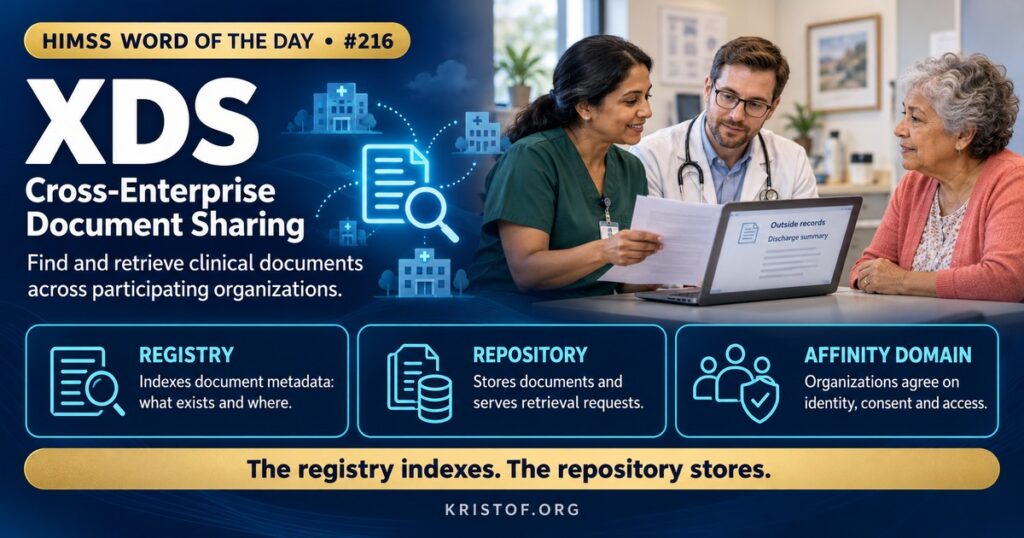
XDS works by separating two jobs. A document repository stores documents securely and answers requests to retrieve them. A document registry stores information about those documents so that those relevant to a patient’s care can be found, selected, and retrieved no matter which repository holds them. A single registry can index content from several repositories.
| XDS Concept | What It Does | Plain-Language Picture |
|---|---|---|
| Document Source | Produces and submits documents | A hospital that publishes a discharge summary |
| Document Repository | Stores documents and serves retrievals | The vault holding the actual files |
| Document Registry | Indexes documents with metadata | The catalog that says what exists and where |
| Document Consumer | Queries the registry and retrieves documents | A clinician’s system looking for a patient’s records |
| Affinity Domain | Group of enterprises sharing common policies | A regional community of care |
⚠️ Exam Alert: In XDS the registry holds metadata about documents, while the repository holds the documents themselves. An affinity domain is a group of organizations that agree on common policies, such as patient identification, consent, and access control. XDS is a profile, not a clinical document format and not a messaging standard.
🌐 Why It Matters: Real-World Healthcare IT Context
Health information is scattered across organizations. Copying every record to every other system is expensive and risky, while leaving records where they are makes them hard to find. XDS addresses this by letting each organization keep its documents while publishing enough metadata to a shared registry that authorized users can locate and retrieve what they need.
The IHE technical framework describes the profile as facilitating the registration, distribution, and access of patient electronic health records across health enterprises. It assumes the participating enterprises belong to one or more affinity domains, groups that have agreed to work together under a common set of policies on a shared infrastructure. Examples include regional communities of care, disease-focused networks such as oncology or diabetes networks, federations of local hospitals, government facilities, and communities supported by insurers.
Policy is a large part of the design. Within an affinity domain, the participants must define how patients are identified, how consent is obtained, how access is controlled, and the format, content, structure, and organization of the clinical information. The profile does not set those rules; it is built to accommodate a wide range of them. XDS is also content neutral, so a document may be simple text, a formatted document such as an HL7 Clinical Document Architecture file, an image, or structured and coded clinical content.
Limits are worth knowing. The framework notes that XDS is not intended to address every cross-enterprise record-sharing need. It addresses dynamic information such as medication lists only in part, through aggregation across structured documents and an on-demand documents option, and it does not support placing and tracking orders. Other IHE profiles address patient identifier cross-referencing, audit trails and node authentication, cross-enterprise user authentication, and retrieving information for display, and real deployments typically combine several of them.
Research shows both the technical and governance sides. A study from Taiwan described building a cloud-based electronic medical record exchange prototype that complied with the XDS profile, using RESTful services on a commercial cloud platform and testing four exchange scenarios, with results suggesting the approach could exchange records successfully. The national exchange center it built on had been established in 2011 to share records among hospitals, including imaging reports, laboratory reports, discharge summaries, and outpatient records. A 2026 qualitative study in the Czech Republic interviewed 18 policymakers, regional authorities, providers, insurers, vendors, and experts about affinity domains, and framed the issue as one where operational interoperability needs not only technical standards but enforceable governance arrangements, including legal accountability for shared data and enforcement of standards.
XDS remains important even as newer approaches based on web APIs spread. Many national and regional programs have XDS-based infrastructure in place, and the concepts of metadata registries, document-level exchange, and shared policy domains carry over to newer designs. Health IT professionals benefit from understanding both.
Common XDS-related challenges:
- Participants publishing documents with inconsistent or incomplete metadata
- Unresolved patient identity across enterprises
- Unclear consent rules and who may access which documents
- Document formats that consumers cannot display or reconcile
- Reliance on documents for data that changes quickly
- Missing governance for onboarding and removing participants
What supports successful document sharing:
- A governed affinity domain with agreed policies
- Reliable patient identity cross-referencing
- Required metadata and document templates
- Audit logging and authentication across enterprises
- Consumer systems that display documents in a usable way
- Clear escalation paths for errors and corrections
🏥 The Nurse’s Perspective: Clinical, Bedside, & Workflow
Nurses rarely see the word XDS, yet the documents it moves often appear in their workflows as outside records.
At the Bedside
An admitting nurse may open a window labeled outside records or community documents to see a recent discharge summary from another hospital. What appears depends on the metadata and the sharing rules behind it. When a document is missing, out of date, or hard to read, the problem may be on the sending side, the patient matching side, or the display side.
Nurses add value by reconciling outside information with what the patient reports, and by flagging apparent mismatches, such as a document that seems to belong to a different person.
In Clinical Workflow
Care transitions, emergency visits, and referrals benefit from outside documents. Nurse care coordinators use shared records to understand recent medications, diagnoses, and follow-up plans. Documents are static snapshots, so staff still verify current medications and allergies directly.
Nurse informaticists help design how outside documents appear in the EHR, which sections are surfaced, and how users record that they reviewed them.
Consent and access rules differ by region and by type of information, so the same patient’s records may be visible in one setting and not another. Nurses who understand the local rules can explain to patients what is shared and why.
In EHR Implementation (Go-Live Perspective)
An Epic Go-Live typically includes connections to external exchanges. Analysts test that outside documents display correctly and that patient matching behaves as expected. At-the-elbow support analysts help clinicians find the outside records tab, and report documents that fail to load or appear under the wrong patient so that the interface team can investigate.
🎓 CAHIMS / CPHIMS & HIMSS Perspective
CAHIMS Exam Domain Mapping
XDS appears in interoperability, standards, and health information exchange questions:
| CAHIMS Domain | How XDS Appears |
|---|---|
| Healthcare & Technology Environments | IHE profiles, health information exchange models, policy domains |
| Clinical Informatics | Outside records in clinical workflow, document types and metadata |
| Healthcare Information & Systems Management | Registry and repository architecture, patient identity, audit and security |
| Management & Leadership | Governance of affinity domains, consent policy, participation agreements |
Key Terms to Know Alongside XDS
- IHE (Integrating the Healthcare Enterprise) — initiative that publishes profiles describing how standards work together
- Affinity Domain — group of organizations sharing policies and infrastructure for exchange
- Document Registry — index of document metadata
- Document Repository — storage and retrieval service for documents
- HL7 CDA — document architecture commonly used for shared clinical documents
- Patient Identifier Cross-Referencing — mapping a patient’s identifiers across systems
HIMSS Organizational Position
HIMSS supports standards-based interoperability and health information exchange through its education, public policy work, and research. Members can find related resources through the HIMSS Resource Center and Public Policy and Advocacy pages.
🔗 Explore Further: External References
- IHE — IT Infrastructure Technical Framework Volume 1, Section 10: Cross-Enterprise Document Sharing (XDS.b) https://profiles.ihe.net/ITI/TF/Volume1/ch-10.html
- IHE International https://www.ihe.net/
- IHE Profiles Library https://profiles.ihe.net/
- Wu et al. (2017), International Journal of Medical Informatics — Implementation of a Cloud-Based Electronic Medical Record Exchange System in Compliance With the Integrating Healthcare Enterprise’s Cross-Enterprise Document Sharing Integration Profile https://pubmed.ncbi.nlm.nih.gov/29029689/
- Bruthans et al. (2026), JMIR Medical Informatics — Stakeholder Perspectives on Affinity Domains in Digital Health Interoperability: Qualitative Study https://pubmed.ncbi.nlm.nih.gov/41926673/
- ONC — Health Information Exchange https://healthit.gov/health-it-basics/hie/
Term source: HIMSS Dictionary of Health Information and Technology Terms, Acronyms, and Organizations, 6th Edition (2025). All definitions in this series are paraphrased for editorial purposes. Readers are encouraged to consult the primary source for exact language.
Eric Andrew Kristof, RN, CAHIMS is a Healthcare IT professional and HIMSS Arkansas Chapter member based in Hot Springs Village, AR, with hands-on Epic Go-Live experience and a diverse healthcare and IT background. He writes at kristof.org at the intersection of clinical care and healthcare technology.
Leave a Reply