By Eric Andrew Kristof, RN, CAHIMS | Healthcare IT Professional | HIMSS Arkansas Chapter Member
About This Series: The HIMSS Word of the Day is a running blog series drawing from the HIMSS Dictionary of Health Information and Technology Terms, Acronyms, and Organizations, 6th Edition (2025) — the authoritative reference for healthcare IT professionals and the primary study resource for CAHIMS and CPHIMS certification. Each post paraphrases the term in plain language, grounds it in real-world healthcare IT context, and adds a bedside nursing perspective you won’t find in a textbook.
📖 The Term: Knowledge Management
Source: HIMSS Dictionary of Health Information and Technology Terms, Acronyms, and Organizations, 6th Edition (2025)
🔍 Plain-Language Definition
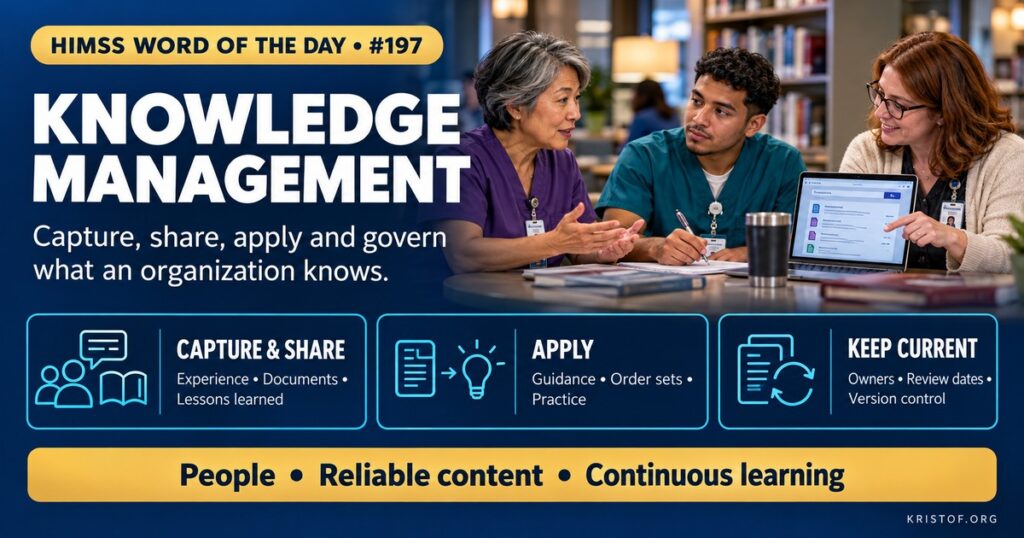
Knowledge management (KM) is the discipline of generating, distributing, applying, and governing what an organization knows, including its information. It usually takes a multidisciplinary approach that aims to help the organization meet its goals by making better use of what it knows.
The HIMSS Dictionary defines it in organizational terms, which fits how it works in health care. Knowledge lives in people, in documents, and increasingly in software such as order sets, alerts, and care pathways. Managing it means deciding who owns it, how it stays current, and how it reaches the person who needs it at the moment of care.
| Knowledge Type | Where It Lives | Example |
|---|---|---|
| Tacit Knowledge | Experience and judgment of individuals | How an experienced nurse spots early deterioration |
| Explicit Knowledge | Documents, policies, guidelines | A sepsis protocol or procedure |
| Embedded Knowledge | Systems and tools | Order sets, alerts, calculators, care plans |
| Organizational Memory | Records of decisions and lessons | Go-live issue logs, committee decisions |
| Shared Knowledge Networks | Communities and relationships | Super user groups, nursing councils |
⚠️ Exam Alert: Data are raw facts, information is data with context, and knowledge is information applied to make decisions or take action. Knowledge management is the organizational process for handling knowledge. Clinical decision support is one way knowledge is delivered to clinicians, not a synonym for the discipline.
🌐 Why It Matters: Real-World Healthcare IT Context
Health care changes constantly. Guidelines update, products change, regulations shift, and staff turn over. An organization that cannot capture and share what it learns repeats mistakes, loses expertise when people leave, and delivers care that varies from unit to unit.
Knowledge management supports clinical decision support. Order sets, alerts, and pathways are knowledge turned into software, and they age. A recommendation that changed in the evidence may remain in an order set for years unless someone owns it. Informatics teams have described methods for extracting and organizing decision support knowledge from mature clinical systems so that rules can be reviewed and reused. Good governance assigns an owner and review date to every piece of embedded content and retires what is no longer valid. The HL7 Clinical Practice Guidelines on FHIR work points toward a future where guidelines are published in computable form that systems can consume.
It also underpins the learning health system. The Institute of Medicine (now the National Academy of Medicine) report Best Care at Lower Cost described a path to continuously learning health care in which knowledge generated from care feeds back into practice. Doing so requires reliable ways to capture lessons, test changes, and spread what works.
Nursing is a major beneficiary. A cross-sectional study of 192 nurses in five public hospitals in southwest Iran examined how nurses perceived knowledge management in their hospitals and how it related to their tolerance of ambiguity. Nurses rated knowledge management capabilities and processes at a moderate level, and the study found that age and experience were linked to how nurses viewed novelty and complexity. The study is a reminder that knowledge management is experienced differently by staff with different backgrounds, and that its design should account for that.
Practical tools are often simple. Searchable policy libraries, quick reference tip sheets, lessons-learned reviews after events and implementations, communities of practice, mentoring, and structured handoffs all count. Technology can help with search, versioning, and analytics, and newer tools that retrieve and summarize internal documents depend on those documents being accurate, current, and well organized.
Standards exist for the discipline. The international standard ISO 30401 sets requirements for knowledge management systems, which gives organizations a framework to assess their practices.
Pitfalls are familiar: documents scattered across drives, policies that conflict, tip sheets nobody updates, and reliance on a few experts who cannot be everywhere. Knowledge management turns those into managed assets with owners, review cycles, and clear locations.
Common knowledge management problems:
- Policies and tip sheets with no owner or review date
- Multiple conflicting versions of the same guidance
- Expertise held by a few people who leave or retire
- Decision support content that lags behind evidence
- Lessons from projects and events never captured
- Search tools that return outdated material
What supports effective knowledge management:
- Named owners and review cycles for content
- One authoritative location for each document
- Structured capture of lessons learned
- Governance for decision support and order set content
- Communities of practice and mentoring
- Metrics on use, currency, and gaps
🏥 The Nurse’s Perspective: Clinical, Bedside, & Workflow
Nursing runs on knowledge that is shared informally, such as a charge nurse’s tips, a preceptor’s shortcuts, and a unit’s unwritten rules. Knowledge management helps make the best of that visible and reliable.
At the Bedside
Nurses rely on policies, procedures, medication references, and order sets that reflect current practice. When a policy is hard to find or contradicts another, workarounds develop. Reporting outdated or conflicting guidance helps owners fix it.
Sharing practical tips through huddles, unit councils, and mentoring keeps useful knowledge from staying with one person. Writing down a successful approach, with the reasoning behind it, makes it easier to evaluate and spread.
In Clinical Workflow
Evidence-based practice councils, shared governance, and clinical practice committees are knowledge management structures. They decide what becomes a standard, how it is communicated, and when it is reviewed.
Nurse informaticists translate between clinical knowledge and system content. They help ensure that an order set, a flowsheet, or an alert reflects the current policy and that the policy itself is clear enough to build.
Onboarding benefits as well. New nurses who can find answers quickly, in a well-organized library or through a mentor, become confident sooner.
In EHR Implementation (Go-Live Perspective)
An Epic Go-Live generates a large amount of knowledge: tip sheets, decisions about workflows, defects and fixes, and observations from at-the-elbow support. Capturing it in an organized issue log and knowledge base prevents the same questions from recurring.
At-the-elbow support analysts and super users are knowledge carriers. After go-live, their lessons feed optimization lists, training updates, and decisions about what to change in the build.
🎓 CAHIMS / CPHIMS & HIMSS Perspective
CAHIMS Exam Domain Mapping
Knowledge management appears in leadership, decision support, and governance questions:
| CAHIMS Domain | How Knowledge Management Appears |
|---|---|
| Healthcare & Technology Environments | Evidence, guidelines, learning health systems |
| Clinical Informatics | Decision support content, order set governance, workflow knowledge |
| Healthcare Information & Systems Management | Document control, version management, searchable repositories |
| Management & Leadership | Organizational learning, governance, training, change management |
Key Terms to Know Alongside Knowledge Management
- Tacit Knowledge — know-how held in people’s experience that is hard to write down
- Explicit Knowledge — knowledge captured in documents, policies, or systems
- Clinical Decision Support (CDS) — tools that deliver knowledge at the point of care
- Learning Health System — model in which care data and evidence continuously improve practice
- Communities of Practice — groups that share and develop expertise in a domain
- Lessons Learned — structured capture of what worked and what did not
HIMSS Organizational Position
HIMSS supports shared learning and professional development through communities, education, and research, including its Nursing Informatics Community. Members can find related resources through the HIMSS Resource Center.
🔗 Explore Further: External References
- Ghalavand et al. (2026), Journal of Nursing Management — Association Between Effectiveness of Knowledge Management and Nurses’ Intolerance of Ambiguity in Hospitals https://pubmed.ncbi.nlm.nih.gov/42770612/
- Institute of Medicine (National Academies) — Best Care at Lower Cost: The Path to Continuously Learning Health Care in America https://www.nationalacademies.org/read/13444
- DesAutels et al. (2016), AMIA Annual Symposium Proceedings — Using Best Practices to Extract, Organize, and Reuse Embedded Decision Support Content Knowledge Rules from Mature Clinical Systems https://pubmed.ncbi.nlm.nih.gov/28269846/
- HL7 International — Clinical Practice Guidelines (CPG on FHIR) Implementation Guide https://hl7.org/fhir/uv/cpg/
- ONC — Clinical Decision Support https://healthit.gov/clinical-quality-and-safety/clinical-decision-support/
- HIMSS — Nursing Informatics Community https://www.himss.org/networking/communities/nursing-informatics/
Term source: HIMSS Dictionary of Health Information and Technology Terms, Acronyms, and Organizations, 6th Edition (2025). All definitions in this series are paraphrased for editorial purposes. Readers are encouraged to consult the primary source for exact language.
Eric Andrew Kristof, RN, CAHIMS is a Healthcare IT professional and HIMSS Arkansas Chapter member based in Hot Springs Village, AR, with hands-on Epic Go-Live experience and a diverse healthcare and IT background. He writes at kristof.org at the intersection of clinical care and healthcare technology.
Leave a Reply