By Eric Andrew Kristof, RN, CAHIMS | Healthcare IT Professional | HIMSS Arkansas Chapter Member
About This Series: The HIMSS Word of the Day is a running blog series drawing from the HIMSS Dictionary of Health Information and Technology Terms, Acronyms, and Organizations, 6th Edition (2025) — the authoritative reference for healthcare IT professionals and the primary study resource for CAHIMS and CPHIMS certification. Each post paraphrases the term in plain language, grounds it in real-world healthcare IT context, and adds a bedside nursing perspective you won’t find in a textbook.
📖 The Term: Addendum (AD)
Source: HIMSS Dictionary of Health Information and Technology Terms, Acronyms, and Organizations, 6th Edition (2025)
🔍 Plain-Language Definition
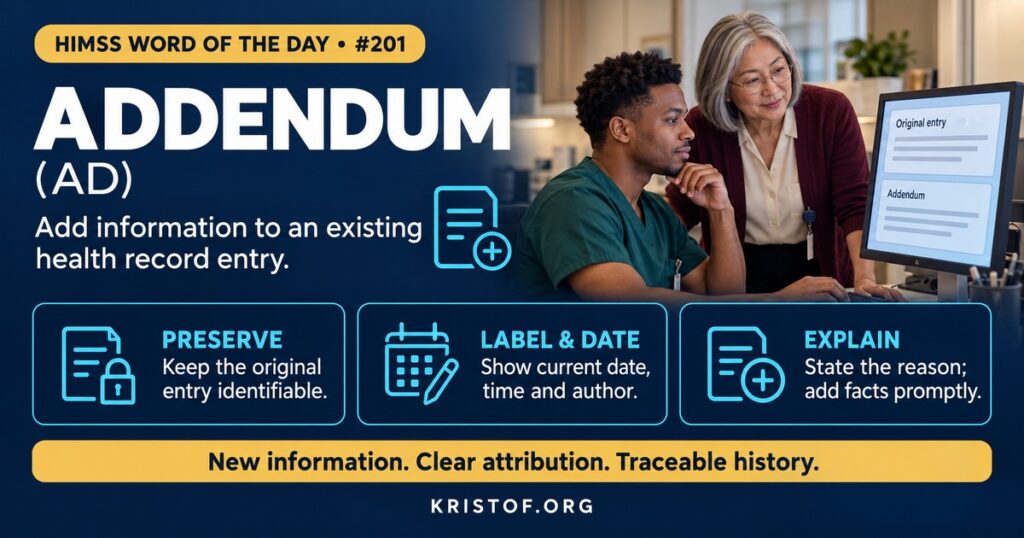
An addendum (AD) is new documentation that adds information to an original entry in the health record. It should be made promptly, carry the current date, and state why the additional information is being added.
The HIMSS Dictionary stresses timeliness, the current date, and a stated reason. The key idea is that the original entry stays in place. The addendum sits alongside it, so readers can see what was documented originally and what was added later.
| Type of Change | What It Does | Example |
|---|---|---|
| Addendum | Adds information to an existing entry | A provider adds a clarification to a signed note |
| Late Entry | Documents care that was not charted when it occurred | A nurse documents a bedside assessment after a busy event |
| Correction | Fixes information that was wrong | A wrong weight entered for a patient |
| Amendment Requested by a Patient | Patient asks to change their record under HIPAA | A patient disputes an inaccurate entry |
| Delayed Entry | Entry made after the time of the service | Documentation completed after a downtime |
⚠️ Exam Alert: An addendum adds to an entry. A correction fixes an error. A late entry documents something that was not charted at the time. All of them should be clearly labeled, dated, and attributed, and the original content must remain identifiable. A patient’s request to amend is a separate HIPAA process.
🌐 Why It Matters: Real-World Healthcare IT Context
Health records support care, billing, quality review, and legal proceedings. Their value depends on trust, and trust depends on knowing who wrote what, when, and whether anything changed. Addenda, corrections, and late entries are routine, but they must be made in ways that preserve integrity.
CMS gives specific guidance in its Program Integrity Manual for medical review contractors. Services are expected to be documented when they are rendered. When an entry must be amended, corrected, or made late, reviewers will consider it only if it follows widely accepted recordkeeping principles: the change is clearly and permanently identified as an amendment, correction, or delayed entry; the date and author are clearly shown; and the original content stays visible without deletion. The manual notes that reviewers do not consider entries that fail these principles, such as undated or unsigned entries handwritten in a margin.
For electronic records, the same principles apply. CMS expects an EHR to distinctly identify any amendment, correction, or delayed entry and to give a reliable way to tell the original content from the modified content, along with the date and author of each change. This is where EHR design matters. Systems that let users overwrite a signed note without a trace create risk, while systems that preserve versions and display addenda clearly protect clinicians and patients.
Audit trails support integrity. ONC certification includes criteria for recording auditable events and protecting those records from tampering, so organizations can show who accessed or changed information and when. Audit data is also what investigators use if a record is questioned.
HIPAA adds a separate right. Individuals can ask a covered entity to amend protected health information in a designated record set. The entity may accept the request and make the amendment, or deny it under specific conditions, in which case the individual can submit a statement of disagreement. This process is distinct from clinicians adding addenda to their own documentation.
Practical judgment matters. Addenda are appropriate for clarifications, new information that became available, or results that were reviewed later. They are not a place to rewrite events after a problem, to defend care, or to hide errors. Timing is part of credibility: an addendum written weeks later, after a complaint, draws scrutiny, while a prompt, factual addendum shows diligence.
Policies should define who can add addenda, how they are labeled, how long after signing changes are allowed, and how notifications reach people who already acted on the original note. Late-arriving information can be clinically significant, so systems often notify care team members when a note they have read is later changed.
Common problems with addenda and corrections:
- Overwriting a signed entry without a visible trail
- Addenda missing a date, author, or reason
- Late entries that lack the time of the care they describe
- Clinicians never notified that a note was changed
- Changes made after a complaint or claim denial
- Confusion between provider addenda and patient amendment requests
What supports record integrity:
- Clear policy on addenda, corrections, and late entries
- EHR functions that preserve and display original content
- Date, time, author, and reason on every change
- Audit trails that capture edits and access
- Notifications when a viewed note is changed
- Education on factual, timely, neutral wording
🏥 The Nurse’s Perspective: Clinical, Bedside, & Workflow
Nurses document constantly, so the need to add or correct an entry comes up often. Handling it well protects the patient, the nurse, and the organization.
At the Bedside
If something was missed, such as an assessment not charted or a result not recorded, the right step is to document it as a late entry as soon as possible, with the current date and time and a note of when the care occurred. Documenting from memory should stay factual and limited to what is clearly remembered.
If something was charted in error, the correction follows the EHR’s process, such as marking an entry as entered in error, so the original remains traceable. Deleting or silently replacing information is not acceptable.
In Clinical Workflow
Addenda help when new information changes the picture. A nurse who learns later that a patient took a medication at home before arrival can add that to the record and notify the provider, instead of assuming the original note will be reread.
Neutral language is essential. Addenda should state facts and the reason for the addition, without blame, speculation, or commentary about other staff.
Nurse informaticists help design addendum and correction workflows, review how entries display, and make sure notifications reach the right people.
In EHR Implementation (Go-Live Perspective)
An Epic Go-Live includes training on late entries, entered-in-error functions, and addenda, because staff who are new to a system often do not know how to correct a mistake. Clear tip sheets prevent workarounds such as duplicate notes or unlabeled free-text corrections.
At-the-elbow support analysts regularly field questions about fixing an entry or adding to a signed note. Consistent answers, supported by policy, protect record integrity from the first days.
🎓 CAHIMS / CPHIMS & HIMSS Perspective
CAHIMS Exam Domain Mapping
Addenda appear in documentation, compliance, and system design questions:
| CAHIMS Domain | How Addenda Appear |
|---|---|
| Healthcare & Technology Environments | Record integrity expectations from CMS and HIPAA |
| Clinical Informatics | Documentation workflows, late entries, corrections, notifications |
| Healthcare Information & Systems Management | Audit trails, versioning, note locking and unlocking |
| Management & Leadership | Documentation policy, compliance, legal health record |
Key Terms to Know Alongside Addendum
- Late Entry — documentation added after the time care was delivered, labeled as such
- Entered in Error — status that removes an entry from active view while preserving it
- Audit Trail — record of who accessed or changed information and when
- Legal Health Record — the records an organization designates as its official business record
- Right to Amend — HIPAA right of individuals to request changes to their protected health information
- Record Integrity — assurance that documentation is complete, accurate, and unaltered without trace
HIMSS Organizational Position
HIMSS supports accurate, trustworthy clinical documentation through education and its clinical and nursing informatics communities. Members can find related resources through the HIMSS Resource Center.
🔗 Explore Further: External References
- CMS — Medicare Program Integrity Manual, Chapter 3, Section 3.3.2.5, Amendments, Corrections and Delayed Entries in Medical Documentation https://www.cms.gov/files/document/r10365pi.pdf
- eCFR — 45 CFR 164.526, Amendment of Protected Health Information https://www.ecfr.gov/current/title-45/subtitle-A/subchapter-C/part-164/subpart-E/section-164.526
- ONC — Certification Test Method: Auditable Events and Tamper-Resistance https://healthit.gov/test-method/auditable-events-and-tamper-resistance/
- Rosenbloom et al. (2011), JAMIA — Data From Clinical Notes: A Perspective on the Tension Between Structure and Flexible Documentation https://pubmed.ncbi.nlm.nih.gov/21233086/
- ANA — Scope and Standards of Practice https://www.nursingworld.org/practice-policy/scope-of-practice/
- HIMSS — Nursing Informatics Community https://www.himss.org/networking/communities/nursing-informatics/
Term source: HIMSS Dictionary of Health Information and Technology Terms, Acronyms, and Organizations, 6th Edition (2025). All definitions in this series are paraphrased for editorial purposes. Readers are encouraged to consult the primary source for exact language.
Eric Andrew Kristof, RN, CAHIMS is a Healthcare IT professional and HIMSS Arkansas Chapter member based in Hot Springs Village, AR, with hands-on Epic Go-Live experience and a diverse healthcare and IT background. He writes at kristof.org at the intersection of clinical care and healthcare technology.
Leave a Reply