By Eric Andrew Kristof, RN, CAHIMS | Healthcare IT Professional | HIMSS Arkansas Chapter Member
About This Series: The HIMSS Word of the Day is a running blog series drawing from the HIMSS Dictionary of Health Information and Technology Terms, Acronyms, and Organizations, 6th Edition (2025) — the authoritative reference for healthcare IT professionals and the primary study resource for CAHIMS and CPHIMS certification. Each post paraphrases the term in plain language, grounds it in real-world healthcare IT context, and adds a bedside nursing perspective you won’t find in a textbook.
📖 The Term: Encounter
Source: HIMSS Dictionary of Health Information and Technology Terms, Acronyms, and Organizations, 6th Edition (2025)
🔍 Plain-Language Definition
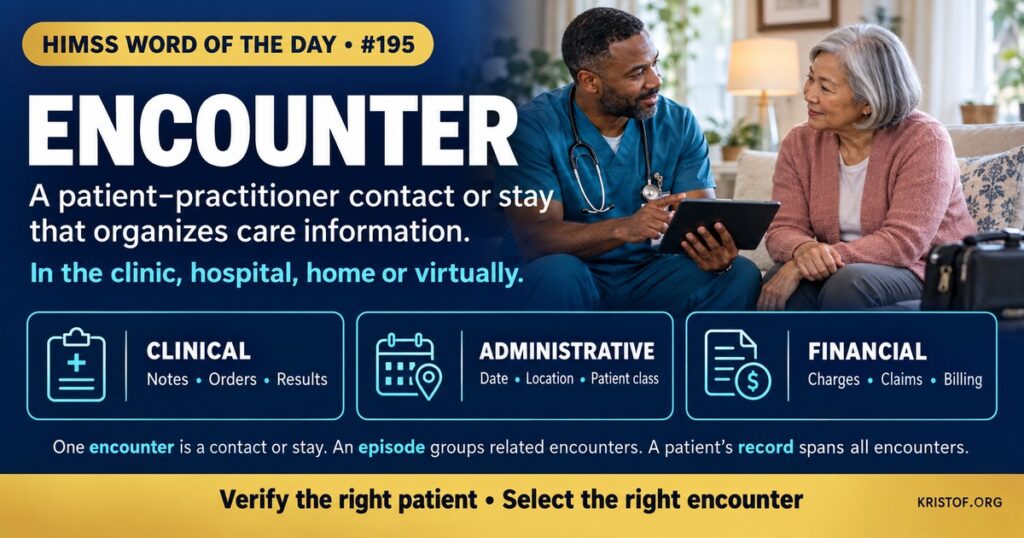
An encounter is an interaction between a patient and a practitioner who has primary responsibility for assessing or treating the patient, exercising independent judgment during that contact. It can occur in any setting.
The HIMSS Dictionary stresses that the encounter serves as the anchor that ties together clinical, administrative, and financial information. It names settings that include ambulatory visits, hospital stays, emergency department care, home health, care delivered in the field, and virtual visits by telemedicine. The HL7 FHIR standard describes an Encounter resource in similar terms, as an interaction between a patient and one or more providers for providing services or assessing health status.
| Term | What It Means | Example |
|---|---|---|
| Encounter | One contact or stay used to organize documentation and billing | An emergency department visit |
| Episode of Care | A group of related encounters for a condition | Pregnancy care from first visit through delivery |
| Visit | Everyday word for an outpatient encounter | A clinic appointment |
| Admission | An inpatient encounter that begins with an admission order | A hospital stay for pneumonia |
| Account or Billing Record | Financial record that may group one or more encounters | Hospital account number |
| Registration Event | The step that creates or updates the encounter | Check-in or ED arrival |
⚠️ Exam Alert: An encounter is the unit of contact or stay. An episode of care groups related encounters over time for one condition. A patient record spans all encounters. Registration, often driven by ADT events, creates and updates the encounter that other systems follow.
🌐 Why It Matters: Real-World Healthcare IT Context
Nearly every EHR function depends on the encounter. Orders attach to it, nursing documentation files under it, results return to it, and charges and claims are built from it. Because it carries the date, location, patient class, and responsible provider, it supplies context that makes the clinical data interpretable.
Encounter type drives workflow. Outpatient visits, emergency visits, inpatient admissions, observation stays, surgical encounters, home health visits, and telehealth sessions all follow different rules for documentation, orders, and billing. The patient class chosen at registration can determine which order sets, nursing assessments, and charge rules apply. Telehealth has added encounters that occur by video, phone, or messaging, and organizations need consistent ways to define and report them.
Registration and ADT messages create and maintain encounters. When a patient arrives, a transfer occurs, or a discharge is entered, the change travels to downstream systems such as pharmacy, laboratory, and imaging so they associate activity with the right encounter. Errors at this step spread widely: a wrong patient class, a missing location, or a delayed transfer can affect bed management, medication verification, and billing.
Encounter identifiers matter. Many systems assign a unique number to each encounter, and Epic, for example, uses a contact serial number for this purpose. That identifier lets documentation, results, and charges be tied to a specific contact even when the patient has many in the same period.
Encounter data supports quality and reporting. Measures often rely on encounter dates, locations, and types to define denominators, and public health and registry reports use encounter information to identify events. Accurate encounter data is therefore a quality issue as well as an operational one.
Data standards reflect the importance of encounters. The FHIR Encounter resource records status, class, type, participants, location, and timing, and many FHIR resources reference the encounter in which they were created. This lets applications retrieve everything associated with a visit or admission.
Encounter context also protects patient safety. Some information, such as allergies and the medication list, carries across a patient’s whole record, while other information, such as an assessment, belongs to one specific contact. Results ordered during one encounter may return after the patient has been discharged or moved to another, and the system has to route them to the right clinician and the right chart. Portals, summaries, and handoff reports often group information by encounter, so a misplaced entry can be missed by the person who needs it. Clear encounter rules, shown plainly on screen, help staff avoid these gaps.
Common errors include documenting on the wrong encounter, leaving old encounters open, creating duplicates for the same stay, and failing to convert an emergency encounter correctly when a patient is admitted. Merges and corrections require careful handling so that clinical and financial data remain consistent.
Common encounter-related problems:
- Documentation or orders placed on the wrong encounter
- Incorrect patient class or encounter type at registration
- Duplicate or unclosed encounters
- Delayed ADT updates that confuse downstream systems
- Inconsistent definitions of telehealth encounters
- Corrections or merges that leave data out of sync
What supports accurate encounters:
- Verification of patient identity and encounter before charting
- Clear registration workflows and patient class definitions
- Reliable ADT interfaces with monitoring
- Standard encounter definitions across systems
- Reports that flag open, duplicate, or mismatched encounters
- Training on encounter selection for staff who document
🏥 The Nurse’s Perspective: Clinical, Bedside, & Workflow
For nurses, the encounter is the container for the shift’s documentation. Working in the right one is a basic safety habit, much like confirming identity.
At the Bedside
Before charting, ordering, or scanning, nurses confirm that the patient and the encounter on screen are correct. This matters most when a patient has multiple recent contacts, such as an emergency visit followed by an admission or a series of outpatient infusions.
Notes, assessments, and medication administrations filed under the wrong encounter can disappear from the view clinicians expect, and can complicate billing and quality reporting.
In Clinical Workflow
Transfers and status changes depend on accurate updates. When a patient moves units, changes status, or is discharged, nurses coordinate with registration and bed management so the encounter reflects reality. Delays can leave orders, scheduling, and medication verification tied to an outdated location.
When something looks wrong, such as results not appearing or a chart that seems empty, checking the encounter is a quick first step before escalating.
Nurse informaticists help design encounter-based views, such as navigators that show only the current stay, and make sure nursing documentation lands in locations that quality reports expect.
In EHR Implementation (Go-Live Perspective)
An Epic Go-Live includes build and testing of patient classes, encounter types, and ADT workflows, along with training on selecting and verifying encounters. Scenario tests often include emergency-to-inpatient conversions and outpatient procedures that become admissions.
At-the-elbow support analysts see encounter confusion early, such as nurses unable to find the right visit or orders attached to a closed contact. Quick coaching on verifying the encounter, plus fixes to workflows that create duplicates, prevents repeated problems.
🎓 CAHIMS / CPHIMS & HIMSS Perspective
CAHIMS Exam Domain Mapping
Encounters appear in registration, data, and quality questions:
| CAHIMS Domain | How Encounters Appear |
|---|---|
| Healthcare & Technology Environments | Care settings, telehealth, registration and billing structures |
| Clinical Informatics | Encounter-based documentation, orders, results, and views |
| Healthcare Information & Systems Management | ADT interfaces, identifiers, merges, data quality |
| Management & Leadership | Patient class policy, quality reporting, compliance |
Key Terms to Know Alongside Encounter
- Admission, Discharge, and Transfer (ADT) — events that create and update encounters across systems
- Patient Class — category such as inpatient, outpatient, or emergency that shapes workflow and billing
- Episode of Care — set of related encounters for a condition
- Master Patient Index (MPI) — directory linking records for one patient across systems
- Charge Capture — recording billable services linked to an encounter
- FHIR Encounter Resource — standard representation of an encounter for data exchange
HIMSS Organizational Position
HIMSS supports standards-based data exchange and education on clinical documentation and health information management. Members can find related resources through the HIMSS Resource Center.
🔗 Explore Further: External References
- HL7 International — FHIR Encounter Resource https://hl7.org/fhir/encounter.html
- CMS — Place of Service Codes https://www.cms.gov/medicare/coding-billing/place-of-service-codes
- HL7 International — HL7 Version 2 Product Brief (ADT messaging) https://www.hl7.org/implement/standards/product_brief.cfm?product_id=185
- ONC — SAFER Guides https://healthit.gov/clinical-quality-and-safety/safer-guides/
- ONC — Patient Identity and Patient Record Matching https://healthit.gov/standards-and-technology/patient-identity-and-patient-record-matching/
- CMS — Telehealth https://www.cms.gov/medicare/coverage/telehealth
Term source: HIMSS Dictionary of Health Information and Technology Terms, Acronyms, and Organizations, 6th Edition (2025). All definitions in this series are paraphrased for editorial purposes. Readers are encouraged to consult the primary source for exact language.
Eric Andrew Kristof, RN, CAHIMS is a Healthcare IT professional and HIMSS Arkansas Chapter member based in Hot Springs Village, AR, with hands-on Epic Go-Live experience and a diverse healthcare and IT background. He writes at kristof.org at the intersection of clinical care and healthcare technology.
Leave a Reply