By Eric Andrew Kristof, RN, CAHIMS | Healthcare IT Professional | HIMSS Arkansas Chapter Member
About This Series: The HIMSS Word of the Day is a running blog series drawing from the HIMSS Dictionary of Health Information and Technology Terms, Acronyms, and Organizations, 6th Edition (2025) — the authoritative reference for healthcare IT professionals and the primary study resource for CAHIMS and CPHIMS certification. Each post paraphrases the term in plain language, grounds it in real-world healthcare IT context, and adds a bedside nursing perspective you won’t find in a textbook.
📖 The Term: Problem-Oriented Medical Record (POMR)
Source: HIMSS Dictionary of Health Information and Technology Terms, Acronyms, and Organizations, 6th Edition (2025)
🔍 Plain-Language Definition
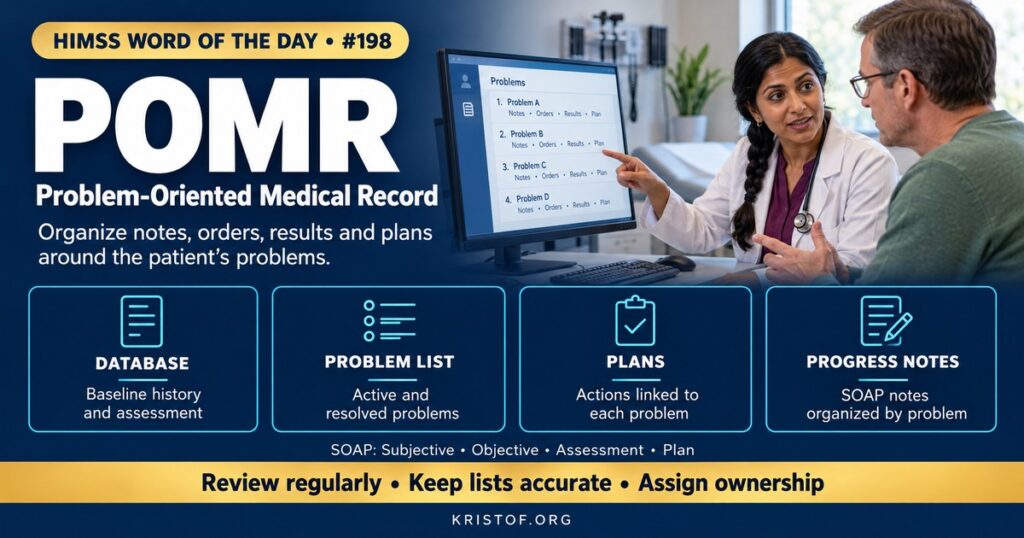
A problem-oriented medical record (POMR) is a health record in which the information can be linked to a list of the individual patient’s health problems, so notes, orders, results, and plans connect to the problem they address.
The HIMSS Dictionary describes it in this concise way. The approach was proposed by Dr. Lawrence Weed in a 1968 paper titled Medical Records That Guide and Teach. His design includes a defined database, a numbered problem list, plans for each problem, and progress notes organized by problem, commonly in the SOAP pattern.
| POMR Element | Purpose | Example |
|---|---|---|
| Database | Baseline history, exam, and initial data | Admission history and assessment |
| Problem List | Numbered list of active and resolved problems | Heart failure, type 2 diabetes, pressure injury |
| Initial Plans | Diagnostic, treatment, and education plans per problem | Daily weights and diuretic plan |
| Progress Notes | Notes tied to each problem | SOAP: subjective, objective, assessment, plan |
| Discharge Summary | Status of each problem at transition | Problems resolved, active, and follow-up needed |
⚠️ Exam Alert: A POMR is organized by problem. A source-oriented record is organized by who or what produced the information, such as physician notes, nursing notes, and lab sections. A problem list is one component of a POMR, while the plan of care describes what will be done about the problems. SOAP stands for Subjective, Objective, Assessment, Plan.
🌐 Why It Matters: Real-World Healthcare IT Context
Before Weed’s proposal, records were often organized by source and time, with physician orders, nursing notes, and laboratory reports in separate sections. Finding the whole story about one problem meant reading across them. The problem-oriented approach reorganized information around what clinicians were trying to solve, which also made reasoning more visible and teachable.
The idea endured. The problem list is now a core feature of EHRs, and the SOAP structure is still taught in clinical education and used in many note templates. HL7 FHIR represents problems and diagnoses through the Condition resource, and standard terminologies such as SNOMED CT are widely used to code them.
Modern problem lists do more than organize notes. They feed clinical decision support, quality measurement, risk adjustment, registries, and population health queries. A diabetes registry, for example, often finds patients through coded problem list entries. When the list is incomplete, those downstream uses miss patients.
Accuracy is the long-standing challenge. A rapid scoping review of 103 studies on electronic problem lists in primary care found that they are widely recognized as foundational for longitudinal care, safety, and coordination, yet incomplete, outdated, or inconsistently maintained lists remain common. Persistent challenges included unclear ownership, workflow misalignment, and variability in what counts as a problem.
Interventions can help, but the effects vary. A multi-site randomized trial tested a decision support tool that inferred missing problems for 12 heart, lung, and blood conditions from structured EHR data and suggested adding them to the problem list. It ran at four healthcare systems using three different EHRs. Clinicians accepted the suggestion about 22 percent of the time, and the intervention group added about 4.6 times as many problems as the control group. However, the study found no significant differences in the HEDIS clinical quality measures it examined, which shows that a more complete list does not automatically translate into measurable quality gains.
Design choices matter. Problem lists can mix diagnoses, symptoms, social needs, and risk factors. Some organizations separate active, chronic, and resolved problems, and some allow problem-based charting that links notes and orders to specific entries. Clear policies about who may add, edit, and resolve problems reduce clutter.
Interoperability adds another layer. When problem list entries are exchanged between organizations, differences in coding and meaning can make lists confusing, and patients may carry diagnoses that no longer apply.
Common problem list issues:
- Outdated or resolved problems left active
- Missing chronic conditions that drive registries and measures
- Duplicate entries for the same problem
- Free-text entries that cannot be coded or queried
- Unclear responsibility for maintaining the list
- Mixed content such as symptoms, risks, and social needs
What supports a useful POMR:
- Clear ownership and rules for adding and resolving problems
- Coded entries mapped to standard terminology
- Decision support that suggests missing problems
- Workflows that link notes, orders, and plans to problems
- Periodic review at admission, transitions, and visits
- Patient involvement in confirming their own problems
🏥 The Nurse’s Perspective: Clinical, Bedside, & Workflow
Nursing has its own problem-oriented traditions, from nursing diagnoses to care plans organized around patient problems, and the POMR idea fits naturally with them.
At the Bedside
Nurses see problems that never appear on a medical problem list, such as fall risk, impaired mobility, caregiver strain, or unmet social needs. Documenting them in the care plan or the appropriate record section makes them visible to the team.
Reviewing the problem list during admission and handoff catches omissions and outdated entries. A patient who no longer has a listed condition, or who has a new one not yet recorded, can often help correct the list when asked.
In Clinical Workflow
Care planning ties assessments, interventions, and goals to patient problems. When nursing care plans connect to the broader problem list, the whole team sees how daily nursing actions address each issue.
Nurses also notice when the list conflicts with what is happening, such as a patient on a medication with no matching condition. Raising the question with the responsible clinician helps keep the record coherent.
Nurse informaticists help define how nursing problems relate to the shared list, which terminologies to use, and how views display problems to different roles.
In EHR Implementation (Go-Live Perspective)
An Epic Go-Live includes decisions about problem list workflows: who maintains the list, how it appears in navigators, and how it connects to notes, care plans, and registries. Training covers adding, editing, and resolving problems so entries are coded and usable.
At-the-elbow support analysts regularly see long, unmanaged problem lists migrated from older systems. Cleanup efforts and clear rules during the first weeks help prevent the clutter from carrying forward.
🎓 CAHIMS / CPHIMS & HIMSS Perspective
CAHIMS Exam Domain Mapping
The POMR appears in documentation, terminology, and decision support questions:
| CAHIMS Domain | How the POMR Appears |
|---|---|
| Healthcare & Technology Environments | History of record design, source-oriented versus problem-oriented records |
| Clinical Informatics | Problem lists, SOAP notes, care plans, terminology |
| Healthcare Information & Systems Management | Problem list governance, coding, data quality, registries |
| Management & Leadership | Policies for maintaining lists, quality measures, documentation standards |
Key Terms to Know Alongside POMR
- Problem List — list of a patient’s health problems, active and resolved
- SOAP Note — progress note format of subjective, objective, assessment, and plan
- Source-Oriented Record — record organized by the department or author that produced the information
- Plan of Care — documented plan for addressing a patient’s problems
- SNOMED CT — clinical terminology widely used to code problems
- Clinical Decision Support (CDS) — tools that can suggest missing problems or act on listed ones
HIMSS Organizational Position
HIMSS supports effective clinical documentation and standards-based data capture through education and its clinical and nursing informatics communities. Members can find related resources through the HIMSS Resource Center.
🔗 Explore Further: External References
- Weed (1968), New England Journal of Medicine — Medical Records That Guide and Teach https://pubmed.ncbi.nlm.nih.gov/5637250/
- Nair et al. (2026), Family Practice — Current State of Electronic Problem Lists in Primary Care: A Rapid Scoping Review https://pubmed.ncbi.nlm.nih.gov/42275183/
- Wright et al. (2023), JAMIA — A Multi-Site Randomized Trial of a Clinical Decision Support Intervention to Improve Problem List Completeness https://pubmed.ncbi.nlm.nih.gov/36806929/
- HL7 International — FHIR Condition Resource https://hl7.org/fhir/condition.html
- NLM — SNOMED CT https://www.nlm.nih.gov/healthit/snomedct/index.html
- ANA — Scope and Standards of Practice https://www.nursingworld.org/practice-policy/scope-of-practice/
Term source: HIMSS Dictionary of Health Information and Technology Terms, Acronyms, and Organizations, 6th Edition (2025). All definitions in this series are paraphrased for editorial purposes. Readers are encouraged to consult the primary source for exact language.
Eric Andrew Kristof, RN, CAHIMS is a Healthcare IT professional and HIMSS Arkansas Chapter member based in Hot Springs Village, AR, with hands-on Epic Go-Live experience and a diverse healthcare and IT background. He writes at kristof.org at the intersection of clinical care and healthcare technology.
Leave a Reply