By Eric Andrew Kristof, RN, CAHIMS | Healthcare IT Professional | HIMSS Arkansas Chapter Member
About This Series: The HIMSS Word of the Day is a running blog series drawing from the HIMSS Dictionary of Health Information and Technology Terms, Acronyms, and Organizations, 6th Edition (2025) — the authoritative reference for healthcare IT professionals and the primary study resource for CAHIMS and CPHIMS certification. Each post paraphrases the term in plain language, grounds it in real-world healthcare IT context, and adds a bedside nursing perspective you won’t find in a textbook.
📖 The Term: Omaha System
Source: HIMSS Dictionary of Health Information and Technology Terms, Acronyms, and Organizations, 6th Edition (2025)
🔍 Plain-Language Definition
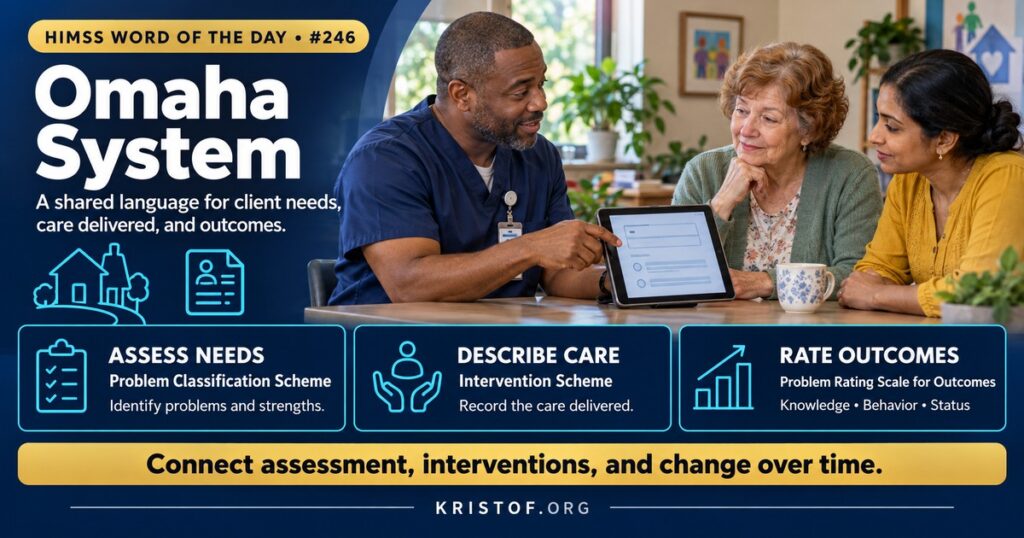
The Omaha System is a research-based, standardized taxonomy designed to improve practice, documentation, and information management. The HIMSS Dictionary describes three linked, reliable, and valid components. One classifies client problems (the Problem Classification Scheme), one organizes the care delivered (the Intervention Scheme), and one rates results (the Problem Rating Scale for Outcomes). Together they give clinicians a structure for recording a client’s needs and strengths, describing the actions of the multidisciplinary team, and measuring change in a simple but comprehensive way.
The system’s own website describes it as existing in the public domain, with terms arranged in a hierarchy from general to specific, and intended for use across the continuum of care for individuals, families, and communities. Its initial development, reliability, validity, and usability research took place in four federally funded projects between 1975 and 1993.
| Component | Purpose | Plain-Language Role |
|---|---|---|
| Problem Classification Scheme | Client assessment | What is the problem or strength? |
| Intervention Scheme | Care plans and services | What was done? |
| Problem Rating Scale for Outcomes | Client change and evaluation | Did knowledge, behavior, or status change? |
⚠️ Exam Alert: The Omaha System is one of the standardized nursing terminologies recognized by the American Nurses Association and is widely used in public health and home-based care. Its outcome scale rates knowledge, behavior, and status. It differs from NANDA (diagnoses), NIC (interventions), and NOC (outcomes), which are separate classifications, whereas the Omaha System combines all three functions in one structure.
🌐 Why It Matters: Real-World Healthcare IT Context
Nursing care is often described in narrative notes that are hard to count or compare. A standardized terminology turns documentation into data that can be analyzed across clients, nurses, and organizations. The Omaha System is especially common in community settings such as public health nursing, home visiting, school health, and home health, where long-term relationships and social needs matter as much as clinical ones.
An integrative literature review covering 2012 to 2022 started with 559 documents and, after screening, analyzed 35 papers. The authors concluded that the system remains a valuable tool for evaluating health care outcomes in a variety of settings, with benefits that include promoting communication, supporting evidence-based decision making, and improving quality of care, and that it is interoperable with other classifications and terminologies. A separate integrative review of standardized nursing terminologies used to capture social determinants of health found seven articles, and the Omaha System was the only standardized nursing terminology represented in the sample. That finding matters because the Omaha System includes environmental and psychosocial problems alongside physiological ones, which suits data on housing, income, and safety.
Studies of routine documentation show what the data can do. A retrospective study of 4,109 clients of public health nurses used Omaha System data generated during routine home visit documentation to compare statistical weighting methods and estimate the effects of the quantity and variety of nursing interventions on client health and social outcomes. Clients served differed substantially in baseline characteristics, and the study found that one weighting method, energy balancing, balanced 105 baseline characteristics better than traditional propensity weighting. The point for informaticists is that standardized, routinely collected nursing data can support causal analysis when handled carefully. Another study analyzed Omaha System data on 900 low-income clients visited by public health nurses from 2013 to 2018 and identified five subgroups of nutritional need: unbalanced diet, overweight, underweight, hyperglycemia with adherence, and hyperglycemia without adherence. Only the unbalanced diet and underweight groups showed increases in knowledge, and no group showed changes in behavior or status, which led the authors to suggest re-examining interventions and tailoring them by phenotype.
These examples also show the limits. Routine data reflect how clinicians actually document, which varies. Outcome ratings depend on nurse judgment and consistent training. Without common definitions, comparing two agencies can mislead. And a terminology used in public health and community care may not be built into the acute care EHR, so data may not follow patients across settings.
For EHR teams, the Omaha System requires decisions about how its concepts appear in flowsheets, care plans, and reports. Teams must decide whether to use the terminology natively, map it to other vocabularies, or collect it in a specialized public health system. They must train nurses to use it consistently, and design reports that show change over time in knowledge, behavior, and status, not only counts of visits. Mappings to other terminologies, such as SNOMED CT or LOINC, can help data move between systems, though mapping always loses some nuance.
Common Omaha System problems:
- Inconsistent use of problems and outcome ratings between nurses
- Documentation burden when the terminology is added to existing charting
- Lack of mapping to other vocabularies used by partners
- Reports that count activity but not outcomes
- Limited integration with acute care records
- Training that is one-time and not reinforced with feedback
What supports effective use:
- Training and periodic reliability checks on ratings
- Workflow-friendly build with discrete fields and defaults
- Mappings to common vocabularies for exchange
- Dashboards that show change over time
- Inclusion of social needs and strengths, not only deficits
- Partnership between nursing, informatics, and analytics teams
🏥 The Nurse’s Perspective: Clinical, Bedside, & Workflow
For nurses who use the Omaha System, it shapes how a visit is planned, documented, and evaluated.
At the Bedside
In a client’s home or a community clinic, the nurse assesses problems across physical, psychosocial, and environmental areas, chooses interventions such as teaching, guidance, treatments, case management, or surveillance, and rates the client’s knowledge, behavior, and status at intervals. Rating status honestly, including when a client has not improved, produces data that guide the next visit.
Clients benefit when plain-language terms make the plan understandable and when strengths are recorded as well as problems.
In Clinical Workflow
Public health and home health managers use Omaha System reports to see which problems are most common, which interventions are used, and which clients are improving. Supervisors coach nurses on consistent rating and on documenting the connection between problem, intervention, and outcome.
Nurse informaticists configure forms and reports, align local lists with the standard, and support research partnerships that use the data. They also advocate for the ability to exchange summaries with hospitals and primary care.
In EHR Implementation (Go-Live Perspective)
An Epic Go-Live that includes community or home-based nursing has to make standardized assessments quick to complete in the field. Analysts test mobile and offline use, and at-the-elbow support analysts observe whether nurses can complete problem and outcome ratings during visits. Reports back to build teams about extra clicks or confusing term lists help keep documentation burden reasonable.
🎓 CAHIMS / CPHIMS & HIMSS Perspective
CAHIMS Exam Domain Mapping
The Omaha System appears in terminology, nursing informatics, and public health questions:
| CAHIMS Domain | How the Omaha System Appears |
|---|---|
| Healthcare & Technology Environments | Standardized terminologies, community and public health care |
| Clinical Informatics | Nursing documentation, care planning, outcome measurement |
| Healthcare Information & Systems Management | Terminology mapping, reporting, data analysis |
| Management & Leadership | Quality improvement, program evaluation, staff training |
Key Terms to Know Alongside the Omaha System
- Standardized Nursing Terminology — controlled vocabulary for nursing diagnoses, interventions, or outcomes
- Problem Classification Scheme — Omaha component for client assessment
- Intervention Scheme — Omaha component for care plans and services
- Problem Rating Scale for Outcomes — Omaha component for rating knowledge, behavior, and status
- NANDA, NIC, NOC — other nursing classifications for diagnoses, interventions, and outcomes
- Social Determinants of Health — conditions in which people live that affect health
HIMSS Organizational Position
HIMSS supports nursing informatics through its Nursing Informatics Community, education, and research. Members can find related resources through the HIMSS Resource Center and community pages.
🔗 Explore Further: External References
- The Omaha System — Overview https://www.omahasystem.org/overview
- NLM — UMLS Omaha System Source Release Documentation https://www.nlm.nih.gov/research/umls/sourcereleasedocs/current/OMAHA/index.html
- Schleder Goncalves et al. (2024), Studies in Health Technology and Informatics — Omaha System: An Integrative Literature Review from 2012 to 2022 https://pubmed.ncbi.nlm.nih.gov/39049341/
- Olsen et al. (2024), CIN: Computers, Informatics, Nursing — Use of Standardized Nursing Terminologies to Capture Social Determinants of Health Data: An Integrative Review https://pubmed.ncbi.nlm.nih.gov/39110025/
- Huling et al. (2024), Nursing Research — Comparison of Weighting Methods to Understand Improved Outcomes Attributable to Public Health Nursing Interventions https://pubmed.ncbi.nlm.nih.gov/38916529/
- Lee et al. (2023), Journal of the American Medical Informatics Association — Prioritizing Nutrition Interventions for Low-Income Clients Receiving Public Health Nurses’ Home Visiting Services: A Latent Class Analysis Study of Omaha System Data https://pubmed.ncbi.nlm.nih.gov/37187156/
Term source: HIMSS Dictionary of Health Information and Technology Terms, Acronyms, and Organizations, 6th Edition (2025). All definitions in this series are paraphrased for editorial purposes. Readers are encouraged to consult the primary source for exact language.
Eric Andrew Kristof, RN, CAHIMS is a Healthcare IT professional and HIMSS Arkansas Chapter member based in Hot Springs Village, AR, with hands-on Epic Go-Live experience and a diverse healthcare and IT background. He writes at kristof.org at the intersection of clinical care and healthcare technology.
Leave a Reply