By Eric Andrew Kristof, RN, CAHIMS | Healthcare IT Professional | HIMSS Arkansas Chapter Member
About This Series: The HIMSS Word of the Day is a running blog series drawing from the HIMSS Dictionary of Health Information and Technology Terms, Acronyms, and Organizations, 6th Edition (2025) — the authoritative reference for healthcare IT professionals and the primary study resource for CAHIMS and CPHIMS certification. Each post paraphrases the term in plain language, grounds it in real-world healthcare IT context, and adds a bedside nursing perspective you won’t find in a textbook.
📖 The Term: Request for Proposal (RFP)
Source: HIMSS Dictionary of Health Information and Technology Terms, Acronyms, and Organizations, 6th Edition (2025)
🔍 Plain-Language Definition
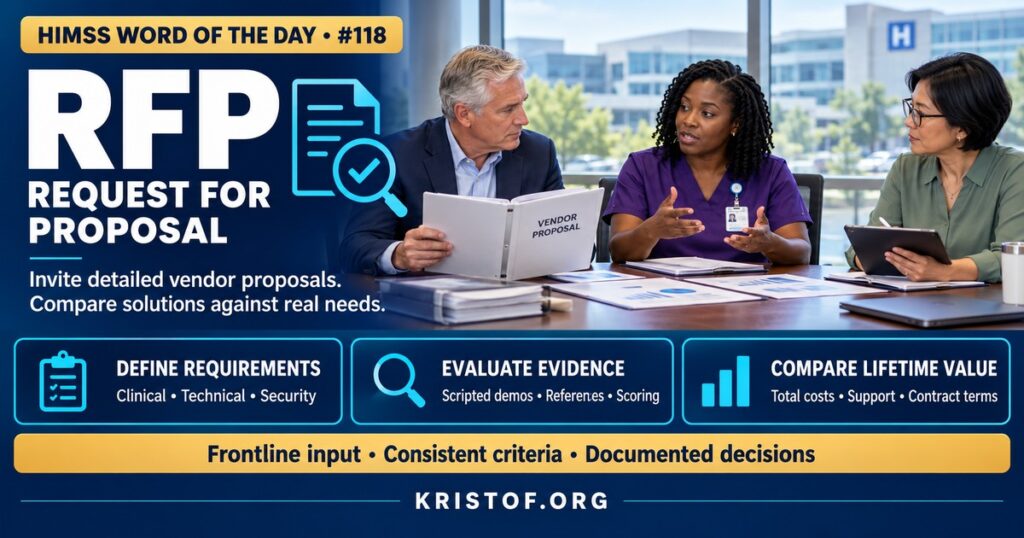
A request for proposal (RFP) is a formal document an organization issues to invite vendors to propose how they would meet a defined need, along with their pricing and terms. In health IT, RFPs are commonly used to select EHRs, departmental systems, devices, and services.
The HIMSS Dictionary describes an RFP as a document, often issued through a bidding process, by which an agency or company interested in procuring a commodity, service, or valuable asset solicits business proposals from potential suppliers.
The RFP is one step in a broader selection process:
| Step | Purpose | Health IT Example |
|---|---|---|
| Needs Assessment | Define the problem, goals, and requirements | Document clinical, technical, and regulatory needs for a new system |
| Request for Information (RFI) | Learn about the market and narrow the field | Ask vendors for general capabilities and experience |
| Request for Proposal (RFP) | Request detailed responses, pricing, and terms | Ask shortlisted vendors to respond to specific requirements |
| Scripted Demonstrations | See how products handle real scenarios | Vendors demonstrate admission, medication administration, and discharge |
| Reference Checks and Site Visits | Learn from current customers | Speak with similar organizations about implementation and support |
| Evaluation and Selection | Score options and choose | Weighted scoring by a multidisciplinary team |
| Contract Negotiation | Define obligations, costs, and protections | Service levels, data ownership, security requirements, exit terms |
⚠️ Exam Alert: An RFI gathers general information; an RFP requests detailed proposals and pricing; an RFQ (request for quotation) focuses on price for well-defined items. A scripted demonstration shows how a vendor handles your scenarios, rather than a generic sales demo. Total cost of ownership includes all costs over the system’s life, not just purchase price.
🌐 Why It Matters: Real-World Healthcare IT Context
Health IT selections are high-stakes and long-lived. An EHR or major clinical system may remain in place for a decade or more and shape daily work for thousands of people. A structured selection process helps organizations compare options fairly, document decisions, and avoid choosing based on impressions or relationships alone.
Good RFPs start with requirements grounded in real workflows. Use cases and scenarios describe what users must accomplish, which makes vendor responses easier to evaluate than long checklists of features. Requirements should cover clinical functionality, interoperability and standards support, security and privacy, usability, reporting and analytics, implementation services, training, and ongoing support.
Regulatory requirements matter. For many uses, organizations need technology certified under ONC’s Health IT Certification Program, and the Certified Health IT Product List (CHPL) lets buyers verify which products and versions are certified for which criteria.
Scripted demonstrations are among the most revealing steps. Asking vendors to show how a nurse documents an admission assessment, how a pharmacist verifies an order, or how a patient’s outside records appear exposes differences in workflow and usability that written responses hide.
Total cost of ownership should drive financial comparison. Licenses and implementation fees are only part of the cost; hardware, hosting, interfaces, staffing, training, upgrades, and support often add more over time.
Fairness and documentation matter, especially for public and nonprofit organizations. Consistent scoring criteria, written evaluations, conflict-of-interest disclosures, and a clear record of why a vendor was chosen protect the organization if decisions are questioned later. They also help future teams understand the reasoning when renewing or replacing a system.
Contracts protect the organization. Terms for data ownership and access, security responsibilities, business associate agreements, uptime and support service levels, pricing over time, and exit and data transition rights are easier to negotiate before signing than after.
Vendor viability and roadmap deserve attention too. A product that meets today’s needs may fall behind if the vendor lacks resources to keep up with regulations, standards, and security requirements.
Common RFP mistakes:
- Requirements copied from templates without reflecting local needs
- Feature checklists that every vendor answers “yes”
- Too little clinical involvement in evaluation
- Ignoring total cost of ownership
- Skipping reference checks with similar organizations
- Weak contract terms for data, security, and exit
Characteristics of strong selection processes:
- Clear goals and decision criteria agreed upon in advance
- Multidisciplinary selection teams with frontline clinicians
- Scenario-based requirements and scripted demonstrations
- Weighted scoring and documented decisions
- Thorough reference checks and site visits
- Careful contract review by legal, security, and finance experts
🏥 The Nurse’s Perspective: Clinical, Bedside, & Workflow
Nurses are among the largest user groups of most clinical systems, so their input during selection is essential.
At the Bedside
Nurses on selection teams can evaluate whether a system supports real bedside work: documenting at the point of care, scanning medications, managing alarms and tasks, communicating with the team, and handing off patients. A system that looks impressive in a sales demonstration may require too many clicks for a busy medication pass.
Usability observations from nurses during demonstrations, such as how easily information can be found or how errors are prevented, often reveal differences that technical comparisons miss.
Nurse informaticists can help translate frontline feedback into scoring criteria, ensuring that comments from demonstrations are captured consistently and weighed alongside technical and financial factors.
Downtime and recovery scenarios belong in evaluations too. Asking how a system supports read-only access, printed reports, and data recovery during outages reveals how well it protects patient care when technology fails.
In Clinical Workflow
Nurses can help write the scenarios used in RFPs and scripted demonstrations, ensuring they include the exceptions and complications of real care, such as held medications, patient transfers, and downtime.
Reference checks benefit from nursing questions too. Speaking with nurses at organizations already using a product can reveal how well it supports nursing workflows in practice, how responsive the vendor is, and what optimization was needed after go-live.
In EHR Implementation (Go-Live Perspective)
Decisions made during selection carry through to Go-Live. Contract terms determine available implementation support, training resources, and Go-Live assistance. Requirements documented during the RFP become a reference for confirming that the delivered system meets expectations.
At-the-elbow support teams often include vendor or consulting staff whose role was defined in the contract. Clear contractual expectations for Go-Live staffing and issue resolution help organizations get the support they paid for.
🎓 CAHIMS / CPHIMS & HIMSS Perspective
CAHIMS Exam Domain Mapping
RFPs appear in systems management and leadership questions:
| CAHIMS Domain | How RFPs Appear |
|---|---|
| Healthcare & Technology Environments | Vendor market; certification requirements; regulatory needs |
| Clinical Informatics | Clinical requirements, usability evaluation, scenario-based demonstrations |
| Healthcare Information & Systems Management | Requirements definition, technical evaluation, interoperability, security |
| Management & Leadership | Procurement process, total cost of ownership, contracts, stakeholder engagement |
Key Terms to Know Alongside RFP
- Request for Information (RFI) — a document gathering general information about vendors and products
- Request for Quotation (RFQ) — a request focused on pricing for defined goods or services
- Scripted Demonstration — a vendor demonstration following scenarios defined by the buyer
- Total Cost of Ownership (TCO) — all costs associated with a system over its life cycle
- Service Level Agreement (SLA) — contractual commitments for performance and support
- Certified Health IT Product List (CHPL) — ONC’s list of certified health IT products
HIMSS Organizational Position
HIMSS supports informed technology selection through education, research, and its CPHIMS certification, which covers systems analysis, selection, and management. Members can find related education and research through the HIMSS Resource Center.
🔗 Explore Further: External References
- ONC — Certified Health IT Product List (CHPL) https://chpl.healthit.gov/
- ONC — About the ONC Health IT Certification Program https://healthit.gov/certification-health-it/about-onc-health-it-certification-program/
- ONC — SAFER Guides https://healthit.gov/clinical-quality-and-safety/safer-guides/
- NIST — Health IT Usability https://www.nist.gov/programs-projects/health-information-technology-usability
- HHS — Business Associates https://www.hhs.gov/hipaa/for-professionals/privacy/guidance/business-associates/index.html
- HIMSS — Certifications (CAHIMS and CPHIMS) https://www.himss.org/certifications
Term source: HIMSS Dictionary of Health Information and Technology Terms, Acronyms, and Organizations, 6th Edition (2025). All definitions in this series are paraphrased for editorial purposes. Readers are encouraged to consult the primary source for exact language.
Eric Andrew Kristof, RN, CAHIMS is a Healthcare IT professional and HIMSS Arkansas Chapter member based in Hot Springs Village, AR, with hands-on Epic Go-Live experience and a diverse healthcare and IT background. He writes at kristof.org at the intersection of clinical care and healthcare technology.
Leave a Reply