By Eric Andrew Kristof, RN, CAHIMS | Healthcare IT Professional | HIMSS Arkansas Chapter Member
About This Series: The HIMSS Word of the Day is a running blog series drawing from the HIMSS Dictionary of Health Information and Technology Terms, Acronyms, and Organizations, 6th Edition (2025) — the authoritative reference for healthcare IT professionals and the primary study resource for CAHIMS and CPHIMS certification. Each post paraphrases the term in plain language, grounds it in real-world healthcare IT context, and adds a bedside nursing perspective you won’t find in a textbook.
📖 The Term: Privacy Officer
Source: HIMSS Dictionary of Health Information and Technology Terms, Acronyms, and Organizations, 6th Edition (2025)
🔍 Plain-Language Definition
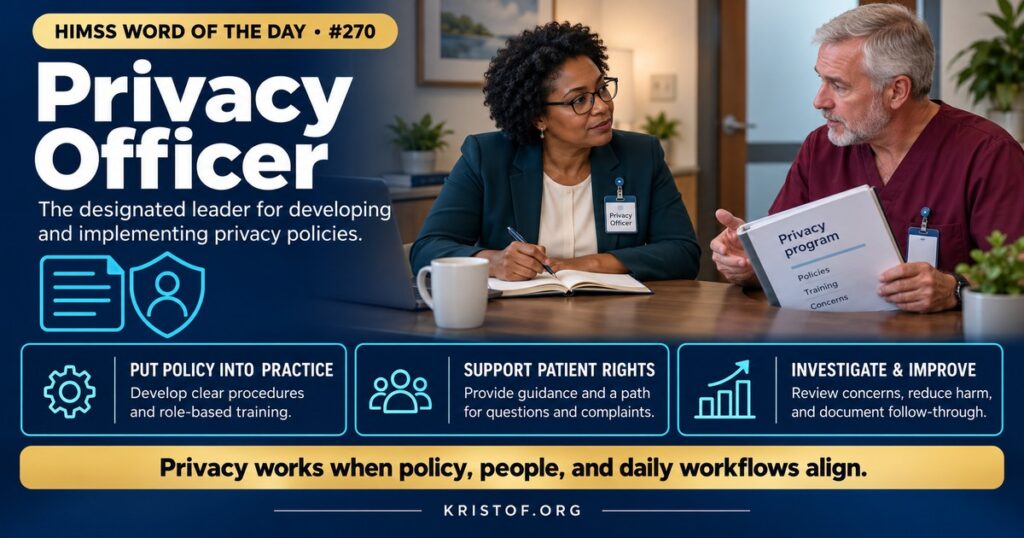
A privacy officer is the person a covered entity appoints to write and put into practice the policies and procedures that keep the organization compliant with the federal health privacy requirements set by HIPAA, the Health Insurance Portability and Accountability Act. The regulation itself uses the term privacy official, and many organizations use titles such as chief privacy officer, privacy director, or compliance officer.
The requirement comes from the HIPAA Privacy Rule at 45 CFR 164.530(a). A covered entity must designate a privacy official responsible for developing and implementing its privacy policies and procedures, and must also designate a contact person or office responsible for receiving complaints and able to provide more information about matters covered in the Notice of Privacy Practices. The designations must be documented. The privacy official and the complaint contact may be the same person.
| Responsibility | What It Involves | Regulation |
|---|---|---|
| Policies and procedures | Implement written policies suited to the organization’s size and activities | 164.530(i) |
| Training | Train all workforce members as needed for their roles | 164.530(b) |
| Safeguards | Maintain administrative, technical, and physical protections | 164.530(c) |
| Complaints | Provide a process for individuals to complain | 164.530(d) |
| Sanctions | Apply sanctions to workforce members who violate policies | 164.530(e) |
| Mitigation | Reduce known harm from improper uses or disclosures | 164.530(f) |
| Documentation | Keep required records for six years | 164.530(j) |
⚠️ Exam Alert: The privacy official is required by the Privacy Rule (164.530); the security official is required by the Security Rule (164.308(a)(2)). The two roles are distinct, though in small organizations one person may serve both. Documentation must be kept for six years.
🌐 Why It Matters: Real-World Healthcare IT Context
HIPAA assigns accountability to a named role because privacy compliance is not automatic. Policies need an owner, workforce members need training, patients need a place to take concerns, and violations need consequences. The rule lists these as separate standards, and together they describe the privacy officer’s work.
The Privacy Rule requires a covered entity to train all members of its workforce on privacy policies and procedures as necessary and appropriate for their functions. It requires a process for individuals to make complaints about the entity’s policies or compliance. It requires sanctions against workforce members who fail to comply, and mitigation of harmful effects of improper uses or disclosures known to the entity, including those of its business associates. It prohibits intimidating or retaliatory acts against people who exercise their rights or file complaints, and bars the entity from requiring people to waive their rights as a condition of treatment, payment, or enrollment. The entity must implement policies and procedures reasonably designed to comply, taking into account its size and the type of activities involving protected health information, and must keep documentation, including policies, communications, and actions that the rule requires to be in writing, for six years from creation or from when last in effect, whichever is later.
The Security Rule creates a parallel role. Section 164.308(a)(2) requires identification of the security official responsible for developing and implementing the security policies and procedures. In practice the privacy officer and the security officer work closely, since many incidents involve both questions about whether access was appropriate and whether safeguards worked. They share breach investigation, risk analysis, vendor review, and training duties, and they often report to compliance committees or the board.
The role has grown with digital health. Privacy officers now weigh patient portals, open notes, telehealth platforms, apps, health information exchange, research data use, artificial intelligence, and the information-sharing rules that encourage access. They review business associate relationships, audit access to records, respond to complaints, investigate snooping, and decide how to handle sensitive information such as behavioral health, reproductive health, and adolescent records. A 2026 interview study of 16 expert stakeholders on granular consent tools for sensitive health data illustrates the complexity: participants stressed trauma-informed, plain-language experiences, described lack of trust, stigma, and workflow burden as major barriers, and pointed to EHR limits that prevent reliable segmentation and enforcement of patient preferences, as well as legal and policy fragmentation. A 2023 survey of 10 U.S. pediatric organizations found significant variation in how they implemented information sharing rules, including how sensitive elements within data classes were protected for adolescents and proxies, and warned that variation can lead to privacy breaches and confusion. Privacy officers sit at the center of these decisions.
The regulation does not specify qualifications. A 2003 article in the Journal of Healthcare Information Management observed that the rule gives no guidance on qualifications, job description, or details of policy implementation, and argued that informatics nurse specialists, with their patient advocacy commitment and professional ethics, are well suited to the role. Today privacy officers come from compliance, law, health information management, nursing, and information security backgrounds. Whatever the path, good ones combine regulatory knowledge, risk judgment, communication skills, and credibility with clinicians.
Common privacy officer challenges:
- Policies that exist on paper but do not match daily workflows
- Training that is a yearly click-through and does not change behavior
- Limited tools to detect inappropriate access
- Fragmented rules for sensitive information across states
- Complaints handled informally and not tracked
- Incomplete documentation when regulators ask
What supports an effective privacy program:
- Clear authority, executive support, and direct access to leadership
- Role-based training with scenarios from real work
- Proactive access monitoring and fast investigation
- Documented sanctions applied consistently
- Strong partnership with security, legal, and informatics teams
- Regular policy review as technology and law change
🏥 The Nurse’s Perspective: Clinical, Bedside, & Workflow
Nurses interact with the privacy officer through training, questions, and incident reports.
At the Bedside
A nurse who is unsure whether a family member may receive information, whether a photo can be taken, or what to do after sending a fax to the wrong number turns to policy and, when needed, to the privacy officer. Reporting quickly allows the organization to mitigate harm and meet its obligations. Reporting should never be discouraged: the rule prohibits retaliation against people who exercise their rights or report concerns.
In Clinical Workflow
Nurse managers reinforce privacy expectations in huddles and respond when access audits flag staff behavior. Unit leaders help translate policy into practice, such as setting norms for screens that face public areas, whiteboards, and handoffs near visitors.
Nurses who move into informatics or compliance roles bring clinical credibility to the privacy officer’s work. Nurse informaticists often partner with privacy teams on EHR access rules, break-the-glass design, sensitive note handling, and portal release decisions.
In EHR Implementation (Go-Live Perspective)
An Epic Go-Live involves privacy decisions: who can see what, how audits are run, how sensitive information is flagged, and how proxy access works. At-the-elbow support analysts hear when staff cannot see what they need or can see what they should not, and they pass these issues to privacy and security staff. Early involvement of the privacy officer in design and testing prevents problems from reaching production.
🎓 CAHIMS / CPHIMS & HIMSS Perspective
CAHIMS Exam Domain Mapping
The privacy officer appears in regulation, governance, and compliance questions:
| CAHIMS Domain | How the Privacy Officer Appears |
|---|---|
| Healthcare & Technology Environments | HIPAA Privacy Rule, patient rights, covered entities |
| Clinical Informatics | Sensitive data handling, portal release, consent |
| Healthcare Information & Systems Management | Access audits, safeguards, business associate review |
| Management & Leadership | Compliance programs, training, sanctions, documentation |
Key Terms to Know Alongside Privacy Officer
- Privacy Official — role required by the HIPAA Privacy Rule
- Security Official — role required by the HIPAA Security Rule
- Notice of Privacy Practices — document explaining how a covered entity uses and discloses PHI
- Workforce Training — required education on privacy policies and procedures
- Sanctions — consequences applied to workforce members who violate policy
- Mitigation — steps to reduce harm from improper use or disclosure
HIMSS Organizational Position
HIMSS supports privacy and security in health information through its public policy work, Healthcare Cybersecurity Community, and research. Members can find related resources through the HIMSS Healthcare Cybersecurity Community page.
🔗 Explore Further: External References
- eCFR — 45 CFR 164.530, Administrative Requirements https://www.ecfr.gov/current/title-45/subtitle-A/subchapter-C/part-164/subpart-E/section-164.530
- eCFR — 45 CFR 164.308, Administrative Safeguards https://www.ecfr.gov/current/title-45/subtitle-A/subchapter-C/part-164/subpart-C/section-164.308
- Malloy (2003), Journal of Healthcare Information Management — The Informatics Nurse Specialist as Privacy Officer https://pubmed.ncbi.nlm.nih.gov/12858598/
- Cooper et al. (2026), Applied Clinical Informatics — Designing Granular Consent Tools for Sensitive Health Data: Challenges, User Needs, and Stakeholder Guidance https://pubmed.ncbi.nlm.nih.gov/42447927/
- Sinha et al. (2023), Journal of the American Medical Informatics Association — Variation in Pediatric and Adolescent Electronic Health Data Sharing Practices Under the 21st Century Cures Act https://pubmed.ncbi.nlm.nih.gov/37643734/
Term source: HIMSS Dictionary of Health Information and Technology Terms, Acronyms, and Organizations, 6th Edition (2025). All definitions in this series are paraphrased for editorial purposes. Readers are encouraged to consult the primary source for exact language.
Eric Andrew Kristof, RN, CAHIMS is a Healthcare IT professional and HIMSS Arkansas Chapter member based in Hot Springs Village, AR, with hands-on Epic Go-Live experience and a diverse healthcare and IT background. He writes at kristof.org at the intersection of clinical care and healthcare technology.
Leave a Reply